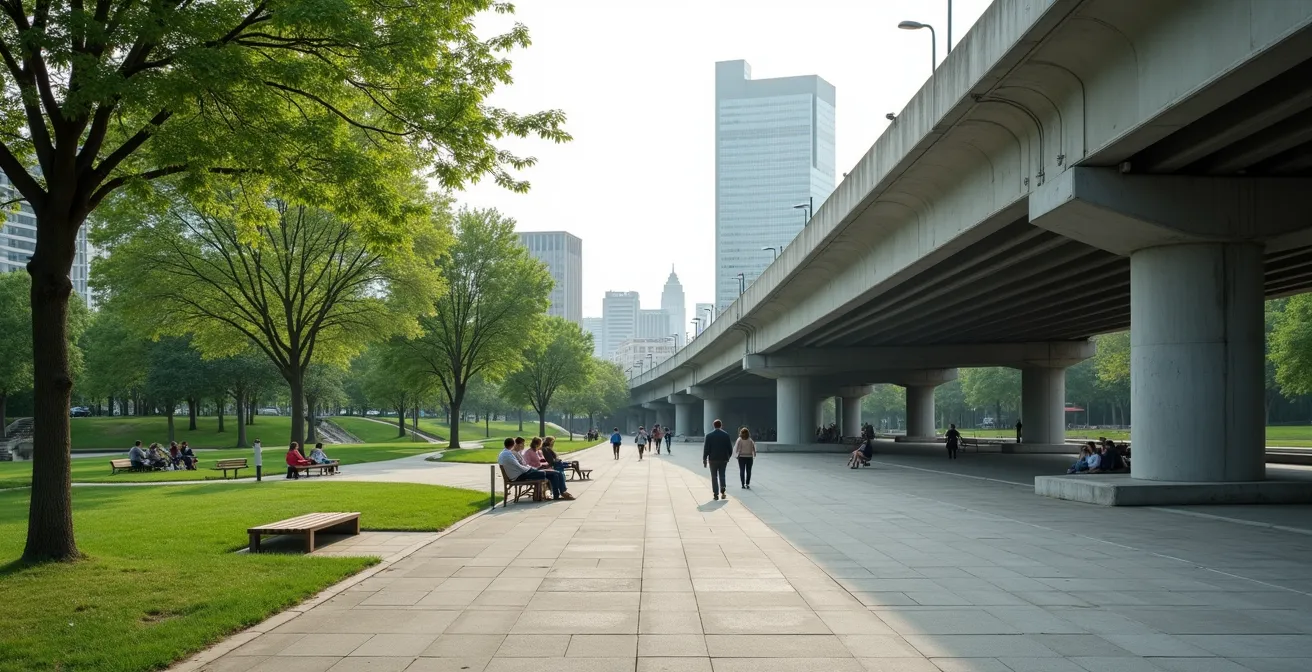
Improving urban mental health isn’t about adding more parks or benches; it’s about fundamentally redesigning the “behavioral choreography” of our cities.
- Chronic environmental stressors, like highway proximity, are proven to elevate biological markers of stress.
- Well-designed density, community hubs, and “third places” like libraries are crucial for fostering the spontaneous social ties that combat isolation.
Recommendation: Scrutinize your own environment not for what it has, but for the social behaviors it actively encourages or prevents.
For many city dwellers, the concrete landscape can feel like an antagonist—a source of constant, low-grade stress and a breeding ground for isolation. We instinctively feel that something is wrong, that the relentless noise, the crowded yet anonymous streets, and the lack of restorative spaces are taking a toll. The common response, often echoed in city planning meetings, is a call for more “green.” We ask for more parks, more trees, and more public benches, believing these are the universal remedies for urban-induced anxiety. While these elements are undeniably beneficial, they represent a superficial understanding of a much deeper issue.
This approach treats the symptoms, not the cause. It views the city as a collection of objects to be added or rearranged. But what if the true key to urban mental health lies not in the *things* a city possesses, but in the *behaviors* it elicits? The visionary perspective of public health-focused urbanism proposes a radical shift: to see the city not as a static backdrop, but as a dynamic script. The design of a street, the placement of a library, or the width of a sidewalk are all subtle but powerful tools of behavioral choreography. They guide how we move, where we pause, and whether we connect with others or retreat into ourselves.
This article moves beyond the platitudes of “more green space.” We will deconstruct how specific, often overlooked design choices directly impact our psychological state. We will explore how urban planning can be wielded as a sociological tool to intentionally reduce psychological friction and cultivate a resilient, supportive community fabric from the ground up. This is not about cosmetic improvements; it is about re-engineering our cities to be active partners in our mental wellbeing.
This guide delves into the specific mechanisms linking our environment to our minds. By understanding these connections, we can become more informed advocates for the kinds of cities that not only house us but also heal us.
Summary: How Urban Design Directly Influences the Mental Health of Residents?
- Why Living Near a Highway Increases Cortisol Levels by 20%?
- How to Petition Your City Council for a Community Garden?
- High-Density Walkability vs. Suburban Space: Which Fosters More Social Ties?
- The Design Mistake That Removes Public Seating and Kills Street Life
- Problem & Solution: Reviving Local Libraries as Community Hubs
- How to Design a Home Office That Physically Separates Work From Rest?
- Urban Infill vs. Rural Greenfield: Which Is Cheaper to Develop?
- How to Spot Hidden Geotechnical Issues Before Buying a Building Plot?
Why Living Near a Highway Increases Cortisol Levels by 20%?
The hum of a distant highway is often dismissed as mere background noise, a standard feature of urban life. However, from a public health perspective, it is a chronic environmental stressor with measurable biological consequences. The constant, low-frequency sound and associated air pollution create a state of perpetual, low-grade alert in our nervous system. This isn’t just an annoyance; it’s a form of psychological friction that forces our bodies to constantly adapt. Over time, this sustained stress leads to elevated levels of cortisol, the body’s primary stress hormone. A sustained increase, even if seemingly small, is linked to a host of negative health outcomes, including anxiety, depression, and impaired cognitive function.
This phenomenon is analogous to the “urban heat island” effect, where built environments trap heat and elevate temperatures. Just as concrete and asphalt create physical heat stress, noise and pollution create a “sensory heat island” that overloads our psychological resources. Studies on the heat island effect show it exacerbates stress and anxiety as residents worry about safety and cooling costs. The same principle applies here: the environment itself becomes a source of chronic worry and physiological strain. The relentless exposure doesn’t allow for psychological recovery, keeping the body in a fight-or-flight state that was designed for short-term threats, not 24/7 living conditions.
Addressing this requires more than just sound barriers. It demands a fundamental rethinking of urban zoning and transit. It means designing cities where residential areas are buffered by green spaces, which act as natural acoustic and particulate filters. It also involves prioritizing transportation modes that don’t generate this level of pervasive sensory pollution. Recognizing that a highway is not just a transit corridor but a significant public health determinant is the first step toward designing cities that soothe the nervous system instead of constantly agitating it.
How to Petition Your City Council for a Community Garden?
Moving from identifying problems to creating solutions requires active community participation. A community garden is one of the most powerful interventions available because it does more than just introduce greenery; it is an act of behavioral choreography. It creates a space that is programmed for positive social interaction, mindful activity, and a shared sense of ownership. Petitioning a city council for such a space is not merely a request for a new park, but a proposal to install a vital piece of social infrastructure. Your petition should be framed as a public health initiative, emphasizing its role in fostering community resilience and reducing the very isolation that plagues urban life.
The argument goes beyond aesthetics. A community garden provides a reason for neighbors who would otherwise never interact to come together, work side-by-side, and build trust. This process of co-creation is fundamental to building social capital. As the NeuroLandscape research team states, thoughtful design is essential for resident health. In their report, they emphasize, “To take full advantage of smart urban design, we must prioritize the health of residents. Planners and policymakers have a key role in promoting mental well-being through thoughtful design.” Your petition can directly connect this expert opinion to a tangible, local project with clear mental health benefits.
The design of the garden itself should be intentional. Incorporating features that promote mindfulness, such as varied plant biodiversity, shaded seating areas, and perhaps a water element, transforms it from a simple vegetable patch into a restorative environment. The goal is to create a counterpoint to the over-stimulating urban world—a sanctuary that calms the mind while strengthening community bonds. The following plan outlines the key steps to turn this vision into a reality.
Your Action Plan for Cultivating Community Green Spaces
- Assess Potential Sites: Identify underutilized public lots, vacant land, or even large rooftop areas, and document their current state.
- Build a Coalition: Gather support from neighbors, local businesses, schools, and wellness practitioners to demonstrate broad community demand.
- Draft a Formal Proposal: Outline the project’s vision, management plan, budget, and, most importantly, its specific mental and social health benefits, citing relevant research.
- Engage with City Planners: Present your proposal to your local city council member and the planning department, framing it as a cost-effective public health investment.
- Design for Inclusivity: Ensure the garden plan includes accessible pathways, raised beds for elderly or disabled participants, and multilingual signage to welcome everyone.
High-Density Walkability vs. Suburban Space: Which Fosters More Social Ties?
The debate between urban and suburban living is often framed around space, privacy, and cost. From a sociological standpoint, however, the most critical difference lies in how each model choreographs social interaction. A well-designed, high-density walkable neighborhood functions as a catalyst for spontaneous community. Its narrow streets, mixed-use zoning, and human-scaled architecture create countless opportunities for casual, unplanned encounters—the very bedrock of social ties. Running into a neighbor at the corner coffee shop, chatting with a shop owner, or simply sharing a sidewalk creates a rich tapestry of weak social ties that collectively combat feelings of anonymity and isolation.
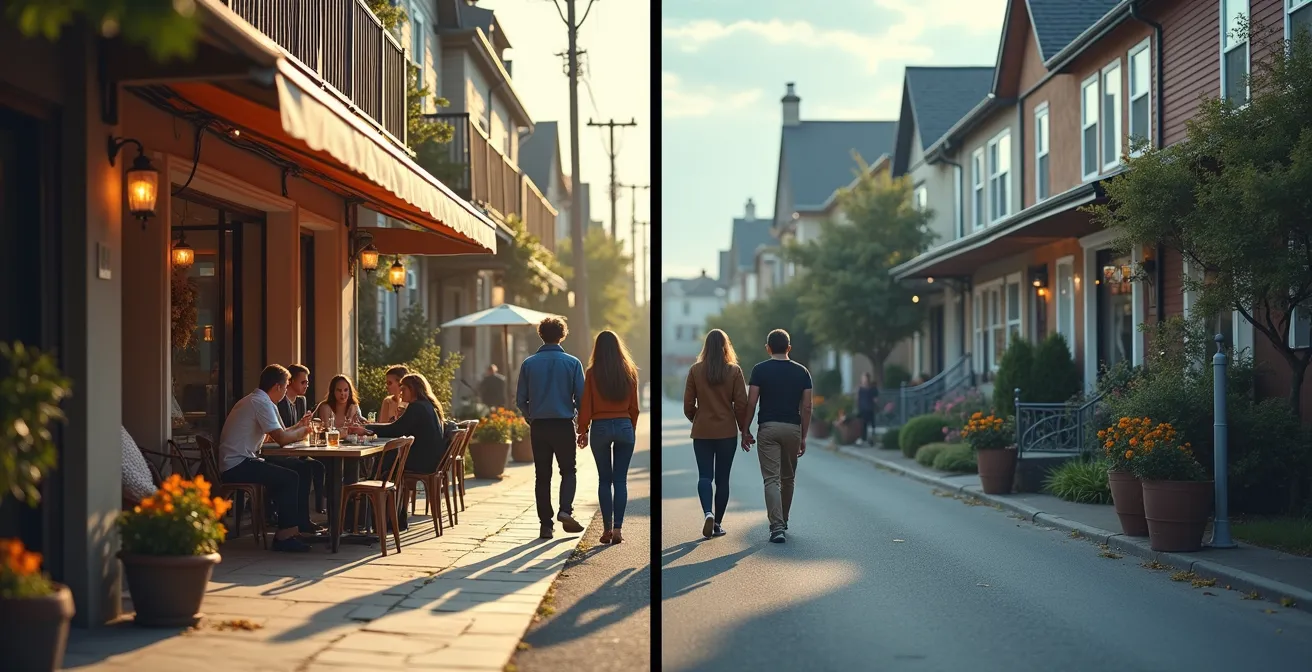
In contrast, the classic suburban model, with its wide streets, single-use zoning, and car-centric layout, structurally engineers isolation. Social interactions must be planned and scheduled. The “in-between” spaces that foster community in a dense city are largely absent. Travel from the private bubble of the home to the private bubble of the car to the destination leaves little room for the serendipitous connections that build a sense of belonging. The physical space between homes becomes a social moat, creating a landscape of visible but disconnected individuals.
The power of a walkable neighborhood is amplified by the integration of green spaces. These are not just aesthetic amenities but crucial components of the social fabric. In fact, research from Restorative Cities authors reveals there’s a strong relationship between access to green space and altruism, trust, and a sense of belonging. Parks and public squares in these dense neighborhoods become shared “living rooms,” places where trust is built and pro-social behaviors are modeled and reinforced. Therefore, high-density walkability, when coupled with accessible green infrastructure, is not just a different lifestyle choice; it is a fundamentally superior model for fostering the social ties essential for mental health.
The Design Mistake That Removes Public Seating and Kills Street Life
One of the most insidious trends in modern urban design is the subtle but systematic removal or hostile design of public seating. Benches are replaced with “leaning bars,” planters are given sharp edges, and open ledges are studded with metal dividers. This practice, often justified under the guise of preventing loitering or rough sleeping, is a critical design mistake. It sends a clear, albeit unspoken, message: this space is for transit, not for lingering. It is for moving through, not for being in. By designing against the simple human need to rest, the city actively kills the spontaneous street life that is the hallmark of a healthy urban environment.
Without places to sit, public spaces lose their function as social incubators. The elderly cannot pause during a walk, parents have no place to watch their children play, and friends cannot gather for an impromptu chat. The street is reduced to a corridor, and its potential for fostering community evaporates. This is a failure to observe and respect what designers call “desire lines.” As Public Works Partners notes in their study on mindful cities, “Desire lines occur in publicly used spaces where a formal pathway takes a longer route, so users carve out a shorter pathway. When designers formalize these usage patterns, it creates spaces that are intuitively navigable and responsive to user needs.” The need to sit is a primary human desire line in public space; ignoring or designing against it is a direct act of user-hostility.
Case Study: The Swedish Street Moves Initiative
In response to car-dominated streets, several Swedish municipalities implemented the Street Moves initiative. Designed by ArkDes and LundbergDesign, this project provides customizable modules that can be installed on streets to reclaim space for people. These modules are co-designed with citizens and local teams to fit community needs, incorporating elements like seating areas, play structures, bike racks, and planter boxes. By replacing parking spots with these “street furniture” kits, the initiative directly addresses the lack of public seating and fosters community dialogue, transforming sterile transit zones into vibrant, place-specific social hubs. It is a prime example of how to reverse the trend of hostile architecture and actively design for street life.
The solution is a conscious re-embrace of “intentional inefficiency”—designing spaces that invite people to slow down, pause, and simply exist. This means providing ample, comfortable, and strategically placed seating that encourages observation and interaction. It is a small detail with profound sociological consequences, transforming a sterile street into a living, breathing community space.
Problem & Solution: Reviving Local Libraries as Community Hubs
In an age of digital everything, local libraries are often perceived as obsolete relics. This is a profound misreading of their sociological function. Libraries have always been, and must increasingly become, the quintessential “third places”—the anchors of community life that exist between the primary spheres of home and work. Their decline or underutilization represents a critical tear in the social fabric, leaving a void that online forums cannot fill. The problem is that many libraries haven’t adapted their design and programming to fully embrace this role. The solution is to consciously redesign them as vibrant, multi-functional community hubs that cater to the modern citizen’s need for connection, learning, and quiet refuge.
This transformation requires looking beyond books. A revived library should be a sensory and socially rich environment. It could include comfortable seating areas for quiet reading, collaborative workspaces for freelancers, soundproof pods for online meetings, a children’s play area, and even a small café. The goal is to create a layered space that supports a variety of social and individual needs. This aligns perfectly with the framework of a “Restorative City,” which seeks to create environments that actively support mental health. With 82% of North America’s population living in cities and mental health being a top priority, investing in these community anchors is not a luxury, but a necessity.
The following table, based on the Seven Pillars of a Restorative City, provides a framework for how a library can be reimagined to meet these critical urban needs.
| Pillar | Key Features | Mental Health Benefits |
|---|---|---|
| Green City | Indoor plants, views of nature, a reading garden | Reduces stress; improves focus and cognitive function |
| Sensory City | Quiet zones, well-lit spaces, pleasant acoustics | Reduces sensory overload and depression symptoms |
| Neighborly City | Community event boards, group meeting rooms, walkability | Protects against mental health problems by building social networks |
| Active City | Bike racks, central location, hosting walking tours | Integrates physical activity into community life |
| Playable City | Children’s section, teen tech labs, board game nights | Fosters cognitive and emotional development for all ages |
How to Design a Home Office That Physically Separates Work From Rest?
The principles of mentally healthy urban design don’t stop at our front door. The rise of remote work has blurred the lines between professional and personal life, turning many homes into sources of chronic stress. A poorly designed home office, one that lacks clear boundaries, is the domestic equivalent of living next to a highway. It creates a constant, low-level psychological friction where the mind is never truly “off.” The solution is to apply the concept of sensory zoning within your own living space, creating clear physical and perceptual boundaries that signal to your brain when it’s time to work and when it’s time to rest.

Physical separation is the ideal. If you have a separate room, use it exclusively for work and close the door at the end of the day. If not, create a designated “work zone” in a corner of a room. The key is to make this boundary tangible. Use a rug to define the office area, a bookshelf as a divider, or even a different color of paint on the wall. This visual demarcation helps your brain associate that specific space with focus and productivity, and the rest of your home with relaxation and leisure.
Beyond physical separation, create sensory boundaries. Your work zone should have a different lighting profile—perhaps brighter, cooler light—than your living area. Use task lighting on your desk that you turn off when work is done. Introduce a specific scent, like a subtle essential oil, that you only use during work hours. Even the textures can be different: a firm office chair versus a soft armchair. At the end of the day, perform a “shutdown ritual”: tidy your desk, turn off the task light, and physically leave the space. This act of crossing a sensory boundary is a powerful signal to your subconscious that the workday is truly over, allowing for genuine rest and recovery.
Urban Infill vs. Rural Greenfield: Which Is Cheaper to Develop?
When viewed through a purely financial lens, developing on a “Greenfield”—a pristine, undeveloped rural plot—often appears cheaper. There are no existing structures to demolish, no complex underground utilities to navigate, and land acquisition can be less expensive. However, this calculation is dangerously incomplete. It ignores the immense long-term social and psychological costs that this pattern of sprawling, car-dependent development imposes on its residents and society. Urban infill—developing vacant or underutilized plots within existing urban areas—presents a higher upfront cost but is profoundly cheaper when measured in terms of human wellbeing and community resilience.
The hidden costs of Greenfield development are staggering. It necessitates the costly extension of infrastructure (roads, water, sewer) and promotes a lifestyle that structurally engineers social isolation and poor physical health. The reliance on cars erodes the potential for spontaneous community. Furthermore, this sprawl often creates stark inequalities. As Delhi urban research shows, there are significant mental health disparities between residents of peripheral, poorly serviced areas and their counterparts in more affluent, well-connected neighborhoods, with stressors like overcrowding and inadequate infrastructure intensifying symptoms of depression and anxiety.
Urban infill, by contrast, leverages existing infrastructure and promotes the very density and walkability that foster strong social ties. It supports local businesses, reduces commute times, and decreases our collective carbon footprint. It is an investment in a more equitable and mentally healthy future. This sentiment is powerfully captured by the World Economic Forum, which states, “More than a matter of transit, mobility is a question of urban dignity. It reflects how cities value time, accessibility and the inner life of their residents… When movement feels safe, dignified and humane, the city itself begins to feel more like a home and less like an obstacle.” Urban infill is a direct investment in that dignity, making it the far more valuable and, in the long run, cheaper path to development.
Key Takeaways
- Mentally healthy urban design is not about aesthetics, but about intentionally choreographing positive social behaviors.
- Chronic environmental stressors like noise and poor design have direct, measurable negative impacts on our physiological and psychological health.
- Well-designed density, walkability, and strong “third places” (like libraries) are critical infrastructure for combating social isolation and building community resilience.
How to Spot Hidden Geotechnical Issues Before Buying a Building Plot?
In civil engineering, spotting hidden geotechnical issues—unstable soil, high water tables, hidden bedrock—before construction is crucial to preventing catastrophic structural failure. The same principle applies to urban planning, but the “geotechnical issues” are sociological. A city plan might look perfect on paper, with neat zoning and wide roads, but it may contain hidden faults in its social fabric that are destined to cause stress, isolation, and community decay. The true task of a visionary planner, and an informed citizen, is to learn how to spot these invisible weaknesses before they are set in concrete.
These “sociological fault lines” often hide in plain sight. They are found in a residential neighborhood with no walkable corner store, forcing residents into cars for every minor need. They are visible in a gleaming new plaza that is devoid of comfortable seating, rendering it a sterile, windswept void. They are present in a transportation system that prioritizes vehicle speed over pedestrian safety and dignity, turning the simple act of crossing the street into a source of anxiety. These are not minor flaws; they are fundamental design decisions that predetermine a low quality of social life.
To develop this “geotechnical eye” for social design, one must stop looking at a city as a collection of objects and start seeing it as a system for human interaction. Ask not “Is there a park?” but “What kind of social life does this park’s design enable or prevent?” Ask not “Are the streets wide?” but “Does this street’s design encourage people to walk, linger, and meet, or does it serve only to move cars as quickly as possible?” By learning to read the behavioral script embedded in our built environment, we can identify the deep-seated issues that truly undermine our collective mental health and advocate for a city built on a more solid social foundation.
The ultimate goal is to transform our cities from sources of stress into platforms for wellbeing. By applying this sociological lens to our own neighborhoods, we can begin to advocate for and co-create environments that are not only efficient and beautiful, but profoundly humane and restorative.