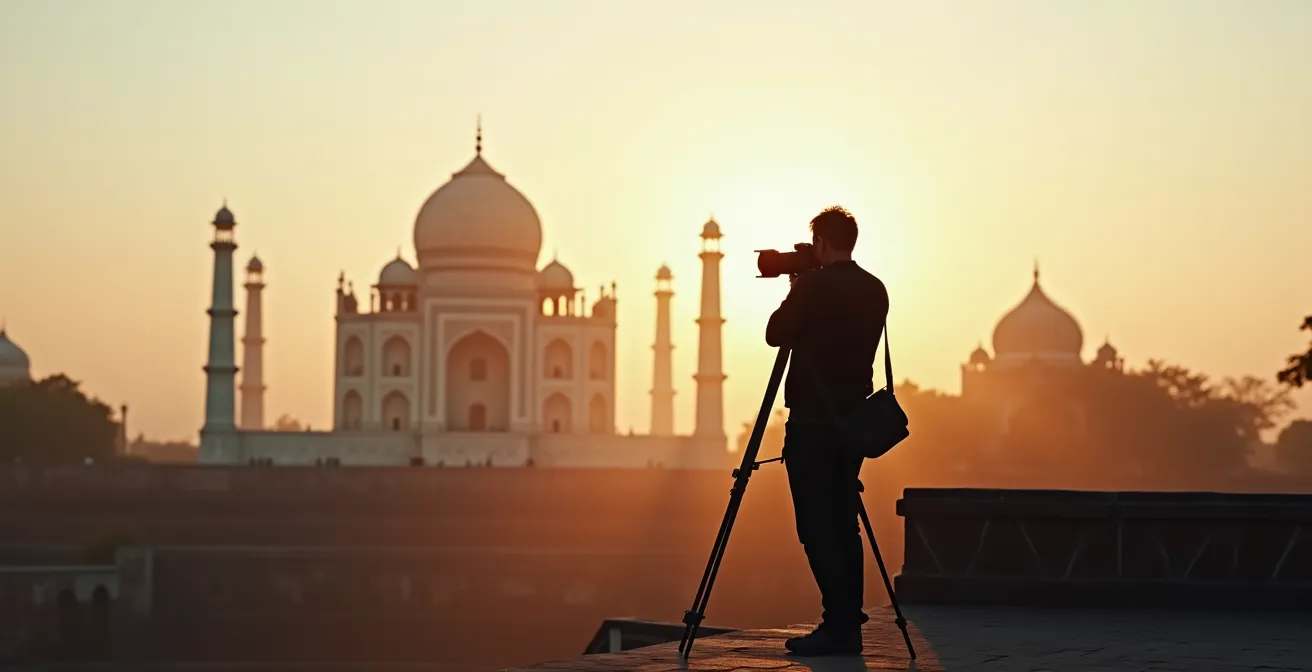
In summary:
- Mastering monument photography requires controlling light, time, and space, not just avoiding people.
- Use strategic workflows like digital pre-scouting and light-based scheduling to be in the right place at the right time.
- Leverage technical skills, from using the right gear to advanced software techniques like median stacking, to digitally remove crowds.
- Adopt an ethical, low-impact presence, especially in sacred sites, to respect the location and its inhabitants.
The feeling is universally frustrating for any budding photographer: you’ve traveled thousands of miles to see an iconic monument, only to find your perfect shot photobombed by a sea of tourists. The classic advice is always the same—wake up before sunrise, be patient, or try to find a unique angle. While these tips have some merit, they barely scratch the surface of what it truly takes to create a compelling, crowd-free image. They treat the problem as a simple matter of timing, ignoring the more powerful forces at play for a travel photographer.
The reality is that a truly stunning architectural photograph isn’t just about the absence of people; it’s about the presence of great light, thoughtful composition, and technical control. But what if the secret wasn’t just avoiding the crowds, but mastering the very elements that define a location? What if you could strategically control time, light, and even the physical space in your frame through a series of deliberate, professional workflows? This approach moves beyond simple tourist hacks and into the realm of artistic discipline.
This guide will deconstruct that discipline. We will explore why midday light is your enemy, how to scout locations like a pro before you even arrive, and the technical methods to literally erase people from your images. It’s time to shift your mindset from a visitor with a camera to a photographer in control of the scene.
To navigate this journey from frustrating snapshots to professional-grade architectural portraits, this article breaks down the essential strategies. The following sections will guide you through mastering light, planning, gear, and ethics to transform your travel photography.
Summary: How to Photograph Famous Monuments Without a Crowd in the Frame?
- Why Mid-Day Sun Makes Monuments Look Flat and Boring?
- How to Scout a Location the Day Before for the Perfect Sunrise Shot?
- High-End Phone vs. Heavy DSLR: Which Is Best for City Monuments?
- The “Selfie” Mistake That Gets You Kicked Out of Sacred Sites
- Problem & Solution: Removing Tourists From Photos Using Software
- Sequencing Your Day: Grouping Sights by Neighborhood to Save Time
- How to Spot Fake Reviews on TripAdvisor Before Booking a Tour?
- How to See the Best of a City in 3 Days Without Exhaustion?
Why Mid-Day Sun Makes Monuments Look Flat and Boring?
The most common mistake amateur photographers make is shooting between 10 AM and 3 PM. During these hours, the sun is directly overhead, casting harsh, downward-facing shadows. This high-angle light effectively flattens architectural details, erasing the subtle textures and contours that give a monument its character. Stone carvings, intricate facades, and sculptural elements lose their three-dimensionality and appear dull. Furthermore, this intense light creates extreme contrast between blinding highlights and deep, information-poor shadows, a dynamic range that most cameras struggle to capture, resulting in blown-out skies or crushed blacks.
The goal is not simply to find a time with fewer people but to find a time with better light quality. The “golden hours”—the first hour after sunrise and the last hour before sunset—provide a soft, directional light that rakes across surfaces. This side-lighting accentuates texture, creates long, dramatic shadows, and bathes the scene in warm, pleasing tones. Arriving early isn’t just a crowd-avoidance tactic; it’s a fundamental artistic choice.
Case Study: The San Marco Square 4 AM Strategy
As one photographer noted, “The well known landmarks usually have a large crowd during normal hours. To shoot something different than a regular tourist snapshot, I always get there early in the morning when most people are sleeping.” By arriving at Venice’s San Marco Square at 4:00 AM, the photographer not only found the location completely deserted but also discovered the “zen-like mood” necessary to identify unique compositional elements that are invisible amidst the daytime chaos. This demonstrates that temporal control is as much about finding creative headspace as it is about finding an empty space.
Even if you are forced to shoot in harsh light, you can still exercise technical control. By using a circular polarizing filter (CPL), you can cut down on reflections from glass and stone, deepening the color of the sky. Alternatively, embracing the high contrast by shooting in black and white can turn harsh shadows into powerful graphic elements in your composition.
How to Scout a Location the Day Before for the Perfect Sunrise Shot?
Arriving at a world-famous monument for sunrise without a plan is a recipe for missed opportunities. The best photographers don’t leave their compositions to chance; they engage in rigorous digital pre-scouting. This process of virtual exploration allows you to identify promising vantage points, anticipate obstacles, and build a shot list long before your alarm clock rings. It transforms you from a reactive tourist into a proactive artist who arrives on-site with a clear vision.
Your scouting workflow should begin online. Use Google Images, Instagram, and stock photo websites not to copy what’s been done, but to understand it. Identify the clichéd shots so you can consciously avoid them. Then, dive into Google Street View. This tool is invaluable for virtually “walking” the perimeter of a location, helping you discover unconventional angles, check for obstructions like fences or streetlights, and assess the accessibility of potential shooting spots. Mark these potential locations on a digital or printed map for efficient navigation in the pre-dawn darkness.
As one expert guide on travel photography advises, this research is non-negotiable:
“The best travel photography starts before you even leave home… Look up the places you’re going to on Pinterest, Instagram, or your favourite travel blogs, find out where are the best places to go and the best time of day to go there… That way, when you’re at the location, you won’t be wasting your precious holiday time searching for the right spot.”
Don’t underestimate local knowledge. Seek out blogs from local photographers or even ask hotel staff or guides for their favorite spots away from the main tourist viewpoints. Often, the most unique and crowd-free perspectives are known only to those who live there.
High-End Phone vs. Heavy DSLR: Which Is Best for City Monuments?
The debate over gear often misses the point. The question isn’t which camera is “better,” but which tool is right for the specific task and environment. For monument photography, both high-end smartphones and professional DSLR or mirrorless systems have distinct advantages. The key is gear intentionality: choosing your equipment based on the creative and logistical demands of the shot you want to achieve.
A modern smartphone is a master of stealth and convenience. Its small size allows you to blend in with tourists, avoiding unwanted attention from security guards who often associate tripods and large cameras with professional activity. This is crucial in areas with photography restrictions. Furthermore, the built-in ultra-wide lenses on many phones are perfect for capturing grand architecture in tight spaces where you can’t step back. On the other hand, a DSLR or mirrorless camera offers unparalleled image quality, especially in low light. The larger sensor is far superior for capturing clean, detailed shots during the golden and blue hours. Its ability to pair with neutral density (ND) filters for long exposures is also the primary method for making moving crowds disappear into a blur, a technique phones can only crudely simulate.
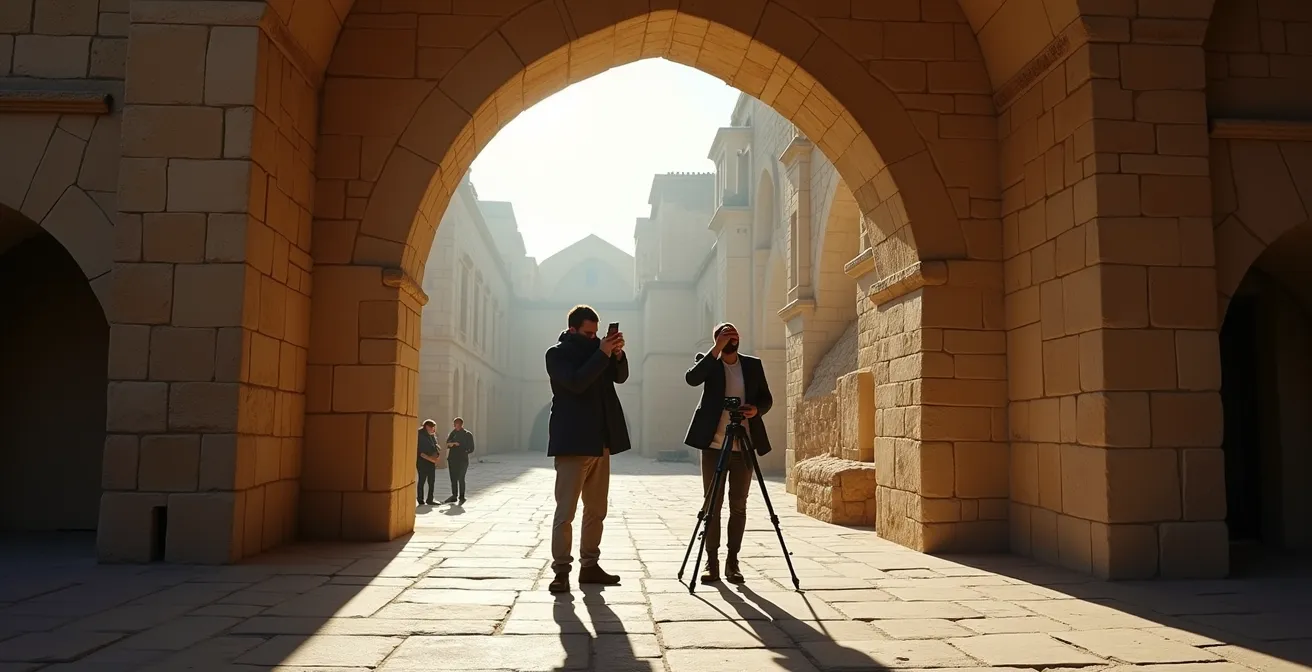
As the image above illustrates, the choice of tool dictates the approach. A photographer with a phone might focus on capturing unique, fleeting moments from ground level, while one with a DSLR setup is prepared for a more deliberate, static shot that maximizes quality. The following table breaks down the strategic choice between these two systems.
| Feature | High-End Phone | DSLR/Mirrorless | Best For |
|---|---|---|---|
| Stealth Factor | Excellent – Blends in with tourists | Poor – Attracts attention | Restricted areas |
| Ultra-Wide Capability | Built-in, instant access | Requires lens change | Tight spaces |
| Long Exposure | Limited without tripod | Superior with ND filters | Crowd removal |
| Low Light Performance | Good with computational photography | Excellent with large sensor | Golden/blue hour |
| Portability | Pocket-sized | Requires dedicated bag | All-day touring |
The “Selfie” Mistake That Gets You Kicked Out of Sacred Sites
Nothing will ruin a photo opportunity faster than being disrespectful. Many of the world’s most beautiful monuments are also active places of worship, memorials, or sites of deep cultural significance. A photographer’s failure to recognize this context is the “selfie mistake”—a mindset of self-centered image-making that ignores the environment and the people within it. This lack of awareness can lead to more than just dirty looks; as recent enforcement data shows, incidents of inappropriate tourist behavior at sensitive sites have resulted in significant fines, jail time, and even deportation.
Practicing photographic etiquette and maintaining a low-impact presence is a technical skill, not just a matter of courtesy. It involves a series of deliberate choices to minimize your footprint. The first rule is to be silent. Use your camera’s silent shutter mode in any religious building or memorial. The sound of a mirror slap is incredibly disruptive. Second, never use a flash, especially during services or near worshippers. It is both disrespectful and rarely produces a good photo.
Tripods are another major signal. In many cathedrals, temples, and museums, a tripod signals “professional” or “commercial” intent and is often explicitly forbidden. Opt for a monopod or learn to brace your camera against a solid surface for stability. When photographing local people, always seek permission. Often a simple smile, eye contact, and a gesture towards your camera are enough to get a nod of approval. Finally, and most importantly, research the specific rules before you visit. Many sites have unwritten customs that you are expected to know and respect.
Problem & Solution: Removing Tourists From Photos Using Software
Sometimes, despite your best planning, crowds are simply unavoidable. In these situations, the solution lies not in the field but in your software. One of the most powerful and professional techniques for creating a pristine, empty-looking scene from a crowded one is called median stacking. This post-processing workflow uses a series of photos to mathematically identify and remove any elements that move between frames—namely, people.
The concept is simple: by taking multiple shots of the same scene over a short period, tourists will be in different positions in each frame, but the monument itself will remain static. When these images are stacked and blended using a “median” algorithm in a program like Adobe Photoshop, the software effectively calculates the most common pixel value for each spot. Since the background is consistent in every shot, it remains. Since the tourists are inconsistent, they are treated as statistical noise and erased.

This is not a simple “clone stamp” job; it is a systematic and clean process that produces incredibly realistic results. For optimal effect, professional photographers recommend taking a series of shots from a fixed position. The key is to capture enough frames to provide the software with sufficient data to work with.
Action Plan: Professional Median Stack Workflow in Photoshop
- Set Up the Shot: Mount your camera on a sturdy tripod to ensure the frame is identical across all shots. Take between 15-20 photos with a 20-second interval between each to allow people to move.
- Load into Photoshop: In Photoshop, use the script `File > Scripts > Load Files into Stack`. This will import all your images as separate layers in a single document.
- Align Layers: Select all layers in the Layers panel and choose `Edit > Auto-Align Layers`. This corrects any minor shifts or vibrations that may have occurred during the shoot.
- Create a Smart Object: With all layers still selected, right-click and choose `Convert to Smart Object`. This groups the layers into a single, non-destructive container.
- Apply the Stack Mode: Go to `Layer > Smart Objects > Stack Mode > Median`. Photoshop will now process the images, magically removing the moving tourists and leaving behind a clean shot of the monument. Fine-tune any remaining artifacts with the Clone Stamp or Healing Brush tools if needed.
Sequencing Your Day: Grouping Sights by Neighborhood to Save Time
An effective travel photographer thinks like a logistician, and the most valuable currency is time. Zig-zagging across a city to chase different sights is inefficient and exhausting. The professional approach is to practice spatial control by grouping your targets by neighborhood. This minimizes travel time and maximizes shooting time. However, the most advanced form of this is light-based scheduling: planning your entire day not just around location, but around the direction and quality of light.
Start by mapping out your must-see monuments. Using a tool like Google Maps, identify which are east-facing and which are west-facing. This simple piece of information dictates your entire day. Your schedule should look something like this:
- 5:00-8:00 AM (Sunrise/Golden Hour): Focus exclusively on your top-priority, east-facing monuments. The light will be perfect, and as tourism statistics reveal a rise in international arrivals, this is your best window to avoid the peak crowds.
- 8:00-10:00 AM: While the masses flock to the main attraction you just shot, use this time to capture secondary, “B-list” sites within the same neighborhood.
- 11:00 AM-3:00 PM (Midday/Harsh Light): This is your strategic break. Escape the crowds and the bad light by visiting indoor locations like museums and galleries, or take time to rest and edit photos.
- 3:00-6:00 PM (Afternoon/Golden Hour): Shift your focus to west-facing monuments to catch them in beautiful afternoon light as the day-trippers begin to depart.
- 6:00-8:00 PM (Sunset/Blue Hour): Return to one of your primary locations to capture it in the dramatic light of sunset or the cool, ethereal tones of the blue hour, now with significantly reduced crowds.
This structured approach ensures you are always in the right place with the best possible light, turning your day from a frantic tour into a deliberate photographic mission.
How to Spot Fake Reviews on TripAdvisor Before Booking a Tour?
For a photographer, a “tour” is not just about seeing the sights; it’s about gaining access to the right spots at the right time. When booking a photography-focused tour, you are paying for logistical expertise and local knowledge. However, the market is flooded with generic tours masquerading as specialized experiences. Learning to dissect reviews on platforms like TripAdvisor is a critical skill to ensure you’re investing in a genuinely valuable photographic opportunity, not a glorified bus ride.
Ignore the star rating and generic praise like “great guide” or “fun tour.” Instead, hunt for specific details relevant to photography. A legitimate review for a photo tour will often mention technical elements. Look for keywords like “golden hour,” “tripod,” “filters,” “composition,” or the quality of the light. Do reviewers mention the actual crowd levels and whether the guide successfully navigated them to good shooting spots?
Cross-reference the guide’s credentials. Does the tour company’s website or the guide’s personal Instagram feature a portfolio of high-quality images that match the style you want to achieve? A true photo guide is a photographer first. Finally, don’t just read the 5-star reviews. The negative reviews are often a goldmine of information, revealing issues with timing, overcrowding, or a guide’s lack of photographic knowledge. As this testimonial for a successful tour reveals, the value is in the details:
“Philip and Leslie both were excellant guides. Being both knowledgeable and personable is a geat combo to help a new visitor not only see, but understand the incredible variety of locations, lighting and history of the Park. Make sure you have an extra battery and memory card as you simply cannot take enough photos; due the constantly changing impact of light angles.”
– Review of Phillips Photography Tours, TripAdvisor
This reviewer highlights key indicators of a great photo tour: knowledge of light, locations, and the practical need for extra batteries—proof that the experience was genuinely geared towards photographers.
Key Takeaways
- Mastering light is the foundation: Plan your shoots around the golden and blue hours, and use midday for rest or indoor activities.
- Technology is your ally: Use digital scouting tools to plan your shots in advance and software techniques like median stacking to remove crowds in post-production.
- Adopt a sustainable rhythm: Prioritize a few high-quality shots over many mediocre ones to avoid burnout and produce better work.
How to See the Best of a City in 3 Days Without Exhaustion?
A short city break presents a tantalizing but dangerous challenge for a photographer: the urge to capture everything. This “fear of missing out” often leads to a frantic, exhausting pace that ultimately results in burnout and subpar images. The key to a successful and enjoyable 3-day shoot is to embrace restraint and adopt a split-day photography schedule. This strategy is built on the principle of quality over quantity, prioritizing energy and creativity over a checked-off list.
Instead of running from dawn till dusk with a heavy camera bag, structure your days around one or two key shooting sessions. For example:
- Day 1: Commit to an intensive sunrise shoot (e.g., 5-8 AM). Afterwards, put the main camera away. Spend the rest of the day exploring casually, perhaps using just a smartphone, and allow yourself to rest.
- Day 2: Skip the early alarm. Use the midday to explore non-photographic interests, then commit your energy to a single, well-planned sunset and blue hour location.
- Day 3: Choose one final “hero” shot—either sunrise OR sunset—and dedicate your focus to executing it perfectly.
This rhythm builds in crucial 2-3 hour rest periods after each intensive shoot. It allows your creative mind to recharge and your body to recover. This is especially vital in cities buckling under the pressure of overtourism. For instance, overtourism data shows that Venice, with only 250,000 residents, must accommodate 20 million tourists annually. Trying to “see it all” in such an environment is a fool’s errand. Instead, by accepting that you cannot capture everything, you give yourself permission to create a few truly exceptional images.
Start planning your next trip not by the sights, but by the light and your own energy levels. By implementing these strategic, technical, and mindful approaches, you will transform your travel photography from a frustrating battle against the crowds into a rewarding artistic pursuit.