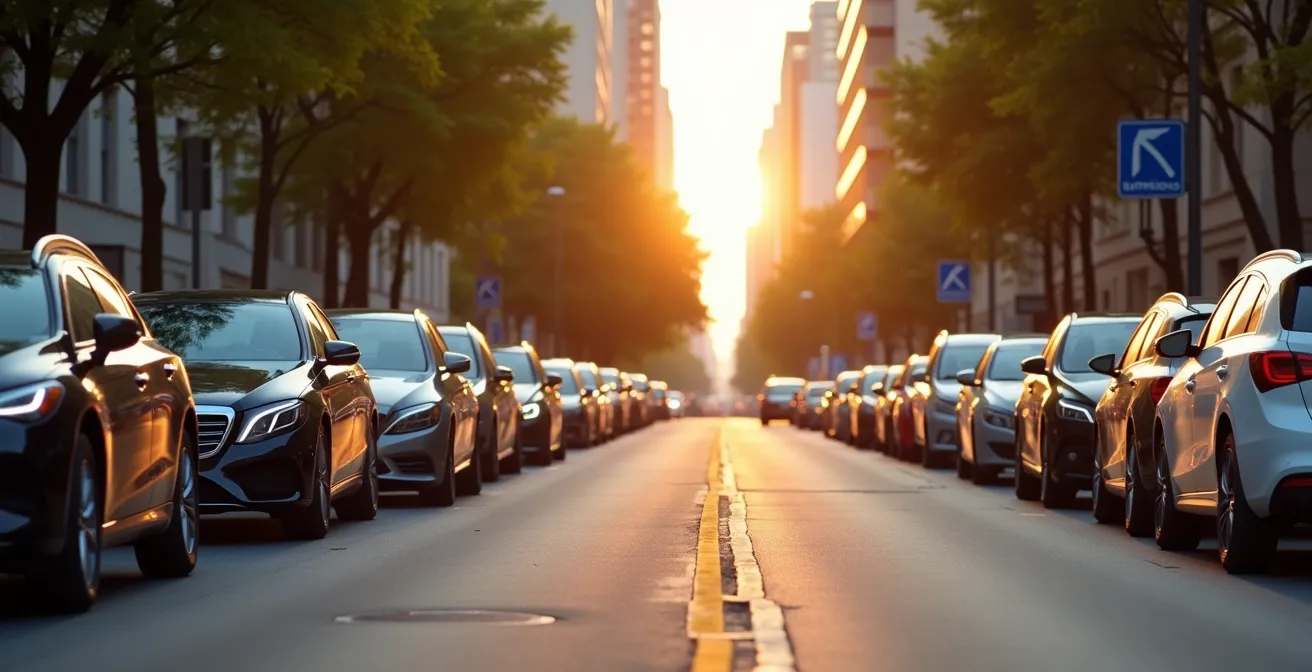
The real cost of street parking isn’t the meter; it’s the constant threat of damage, fines, and towing that basic precautions fail to prevent.
- Effective protection involves a mix of financial calculation, mastering defensive parking geometry, and applying layers of psychological deterrence.
- Physical guards are only one piece of the puzzle; understanding your environment and local regulations is just as critical.
Recommendation: Stop thinking like a driver looking for a spot and start thinking like a risk manager securing an asset.
For any car owner without a dedicated garage, the daily routine of street parking feels like a low-grade battle. You circle the block, hunting for that elusive spot, all while a mental checklist of potential disasters runs in the background: door dings from careless neighbors, scraped bumpers from clumsy parallel parkers, and the dreaded disappearance of your car, only to find it’s been towed. Most advice revolves around the obvious—fold your mirrors, park under a light. But these are just minor tactics in a much larger strategic game.
The reality is that these common tips barely scratch the surface. They don’t account for the complex financial trade-offs, the specific physics of maneuvering in tight urban canyons, or the psychology of what makes one car a target and another invisible. Relying on them is like bringing a shield to a chess match; you’re prepared for a direct hit but completely unaware of the strategic threats all around you. In the US, where 63% of occupied housing units have a garage or carport, the remaining third of drivers are left to navigate this gauntlet daily.
But what if the key wasn’t just *protecting* your car, but making it fundamentally less vulnerable from the start? This guide moves beyond the platitudes. We’re adopting a new mindset: one of defensive geometry and risk calculus. It’s about understanding the hidden economics of your choices, mastering the art of positioning, and layering deterrents so effectively that trouble simply passes you by. We will treat street parking not as a daily chore, but as a skill to be mastered.
This guide will walk you through the essential strategies for urban car survival. We’ll start by analyzing the true costs, then move to mastering the physical and psychological tactics needed to keep your vehicle safe on the street, and finally explore advanced strategies for a smarter commute.
Summary: How to Protect Your Car From Daily Street Parking Damage
- Why Paying for a Garage Might Be Cheaper Than Street Parking Fines and Dings?
- How to Parallel Park in Tight Spaces Without Curbing Your Alloys?
- Bumper Bully vs. Rubber Strips: Which Actually Stops low-Speed Impacts?
- The “Street Cleaning” Trap That Gets Your Car Towed in 15 Minutes
- Problem & Solution: Making Your Street-Parked Car Look Like a Hard Target
- Why You Can’t Build Within 10 Feet of Your Property Line?
- Problem & Solution: Finding Parking Spots That Are Close to Bike Lanes
- How to Combine a Compact Car and e-Scooter for the Ultimate Urban Commute?
Why Paying for a Garage Might Be Cheaper Than Street Parking Fines and Dings?
The first step in street parking survival is a dose of cold, hard math. We often see street parking as “free” and a garage as an expensive luxury. But this view ignores the hidden costs that accumulate over time. Fines, cosmetic repairs from dings and scratches, and even major damage from break-ins or sideswipes are the unpredictable taxes of street parking. For the 35% of American households without access to a garage or carport, this is a constant financial risk.
This is what we call the risk calculus: a conscious evaluation of predictable costs versus unpredictable, and often higher, expenses. A $300 monthly garage fee seems steep until you get a $150 towing bill, a $500 bumper repair, and two $75 parking tickets in the same year. Suddenly, the “expensive” garage looks like a predictable, budget-friendly insurance policy against the chaos of the street.
The economics can sometimes be counterintuitive. A case study from Consumer Reports highlights a driver in Brooklyn, Todd Rogers, who did the math and found it was more economical to risk weekly $45 parking tickets than to pay a $300 monthly garage fee. While this worked for his specific high-fine, high-cost area, it demonstrates the importance of running the numbers for your own situation. What is the average cost of a parking ticket in your city? How much does a typical bumper scuff repair cost? How many of these incidents would it take to equal a year’s worth of garage payments?
Before you even think about parking techniques, perform this audit. Calculate the total potential cost of a “bad year” on the street. Compare that number to the annual cost of the cheapest, safest off-street option available. The answer might surprise you and reframe your entire approach to where you leave your car. This isn’t about giving up; it’s about making a financially sound decision based on data, not just habit.
How to Parallel Park in Tight Spaces Without Curbing Your Alloys?
Once you’ve committed to the street, mastering the physical space is paramount. Parallel parking is the most fundamental skill, and doing it well is the first layer of defense. It’s not just about getting into the spot; it’s about positioning your car with defensive geometry in mind. This means maximizing the buffer space around you and minimizing your exposure to passing traffic and other parkers. The goal is to avoid not only curb rash on your expensive alloy wheels but also contact with the cars in front and behind.
A common mistake is focusing only on the curb. A truly defensive parker is aware of a 360-degree bubble. The key is a systematic approach, turning a stressful guess-and-check process into a repeatable, low-risk maneuver. The standard method involves a few key reference points that, once learned, become second nature and dramatically reduce the chance of error.

The technique visualized above relies on precise angles and alignment. According to experts at MotorBiscuit, a reliable process is as follows: Find a spot at least 1.5 times your car’s length. Align your car parallel to the vehicle in front, about three feet away. Reverse slowly until your rear bumpers align, then cut your wheel sharply toward the curb to enter at a 45-degree angle. Once your front bumper clears the car in front, straighten the wheel and continue backing in. Finally, turn the wheel away from the curb to straighten out, leaving 6-12 inches of space from the curb. This method centers your car perfectly, creating that vital buffer.
Your 5-Point Parallel Parking Pre-Flight Check
- Spot Assessment: Is the space genuinely 1.5x my car’s length? Are there hidden obstacles like low posts or fire hydrants?
- Initial Alignment: Am I a consistent 2-3 feet away from the car I’m parking behind? Is my rear bumper aligned with theirs?
- Angle of Entry: As I reverse, does my front end have enough clearance to swing in without hitting the forward car?
- Curb Proximity: As I straighten out, have I checked my passenger-side mirror to monitor the distance to the curb and prevent alloy damage?
- Final Position: Am I centered between the two cars, with equal buffer space at the front and rear?
Bumper Bully vs. Rubber Strips: Which Actually Stops low-Speed Impacts?
Even with perfect parking, you can’t control other drivers. The next layer of defense is physical armor. The “love taps” from other drivers trying to squeeze into tight spots are a primary source of scratches and scuffs. This is where bumper protectors come in, but not all are created equal. The choice between a deployable guard like a Bumper Bully and permanently affixed rubber strips depends on your specific parking environment and tolerance for daily setup.
Deployable guards, typically made of thick foam or rubber, offer the highest level of protection against low-speed impacts. They hang over your bumper while parked, providing a thick cushion. Their main drawback is convenience; you must remember to deploy it every time you park and store it before you drive. Permanent rubber or silicone strips, on the other hand, are a “set it and forget it” solution. They offer moderate protection against light scrapes but won’t do much against a more forceful bump. Your choice involves a trade-off between maximum protection and daily convenience.
To make an informed decision, it’s helpful to see a direct comparison of the options available for protecting your vehicle’s exterior.
| Protection Type | Material | Deployment | Effectiveness | Price Range |
|---|---|---|---|---|
| Bumper Guards | Foam/Rubber | Deployable | High for impacts | $40-80 |
| Rubber Strips | Rubber/Silicone | Permanent | Moderate | $20-50 |
| Car Covers | Polyester/Polypropylene | Daily removal | Protection from debris | $60-250 |
The data shows a clear hierarchy. For those in high-contact parking areas, the superior impact absorption of a deployable bumper guard is likely worth the daily hassle. For those in less aggressive environments, permanent strips may be enough. As Jack from Auto Shop Accessories noted in an interview with Torque News, the return on investment is clear. He states, “Given the cost of an average car and the cost of repairing door dings, we think this is a good return on investment.” This investment in physical protection is a direct application of the risk calculus we discussed earlier—a small, fixed cost to prevent larger, unpredictable ones.
The “Street Cleaning” Trap That Gets Your Car Towed in 15 Minutes
Physical damage isn’t the only threat; administrative hazards can be just as costly. The most common of these is the “street cleaning” trap. Forgetting to move your car on the designated day can result in a hefty ticket and, in many cities, a swift tow to an impound lot. This is a purely preventable expense that requires situational awareness and a simple system to manage. The key is to externalize your memory—don’t rely on yourself to remember a complex schedule of alternating side-of-the-street rules.
Modern technology is your best ally here. For drivers in urban centers, parking apps are essential tools. Experts note that in the U.S. alone, more than 20 major cities have mobile parking apps, including Atlanta, Boston, Chicago, and NYC. Apps like SpotAngels or ParkWhiz not only help you find parking but also send you reminders for street cleaning, effectively acting as your personal parking assistant. If you live outside a major metro area, a simple recurring calendar reminder on your phone for each street cleaning day is an equally effective, low-tech solution.
Beyond digital tools, developing a habit of “reading the street” is crucial. When you park, make it a reflexive action to look up and down the block for signs. Pay attention to temporary “No Parking” signs for events or construction, which often go unnoticed. A good street-smart parker builds a mental map of their neighborhood’s regulations. This includes knowing the local rules for snow emergencies, where parking is often restricted to one side of the street to allow for plows. Having a snow shovel in your trunk during winter isn’t just for getting unstuck; it’s a tool to comply with regulations that require you to clear snow around your vehicle.
These strategies transform you from a passive participant into an active manager of your parking environment. You’re no longer hoping you remembered the rules; you’ve built a system that prevents you from forgetting. This proactive stance is the difference between a stress-free experience and an expensive trip to the impound lot.
Problem & Solution: Making Your Street-Parked Car Look Like a Hard Target
Our final layer of defense is psychological. Thieves and vandals, much like water, follow the path of least resistance. Your goal is to make your car look like a “hard target”—a difficult, time-consuming, or risky proposition. This isn’t about making your car impenetrable, but about making it less appealing than the one parked down the street. This concept is known as deterrence layering, where you combine multiple visible and invisible security measures to create a powerful psychological barrier.
Visible deterrents are your first line of defense. A classic steering wheel lock (like The Club), a blinking LED from a dashcam (even a fake one), or a visible security system sticker on the window all send a clear message: “This car is protected.” The goal is to make a potential thief’s initial assessment conclude that the effort or risk is too high. Parking in well-lit areas or near security cameras adds another layer to this visible deterrence.

As the image suggests, even the position of your car can be a deterrent. Parking with your wheels turned towards the curb on a hill not only prevents a roll-away but can also make it slightly harder for a tow-truck-based thief to quickly snatch your vehicle. UK vehicle security experts have found this layering approach to be highly effective. Their analysis shows that cars combining visible deterrents are often bypassed for easier targets, as most opportunistic thieves will abandon an attempt if it takes more than a few minutes. This principle of making your car an inconvenient choice is the core of psychological defense.
Finally, never leave anything of value visible inside your car. This seems obvious, but items like charging cables, sunglasses, or even loose change can be enough to entice a smash-and-grab. A clean, empty interior suggests there is nothing to gain. By combining a clean interior, visible security devices, and smart positioning, you create a powerful, multi-layered message that encourages criminals to simply keep walking.
Why You Can’t Build Within 10 Feet of Your Property Line?
This question from the world of real estate holds a surprisingly relevant lesson for street parking. Zoning laws that require a “setback”—a minimum distance between a building and a property line—exist for safety, access, and to prevent conflicts between neighbors. A street-smart driver should apply this same principle, creating their own personal setback or buffer zone around their vehicle. The lines of a parking space are a suggestion; your real goal is to maximize the empty space separating you from potential threats.
This mindset fundamentally changes how you select a spot. Instead of just finding a space that fits, you start looking for a space that protects. As the experts at Gruven Parts advise, “Parking close to the curb keeps you far from passing traffic, and other vehicles in line serve as a buffer.” This is the setback principle in action. Hugging the curb creates a buffer from moving traffic, while positioning yourself tightly between two well-parked cars uses them as shields. Your car becomes the protected filling of a parking sandwich.
You can actively create these buffers even in tight spots. Follow these defensive positioning techniques to establish your zone:
- Avoid End Spots: The car at the end of a block is highly vulnerable to being sideswiped by vehicles making a turn too tightly. Choose a mid-block spot whenever possible.
- Position Off-Center: If you have a long space, don’t park right in the middle. Park closer to one end to create a larger, more obvious buffer on the other, discouraging another driver from trying to squeeze into the non-space you’ve left.
- Use Natural Barriers: A spot with a fire hydrant, a sturdy tree, or a driveway on one side is ideal. It provides one-sided protection, effectively cutting the number of potential threats in half.
By thinking like a city planner, you stop seeing parking as just fitting into a box. You start seeing the street as a dynamic environment where you can use distance and positioning to create an invisible shield. This is the essence of defensive geometry—it’s not about the space you occupy, but the protective space you command around it.
Problem & Solution: Finding Parking Spots That Are Close to Bike Lanes
Your risk assessment shouldn’t stop with other cars. Urban environments are filled with other environmental threats, from natural hazards to other modes of transportation. Parking near a bike lane, for instance, introduces a new set of variables. While it may seem harmless, it puts your car in the direct path of fast-moving cyclists, e-scooters, and the occasional swerving vehicle trying to avoid them. This increases the risk of sideswipes, broken mirrors, and scratches from handlebars.
The solution is, again, situational awareness and spot selection. When given the choice, always choose a spot on a quieter side street over one on a main artery with a busy bike lane. If you must park near one, apply the setback principle: leave as much room as possible between your car and the bike lane. A crucial but often overlooked danger is the “dooring” risk—not to you, but from you. Always check your mirror and look over your shoulder for cyclists before opening your door into the flow of traffic. An accident caused by your own negligence can be far more costly than a simple scratch.
Beyond traffic, consider natural environmental threats. Parking under a large, old tree might offer shade, but it also comes with the risk of falling branches during a storm or a sticky coating of sap and bird droppings that can ruin your paint. More dramatically, poor spot selection can lead to total vehicle loss. For example, a case study reported a Mercedes-Benz being totaled by an insurance company simply because flash flooding reached the floor mats while it was street-parked, causing catastrophic electrical damage. This highlights the need to park “upstream” or on higher ground when heavy rain is forecast. In fact, research shows that approximately 20% of cars parked outside will be struck by road debris or affected by environmental factors, a risk that goes far beyond other parkers.
A street-smart driver reads the entire environment. They see the bike lane not as paint on the road, but as a river of potential risk. They see the weather forecast not as small talk, but as actionable intelligence for spot selection. This holistic view of risk is what separates the amateur from the pro.
Key Takeaways
- Parking is an economic decision: Always weigh the predictable cost of a garage against the unpredictable, and often higher, costs of street parking damage and fines.
- Master defensive geometry: It’s not about fitting in a space, but about positioning your car to create a protective buffer zone from traffic and other drivers.
- Layer your deterrents: Combine visible security gadgets, smart positioning, and a clean interior to make your car a psychologically unattractive target for thieves.
How to Combine a Compact Car and e-Scooter for the Ultimate Urban Commute?
The final and most advanced strategy is to change the game entirely. If the most dangerous part of your journey is finding a safe spot in a high-risk, high-density area, why not eliminate that part of the trip? This is where the concept of a hybrid “park-and-ride” commute comes into play, combining the range of a compact car with the last-mile agility of an e-scooter or foldable bike. This strategy solves the “last mile” problem by redefining your destination.
The tactic is simple: instead of driving into the heart of the urban jungle, you drive to its edge. You find a safe, abundant, and often cheaper parking spot in a less congested residential or commercial area a mile or two from your final destination. From there, you retrieve your e-scooter from the trunk and glide the rest of the way. This approach offers multiple benefits. You drastically reduce the stress and time spent hunting for parking. You expose your car to a much lower-risk environment. And you often save money on expensive downtown parking rates.
A compact car is ideal for this strategy. Its smaller footprint makes it easier to park in a wider variety of spaces, further increasing your options in the “safe zones” you’ve identified. The combination allows you to leverage the strengths of each vehicle: the car for efficient long-distance travel and the scooter for navigating the congested, parking-starved city core. It’s a pragmatic solution born from a clear-eyed assessment of urban reality: sometimes the safest move is not to play the game at all.
This represents the pinnacle of the street-smart mindset. You’re no longer just reacting to the environment; you’re redesigning your entire commuting process to mitigate risk from the outset. It’s a shift from defensive parking to a truly offensive strategy, taking control of your journey and refusing to let the limitations of urban infrastructure dictate your car’s safety and your own peace of mind.
Start applying these principles today. The next time you park, don’t just look for an empty space. Look for the smartest space. Assess the risks, create your buffer zones, and make your car a hard target. This proactive mindset is your best and most valuable tool for winning the daily battle of street parking.