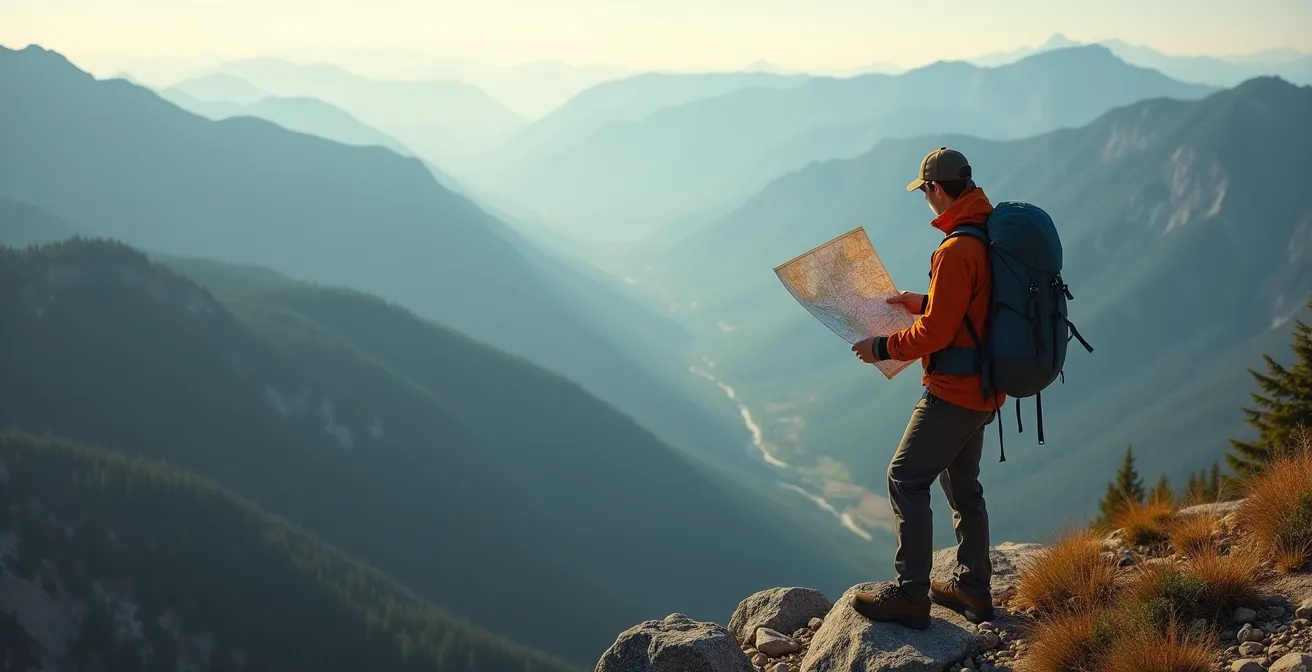
The transition to backcountry hiking is not about physical endurance, but about surviving the inevitable failure of your trail-based assumptions.
- Your phone’s GPS is not a primary navigation tool; it’s a liability. Mastering a map and compass is non-negotiable.
- Small judgment errors, like taking a “shortcut,” are the primary cause of search and rescue operations for lost hikers.
- Reducing pack weight must be achieved by systematically upgrading gear, not by compromising on essential safety equipment.
Recommendation: Before your first trip, perform an honest “dependency audit” to identify every park-based convenience you rely on and replace it with a personal skill or robust system.
The confidence you feel on a well-marked park trail is understandable. The path is clear, help is relatively close, and a cell signal is often just a short walk away. This environment builds comfort with hiking, but it also builds a deep-seated dependency on external systems. Many guides will tell you to “pack the ten essentials” or “tell someone your plan.” While this is sound advice, it misses the fundamental point of the backcountry transition.
The true shift from trail hiker to backcountry explorer is a mental one. It’s an acceptance of total self-reliance. The question is not “What do I bring?” but rather “What systems will I use when what I brought fails?” This is the perspective of a Search and Rescue volunteer, because we are called when systems—and the assumptions behind them—break down. This guide is not about having a pleasant walk; it’s about building the personal protocols and risk-assessment frameworks that prevent you from becoming a statistic.
This article will deconstruct the most common failure points encountered during this transition. We will analyze the flaws in modern navigation, the critical decisions in gear selection, the psychology of getting lost, and the unseen environmental dangers. The goal is to help you systematically replace trail-based dependencies with genuine backcountry competence, ensuring your adventures end at the trailhead, not in a rescue report.
To navigate this crucial transition, this guide is structured around the key areas where a hiker’s safety system is tested. We will cover the specific skills and mindset shifts necessary to move beyond marked paths and into the wild with confidence and competence. The following sections outline your roadmap to true self-reliance.
Summary: A SAR Volunteer’s Guide to Backcountry Self-Reliance
- Why Your Phone’s GPS Will Fail You in Deep Valleys?
- How to Read Contour Lines to Avoid Dangerous Cliffs?
- Heavy Boots vs. Trail Runners: Which Is Better for Long Distances?
- The “Short Cut” Mistake That Leads Hikers Off-Trail Forever
- Problem & Solution: Shaving Pounds Off Your Pack Without Ditching Safety Gear
- How to Petition Your City Council for a Community Garden?
- The Dry Air Trap That Dehydrates You Faster Than Heat
- How to Get Into Nautical Sports Without Breaking the Bank?
Why Your Phone’s GPS Will Fail You in Deep Valleys?
The single most dangerous assumption a transitioning hiker makes is that their smartphone is a reliable navigation tool. From a search and rescue perspective, over-reliance on consumer electronics is a primary catalyst for disaster. The GPS in your phone is designed for an urban environment with clear sky views; it is not a mission-critical device for the wilderness. The signal is weak and easily obstructed by the very terrain you seek to explore: deep canyons, dense forest canopies, and steep northern faces of mountains create vast “GPS shadows” where your device becomes useless.
Beyond signal loss, you face the predictable failure of the hardware itself. Batteries die, especially in cold weather. Screens crack. A brief submersion in water can render it inoperable. Treating your phone as anything other than a tertiary, bonus tool is a critical error in judgment. This is not a theoretical problem; it has measurable and tragic consequences.
Case Study: The Grand Canyon’s GPS Dead Zones
The challenging terrain of the Grand Canyon is a stark reminder of technology’s limits. The area accounts for over 1,000 missing person reports since 2018, with many incidents happening where GPS signals are completely blocked by the steep canyon walls. Hikers who depend solely on their phones find themselves disoriented and unable to call for help or even identify their position, turning a manageable situation into a life-threatening one. This demonstrates how reliance on a single, fragile system in complex terrain is a direct contributor to becoming lost.
The solution is not a better app or a bigger battery pack. The solution is to build a redundant navigation system where electronics are the last resort, not the first. This means mastering the tools that never run out of batteries: a topographic map and a compass. Your primary navigation must be analog. Your phone is for taking pictures and, if you are extremely lucky, calling for help once you have safely navigated back to civilization using real skills.
How to Read Contour Lines to Avoid Dangerous Cliffs?
Once you accept that a map and compass are your lifelines, you must learn to speak their language. The most important vocabulary in that language is contour lines. A topographic map is a two-dimensional representation of a three-dimensional world, and contour lines are what make this translation possible. Each line connects points of equal elevation. Understanding their patterns is the difference between choosing a safe ascent and walking toward an impassable cliff.
The concept is simple: the closer the contour lines, the steeper the terrain. When you see lines packed so tightly they almost merge into a single band, you are looking at a cliff or a very steep, dangerous slope. Conversely, lines that are spaced far apart indicate a gentle slope or relatively flat ground. This visual information allows you to “see” the landscape before you even set foot on it. You can identify ridges (U- or V-shaped lines pointing downhill), valleys or ravines (U- or V-shaped lines pointing uphill), and saddles (an hourglass shape between two peaks).

As the image above illustrates, this is not an abstract exercise. Tracing your intended route with a finger and observing how many contour lines you cross—and how quickly—is a core part of backcountry trip planning. It tells you where the climbs will be, where you can make good time, and most importantly, which areas to avoid entirely. Mastering this skill is a direct replacement for the convenience of a marked trail; you are creating your own path by understanding the very shape of the earth.
Heavy Boots vs. Trail Runners: Which Is Better for Long Distances?
Footwear choice is a frequent and contentious debate, but from a safety and systems perspective, the answer is less about the shoe and more about the load it must support. A hiker’s body, gear, and footwear are an interconnected system. The transition from heavy boots to lightweight trail runners is a milestone for many, but attempting it prematurely can lead to instability, twisted ankles, and trip-ending injuries. The primary factor in your decision should be your total pack weight relative to your body weight.
Heavy, supportive boots are designed to do the work your ankles can’t when you are carrying a heavy load. They act as an external support structure, protecting you from rolling an ankle under the weight of a multi-day pack. Trail runners, in contrast, offer minimal support and assume your ankles and legs are strong enough to provide stability on their own—a state most easily achieved with an ultralight pack.
The following table provides a clear framework for making this decision, based on analysis from experienced long-distance hikers. As an in-depth look at beginner mistakes shows, matching your footwear to your load is a fundamental safety principle.
| Pack Weight | Recommended Footwear | Key Considerations |
|---|---|---|
| Under 15% body weight | Trail Runners | Lightweight, fast-drying, less ankle support needed |
| 15-20% body weight | Hybrid Hikers | Moderate support, good for transition period |
| Over 20% body weight | Sturdy Boots | Maximum ankle support, essential for heavy loads |
Many successful hikers follow a progressive transition strategy. They begin their backcountry careers with sturdy boots to support the heavier packs common among beginners. As their skills grow and they learn to lighten their load, they move to a hybrid shoe. Finally, once their base pack weight is consistently low and their ankle strength is high, they graduate to trail runners for fast and light travel. This systematic approach minimizes risk while allowing for adaptation and skill development.
The “Short Cut” Mistake That Leads Hikers Off-Trail Forever
One of the most common threads in search and rescue reports is the seemingly innocuous decision to take a shortcut. This single error in judgment is a more frequent cause of a hiker becoming lost than injury or gear failure. The temptation is understandable: you see what appears to be a more direct route, you feel tired, and you convince yourself it will save time and energy. In reality, you are stepping off a known system (the trail) and into an unknown one, instantly multiplying your risk.
What looks like a simple walk through the woods from a distance can quickly become an impassable thicket, a hidden swamp, or the edge of a ravine. Disorientation happens fast. When you try to turn back, the trail is no longer visible. Every direction looks the same. Panic begins to set in, further impairing judgment. This is the classic scenario that leads to a rescue call. In fact, according to wilderness rescue data, a large portion of rescues are not for injuries, but for hikers who are simply lost after making a small navigational error.
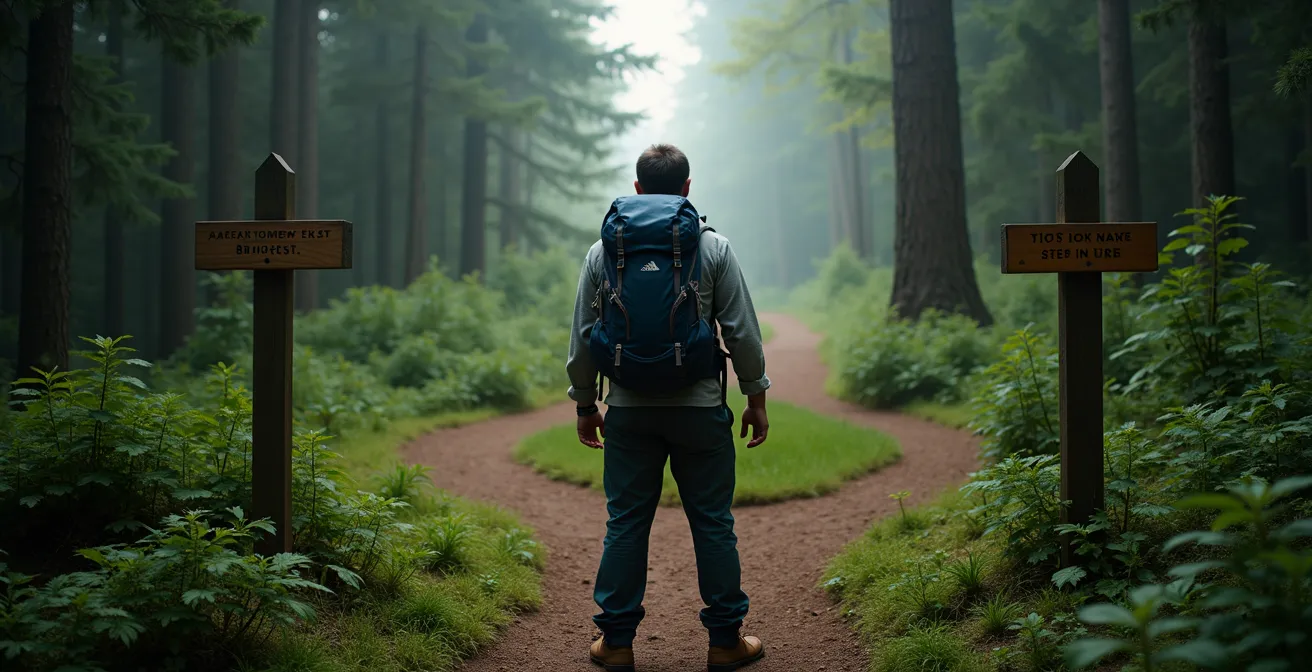
The moment of temptation, as shown above, is the most critical point. Your first line of defense is a rigid mental protocol. The moment the thought “I’ll just cut through here” enters your mind, you must stop. Experienced hikers use a mental checklist to override this dangerous impulse. The National Park Service provides guidance that forms the basis of this rule:
- Stop immediately. Do not take another step toward the shortcut.
- Hydrate and rest. Poor judgment is often a symptom of fatigue or dehydration.
- Consult your map. Identify exactly where you are and what known hazards (cliffs, swamps, dense vegetation) lie between you and your intended destination.
- State the risks vs. gains aloud. Articulating the decision forces you to confront the reality: the potential gain is a few minutes, while the potential risk is becoming dangerously lost.
- When in doubt, stick to the trail. This is the default, non-negotiable choice.
Problem & Solution: Shaving Pounds Off Your Pack Without Ditching Safety Gear
As you gain experience, the desire to lighten your pack becomes overwhelming. A lighter pack means more miles, less fatigue, and more enjoyment. However, the beginner’s mistake is to achieve this by leaving critical safety gear at home. Ditching the rain shell, the first-aid kit, or the emergency shelter to save a few pounds is a fool’s bargain. The professional approach is not to subtract, but to substitute. You reduce weight by systematically replacing heavier items with lighter, more efficient, and often multi-functional alternatives.
The most effective strategy is to focus on the “Big Four”: your pack itself, your shelter, your sleeping bag, and your sleeping pad. These four items typically account for the majority of your base weight (the weight of your gear before adding consumables like food and water). A small weight saving in each of these categories adds up to a significant overall reduction.
To do this methodically, perform an audit of your current gear:
- Your Pack: Can you switch from a heavy-duty internal frame pack to an ultralight model? This alone can save 2-3 pounds.
- Your Shelter: Is your two-person tent overkill for a solo trip? Consider a single-wall tent, a bivy sack, or a simple tarp setup to save 1-2 pounds.
- Your Sleeping Bag: Down is lighter and more compressible than synthetic for the same temperature rating. Are you carrying a 0°F bag for a summer trip? Optimize for the expected conditions.
- Your Sleeping Pad: Inflatable pads are often heavier than closed-cell foam pads. Evaluate your comfort needs against the weight penalty.
Expert Strategy: The Multi-Use Gear System
Experienced ultralight hikers take this a step further by embracing a multi-use gear philosophy. Every item that can serve more than one purpose is a win. For example, trekking poles can be used as the structural poles for a tarp shelter. A bandana can serve as a pot holder, a pre-filter for water, and a bandage. A foam sleeping pad can double as a pack frame to provide rigidity and be cut down to serve as an emergency splint. This mindset allows for a dramatic reduction in carried weight without compromising on the functionality of a complete safety system.
How to Petition Your City Council for a Community Garden?
The skills required for civic engagement and backcountry survival are worlds apart. You cannot petition a mountain for a safer path or lobby a storm to pass you by. The only proposal that matters in the wild is the one you make to yourself: to fully accept the transition from a follower, who depends on marked trails and the possibility of rescue, to a self-reliant leader who is wholly responsible for their own safety. This is a fundamental shift in mindset, and it is the most important piece of gear you will ever carry.
This internal petition requires you to take active ownership of your competence. It is a commitment to continuous learning and honest self-assessment. As safety experts recommend, while hiking with a companion is safer, those who choose to go solo must adopt an even higher level of preparedness, including leaving meticulously detailed trip plans with trusted contacts. This is just one component of a much larger mental framework.
Adopting a leadership mindset involves several key commitments:
- Accept Full Responsibility for Navigation: You are the only one who can get yourself out. You cannot blame the map, the compass, or a companion if you become lost.
- Practice Skills Before You Need Them: Use your map and compass on familiar trails. Practice setting up your emergency shelter in your backyard, not during a surprise hailstorm.
- Learn to See Hazards, Not Just Scenery: This means identifying potential avalanche chutes in winter, assessing the true danger of a river crossing, and recognizing the signs of an impending thunderstorm.
- Develop Decision-Making Frameworks: Have pre-defined rules for when to turn back due to weather, when to rest, and how to handle an unexpected obstacle.
- Build Confidence Through Progressive Challenges: Your first backcountry trip should not be a 50-mile traverse. Start with a single overnight trip on a moderately-trafficked route and build from there.
The Dry Air Trap That Dehydrates You Faster Than Heat
While most hikers are aware of the dangers of dehydration from heat and exertion, many underestimate a more insidious threat: dry air, especially at altitude. In arid environments or at higher elevations, the air has very little moisture. Every time you exhale, your body loses a significant amount of water vapor to this dry air. You are dehydrating from the inside out, often without the obvious trigger of heavy sweating that you’d experience in a hot, humid climate.
This respiratory water loss is compounded by the fact that the sensation of thirst is often suppressed at higher altitudes. You may not feel thirsty, but your body is still losing fluids at an accelerated rate. Dehydration impairs physical performance, clouds judgment, and can be a primary contributor to more serious conditions like hypothermia and altitude sickness. As a rule, wilderness medicine experts advise that while hikers need about one liter of water for every 10 miles in normal conditions, that need can increase by 50% or more at high altitude or in very dry air.
Because you cannot rely on thirst alone, you must manage your water intake with a proactive system. This is not optional; it is a critical safety protocol.
- Pre-hydrate: Drink 16-20 ounces of water before you even start your hike.
- Hydrate on a Schedule: Set an alarm on your watch to remind you to drink a certain amount every hour, regardless of whether you feel thirsty.
- Maintain Salt Balance: Add electrolyte powders or tablets to your water. Water alone is not enough; you must replace the salts you lose through sweat and respiration to prevent hyponatremia.
- Monitor Your Output: A simple but effective check is to monitor your urine color at rest stops. Pale yellow is ideal; dark yellow or brown is a serious warning sign of dehydration.
- Plan Your Water Sources: Before your trip, use your topographic map to identify reliable rivers, streams, and lakes where you can filter and refill your water. Never assume water will be available.
Your Pre-Hike Hydration System Audit
- Water Capacity: Calculate your total water-carrying capacity (bottles, bladder). Does it meet the minimum requirement for the length and conditions of your trip, including a reserve?
- Purification Method: Inventory your water filter or purification tablets. Do you have a physical and chemical backup method (e.g., filter + iodine tablets)?
- Electrolyte Stock: Count your electrolyte packets. Do you have enough for every liter of water you plan to drink?
- Source Planning: On your map, circle all potential water refill points. Identify the longest stretch between sources and confirm you have the capacity to cross it.
- Pre-Hike Hydration: Plan to consume at least 16oz of water with electrolytes in the hour before you leave the trailhead. Write it into your morning plan.
Key Takeaways for a Safe Transition
- Master Analog Navigation: Your primary system must be a map and compass. Electronics are backups, not lifelines.
- Practice Judgment Under Pressure: The most dangerous moments are small decisions, like taking a shortcut. Develop strict mental rules to override temptation.
- Build Systems, Not Just Gear Lists: Approach gear, hydration, and learning as interconnected systems designed for redundancy and efficiency.
How to Get Into Nautical Sports Without Breaking the Bank?
A sailor doesn’t truly master the sea by simply buying a boat; they master it by learning from every voyage, every unexpected squall, and every navigational choice. Your journey into the backcountry requires the exact same discipline. The trip isn’t over when you get back to your car. The most critical phase of learning happens in the post-hike debrief, where you systematically analyze your performance to improve your systems for the next expedition.
This process of self-assessment is what separates the lucky from the competent. It’s a formal commitment to learning from your experience, both good and bad. Immediately after returning, while the details are still fresh, you should document the trip. This debrief turns every hike into a valuable training exercise.
Your post-hike debrief should cover several key areas:
- Navigation: Review your route. Were there any points of confusion or “close calls”? Why did they happen? How will you prevent them next time?
- Gear Performance: What worked well? What failed? Were there any items you carried but never used? Were there any you desperately needed but didn’t have?
- Timing and Pacing: How did your actual time compare to your planned time? Were your estimates for climbs or difficult sections accurate? This data will make future trip planning more realistic.
- Decision Making: Re-evaluate every major decision you made regarding weather, route changes, or camp selection. Given what you know now, would you have made the same choice?
This process of continuous improvement is part of a larger ethos of responsibility that extends beyond yourself to the environment and other visitors. A core tenet of the experienced backcountry traveler is the mastery and application of Leave No Trace principles. This is not simply about “packing out what you pack in”; it is a comprehensive ethical framework for interacting with the wild.
Field Application: Leave No Trace Principles
Successful implementation of Leave No Trace requires conscious study and practice. It encompasses seven core principles: planning ahead and preparing, traveling and camping on durable surfaces, disposing of waste properly (which includes burying human waste at least 200 feet from water sources), leaving what you find, minimizing campfire impacts (or forgoing them entirely), respecting wildlife from a distance, and being considerate of other visitors. Mastering these principles is the final step in the transition from a mere user of the backcountry to a responsible steward.
Your transition to the backcountry begins not on the trail, but with the preparation you do today. Start by conducting an honest audit of your skills and gear, and commit to mastering one new competency before your next adventure. True safety is not a product you can buy; it is a process you must own.