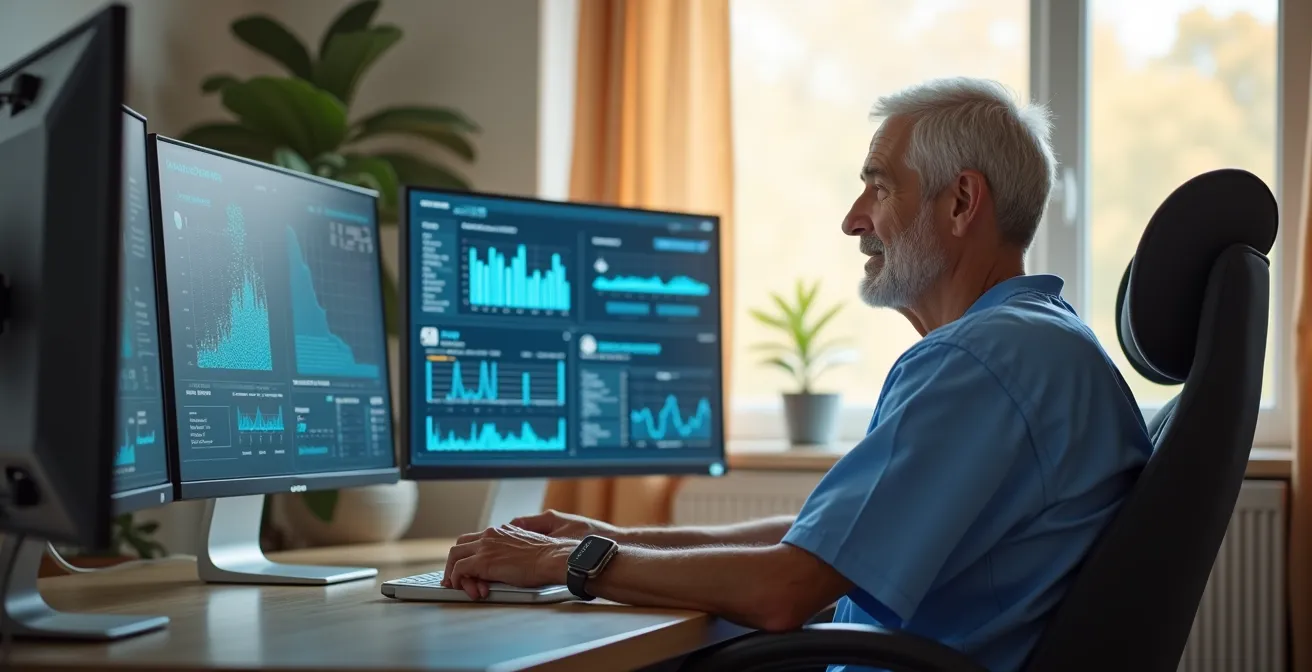
Telemedicine is more than convenience; it transforms you from a passive patient into the active, data-savvy manager of your own chronic condition.
- Success requires new skills: knowing when virtual care is insufficient, proactively protecting your medical data, and interpreting device readings without anxiety.
- The most effective digital health models augment, rather than replace, human clinicians, blending AI’s efficiency with a doctor’s empathy and judgment.
Recommendation: Embrace this shift by learning to use these tools as a way to partner with your doctor, turning your personal health data into better, more personalized treatment outcomes.
For anyone managing a chronic condition like diabetes or hypertension, the routine can be exhausting: the constant travel to clinics, the time spent in waiting rooms, and the feeling that your health is something managed in 20-minute increments. The promise of telemedicine—managing your health from the comfort of your home—seems like a straightforward solution. Many view it simply as a convenient way to replace physical appointments with video calls.
But this perspective misses the profound transformation underway. The real shift isn’t just about changing your location; it’s about changing your role. Telemedicine is evolving beyond simple consultations into a dynamic system of continuous monitoring, asynchronous communication, and AI-assisted care. This new paradigm positions you not as a passive recipient of care, but as an active, empowered partner in your own health journey. You become the manager of your own data, a crucial collaborator who brings real-world information to the clinical expertise of your doctor.
This increased responsibility, however, comes with a new set of challenges and critical questions. The convenience of technology introduces a new kind of “digital friction,” forcing you to become more discerning about the tools you use and the information you trust. This guide explores how to navigate this new landscape, examining the real limitations of virtual exams, the critical importance of data privacy, the safety of AI-driven advice, and the strategies to turn your health data into a powerful tool for better care, not a source of anxiety.
To navigate this evolution in healthcare, it’s essential to understand both the powerful opportunities and the hidden risks. The following sections break down the key areas where telemedicine is reshaping chronic disease management, providing the insights you need to become an effective digital health manager.
Summary: How Telemedicine Changes Your Role in Chronic Care Management
- Why a Video Call Cannot Replace a Physical Exam for Certain Symptoms?
- How to Ensure Your Health App Isn’t Selling Your Medical History?
- AI Chatbot vs. Nurse Hotline: Who Gives Safer Advice for Midnight Fevers?
- The “Cyberchondria” Loop: When Health Trackers Increase Your Anxiety
- Problem & Solution: Using Wearable Data to Help Your Doctor Adjust Medication
- How to Scan a Terms of Service Agreement for Red Flags in 2 Minutes?
- Why ChatGPT Can Solve the Equation but Can’t Explain the “Why”?
- How Does Genomic Testing Change Cancer Treatment Options for Patients?
Why a Video Call Cannot Replace a Physical Exam for Certain Symptoms?
The rapid adoption of telemedicine is undeniable. During the initial wave of the COVID-19 pandemic, Cleveland Clinic’s rapid telemedicine transformation saw virtual visits skyrocket, handling the majority of outpatient care. While this shift proved the model’s viability, it also highlighted a fundamental limitation: a screen cannot replicate the diagnostic power of touch. A physician can’t use a video call to palpate a tender abdomen, listen to a heart murmur, or feel for swollen lymph nodes. These tactile assessments are irreplaceable for diagnosing many conditions, from appendicitis to certain infections.
Recognizing this gap, leading institutions are developing sophisticated hybrid models. The goal is not to eliminate in-person visits but to make them more purposeful. This involves using virtual appointments for initial screenings, follow-ups, and managing stable conditions, while reserving physical exams for situations where they provide critical diagnostic value. For the patient, this means understanding that a video call is one tool in the toolbox, not a universal replacement.
Case Study: Mayo Clinic’s Advanced Team-Based Telemedicine
To bridge the gap left by the absence of a physical exam, Mayo Clinic pioneered a team-based virtual care model. During a video visit, the physician is supported by two medical assistants. One handles pre-visit work, such as reviewing medications and closing care gaps, while the other assists with documentation and placing orders in real-time. This structure ensures that even without a physical examination, the consultation is comprehensive, maintaining a high standard of care and continuity from beginning to end. It demonstrates how technology and teamwork can compensate for the inherent limits of virtual interactions.
As a patient, your role is to be a clear communicator. Describing your symptoms with precision—their location, intensity, duration, and what makes them better or worse—becomes even more critical. A well-managed telehealth system will use this information to triage your needs effectively, ensuring you receive a physical exam precisely when it’s needed most.
How to Ensure Your Health App Isn’t Selling Your Medical History?
In the new era of digital health management, your smartphone becomes a central hub for tracking everything from blood glucose levels to daily steps. While these apps offer incredible power to monitor your condition, they also open a Pandora’s box of privacy concerns. A common misconception is that all health data is protected by strict regulations like the Health Insurance Portability and Accountability Act (HIPAA). In reality, HIPAA only covers data held by healthcare providers and their business associates. Many popular wellness and health tracking apps fall outside this scope, operating under consumer protection laws that offer far weaker privacy guarantees.
This regulatory gap means that some apps may be legally permitted to anonymize, aggregate, and even sell your data to third parties, including marketers, data brokers, or research firms. Your seemingly private health history could become a commodity. This “digital friction” places a new responsibility on you, the patient-as-manager: you must become a discerning consumer of health technology, capable of vetting an app’s privacy practices before entrusting it with your most sensitive information.

Becoming data-literate in this context means learning to look beyond the user-friendly interface and scrutinize the underlying policies. An app’s permissions and its terms of service are where the truth lies. Does a diabetes app really need access to your contacts or location data? Is the privacy policy buried, or is it transparent and easy to find? The absence of a clear policy is a major red flag, suggesting the company prefers to keep its data practices in the shadows.
AI Chatbot vs. Nurse Hotline: Who Gives Safer Advice for a Midnight Fever?
It’s 2 A.M., and a sudden fever or a worrying symptom appears. In the past, your only option was a trip to the emergency room or waiting for morning. Today, you have instant access to advice. The two most common digital front doors are AI-powered chatbots and traditional 24/7 nurse hotlines. The question is, which one provides safer, more reliable guidance? AI chatbots offer instantaneous, data-driven triage, often at a very low cost. They are excellent at pattern recognition and can quickly process symptoms against a vast database of medical knowledge.
However, they lack the crucial human elements of empathy, intuition, and the ability to understand nuanced contexts. A human nurse can pick up on the anxiety in your voice, ask clarifying questions based on your unique history, and provide reassurance alongside medical advice. This is particularly vital in complex cases or when a patient is distressed. On the other hand, nurse hotlines can involve long wait times and are significantly more expensive to operate.
A third, more advanced model is now emerging: the “Augmented Nurse.” In this system, an AI chatbot performs the initial intake, gathering symptoms and basic information efficiently. This data is then passed to a human nurse, who enters the conversation already informed, allowing them to focus immediately on clinical judgment and patient care. This hybrid approach combines the best of both worlds—AI’s speed and a nurse’s expertise—representing the true future of remote triage.
The following table, based on industry analysis, breaks down the key differences between these models. Understanding these trade-offs is crucial for making an informed choice when you need immediate advice.
| Feature | AI Chatbot | Nurse Hotline | Augmented Nurse Model |
|---|---|---|---|
| Availability | 24/7 Instant | 24/7 with wait times | 24/7 Prioritized |
| Response Time | <1 minute | 5-30 minutes | 2-5 minutes |
| Empathy Level | Limited | High | High |
| Complex Cases | Struggles | Excellent | Excellent |
| Liability Clear | Unclear | Clear | Clear |
| Cost per Call | $0.50-2 | $15-50 | $8-20 |
The “Cyberchondria” Loop: When Health Trackers Increase Your Anxiety
Wearable devices and health trackers are marketed as tools of empowerment, giving you a constant stream of data about your body. For many, they are. But for some, this constant flow of information can trigger a vicious cycle of anxiety known as “cyberchondria.” Every minor fluctuation in heart rate, every less-than-perfect sleep score, or every blood pressure reading that’s slightly off-baseline can become a source of worry. Instead of feeling in control, you feel hyper-vigilant, constantly seeking reassurance from the data or searching for online diagnoses for every small deviation.
This anxiety is often amplified by the gamification elements built into many apps. Streaks, badges, and color-coded warnings (green for good, red for bad) are designed for engagement, but they can easily be misinterpreted as urgent health imperatives. A broken “perfect week” streak can feel like a health failure rather than a normal part of life. The patient-as-manager must develop a new kind of data literacy: the ability to see trends over individual data points and to separate a statistically significant change from meaningless noise.
Breaking this cycle isn’t about abandoning the technology, but about reframing your relationship with it. It requires moving from being a passive consumer of data to an active interpreter. Working with your doctor to set personalized alert thresholds is a critical step. This ensures you are only notified of changes that are genuinely meaningful for your specific condition. The goal is to make the technology serve you, not the other way around, turning your tracker from a source of anxiety into a calm, effective partner in managing your health.
Action Plan: Reclaiming Control from Health Anxiety
- Practice ‘sensation journaling’: Log your physical feelings alongside device readings to rebuild your innate body awareness and contextualize the data.
- Set specific ‘data check-in’ times: Instead of constant monitoring, limit yourself to checking your health data once or twice a day at scheduled times.
- Collaborate with your doctor: Ask them to help you customize alert thresholds on your devices to flag only truly significant changes for your condition.
- Recognize gamification: View elements like streaks, scores, and color codes as engagement tools designed by the app, not as absolute medical judgments.
- Schedule ‘device-free’ periods: Dedicate a day or a weekend to being without your tracker to reconnect with your body’s natural signals without digital mediation.
Problem & Solution: Using Wearable Data to Help Your Doctor Adjust Medication
One of the biggest challenges in managing chronic illnesses like diabetes or hypertension is the slow, reactive process of medication adjustment. Typically, a patient visits their doctor every three to six months. Based on a few readings taken in the clinic and a patient’s self-reported data, the doctor makes a dosage change. It can take months, or even years, of these incremental adjustments to find the optimal therapeutic level. This process is inefficient and leaves the patient in a sub-optimal state for long periods.
This is where telemedicine, combined with wearable technology, offers a revolutionary solution. Continuous glucose monitors (CGMs), smart blood pressure cuffs, and other devices provide a constant stream of real-world data, painting a far more accurate picture of a patient’s condition than a few isolated readings ever could. This data can be transmitted directly to the healthcare team, enabling a proactive and nearly continuous model of care.
Case Study: Cleveland Clinic’s Asynchronous Medication Titration
A groundbreaking asynchronous telemedicine workflow at Cleveland Clinic exemplifies this new model. Continuous glucose monitors automatically flag concerning patterns over a three-day period. This triggers an alert to a dedicated nurse, who reviews the data in the context of the patient’s records. The nurse then summarizes the findings and proposes a medication adjustment to the physician. The physician reviews the recommendation and can approve the new insulin dosing directly through the patient portal—all without requiring a synchronous video or in-person visit. This “tele-titration” process has dramatically reduced the time it takes to reach optimal dosing from months to mere weeks.
This asynchronous workflow represents a fundamental shift in chronic care. It moves management from a series of disjointed appointments to a continuous, collaborative process. As a patient, your role is to ensure the data flows reliably, while your clinical team uses that data to make timely, precise adjustments. It’s the ultimate expression of the patient-provider partnership, powered by technology.
How to Scan a Terms of Service Agreement for Red Flags in 2 Minutes?
Let’s be honest: almost no one reads the full Terms of Service (ToS) for a new app or service. These documents are notoriously long, dense, and filled with legal jargon. However, when it comes to a health app where you’re sharing sensitive medical data, blindly clicking “I Agree” is a significant risk. The good news is that you don’t need a law degree to spot the most serious red flags. A strategic, two-minute scan can reveal most of what you need to know about how a company intends to use your information.
The key is to use the “Find” function (Ctrl+F on Windows, Cmd+F on Mac) to search for specific keywords. These terms are often associated with clauses that compromise your privacy or your legal rights. Rather than reading every word, you’re performing a targeted search for potential problems. This method turns an overwhelming task into a manageable checklist, empowering you to make a quick yet informed decision about whether an app is trustworthy.
Here are the critical keywords to search for and what they might signify:
- “Third party” / “Affiliates”: These terms reveal if the company shares your data with other entities. More than a few mentions suggest extensive data sharing networks.
- “Sell” / “Transfer”: Any mention of these words near “data” or “information” is a major warning sign that your data could be commercialized.
- “Anonymize”: While it sounds good, this term is often followed by language that gives the company broad rights to use your “anonymized” data, which can sometimes be re-identified.
- “Marketing” / “Promotional”: This indicates your data may be used to target you with advertising, either from the company or its partners.
- “Arbitration”: The presence of a mandatory arbitration clause means you give up your right to sue the company in court if a dispute arises, such as in the event of a data breach.
As one expert in a guide on telehealth security best practices notes, transparency is paramount.
If you can’t find the privacy policy easily, assume the worst.
– Healthcare IT Security Expert, Telehealth Security Best Practices Guide
Why ChatGPT Can Solve the Equation but Can’t Explain the “Why”?
The rise of Large Language Models (LLMs) like ChatGPT has introduced a powerful new tool into the healthcare landscape. These AIs can process vast amounts of text, answer complex medical questions, and even draft clinical notes with impressive speed. For a patient managing a chronic condition, they can seem like an omniscient medical resource, available 24/7. However, it is crucial to understand their fundamental limitation: these models are masters of pattern recognition, not genuine comprehension. They can tell you *what*, but they can’t truly explain *why*.
An AI can analyze millions of data points and conclude that a certain medication adjustment leads to better outcomes for patients with a specific profile. What it cannot do is explain the clinical reasoning behind that adjustment in the context of an individual’s life. It doesn’t understand your lifestyle, your personal values, your family situation, or the side effects you find intolerable. This is the “black box” problem of AI in medicine: it can produce a correct answer without being able to articulate the human-centric reasoning that is the bedrock of good clinical practice.

Case Study: The AI “Black Box” in Chronic Disease Management
An AI-enabled platform from Johns Hopkins Medicine achieved impressive results in diabetes care, demonstrating significant reductions in HbA1c levels by recognizing patterns in patient data. However, the platform highlights the core AI limitation. Unlike a human clinician who can say, “I recommend we adjust your insulin because your glucose spikes after your morning run, and we need to account for that activity,” the AI cannot articulate its reasoning process. It identifies a correlation but lacks the clinical judgment to connect it to a patient’s lived experience, illustrating the critical gap between algorithmic output and true medical understanding.
As a patient-manager, the safest way to use these AI tools is as a starting point for a conversation with your doctor, not as a replacement for one. Use them to gather information, formulate better questions, and understand your condition, but always rely on your human healthcare provider for the final, contextualized medical judgment.
Key Takeaways
- Telemedicine’s success depends on the patient becoming an active, data-literate health manager, not a passive recipient of care.
- Your health data privacy is not guaranteed by default; you must proactively vet apps and understand their terms to protect your medical history.
- The best digital tools augment, rather than replace, human expertise, combining AI’s efficiency with a clinician’s judgment and empathy.
How Does Genomic Testing Change Cancer Treatment Options for Patients?
The principles of personalized, data-driven healthcare find their ultimate expression in the field of genomics, particularly in cancer treatment. For decades, cancer was treated based on its location in the body (e.g., lung cancer, breast cancer). Today, genomic testing allows oncologists to treat it based on its unique genetic makeup. This represents a paradigm shift from a one-size-fits-all approach to truly personalized medicine, where treatment is tailored to the specific DNA mutations driving a tumor’s growth.
Genomic testing, also known as tumor sequencing, analyzes a sample of the tumor to identify specific genetic alterations. For a patient, discovering that your tumor has a specific mutation, like EGFR in lung cancer or HER2 in breast cancer, can open the door to highly effective targeted therapies. These drugs are designed to attack cancer cells with those specific mutations, often resulting in better outcomes and fewer side effects compared to traditional chemotherapy, which affects all fast-growing cells in the body.
Furthermore, this field extends to pharmacogenomics—the study of how your own genes affect your body’s response to medications. A genomic test can predict whether you are likely to have a severe reaction to a certain chemotherapy drug or whether a standard dose will be effective for you. This allows doctors to select the right drug at the right dose from the very beginning. By transforming cancer from a location-based disease into a genetic one, this technology places your unique biological data at the very center of your treatment plan, embodying the future of proactive, personalized chronic disease management.
The journey into digital health management is an ongoing process of learning and adaptation. To become a truly empowered partner in your own care, the first step is to open a dialogue. Begin your transition by discussing these digital tools, privacy concerns, and data-driven strategies with your healthcare provider to build a collaborative and effective treatment plan for your future.