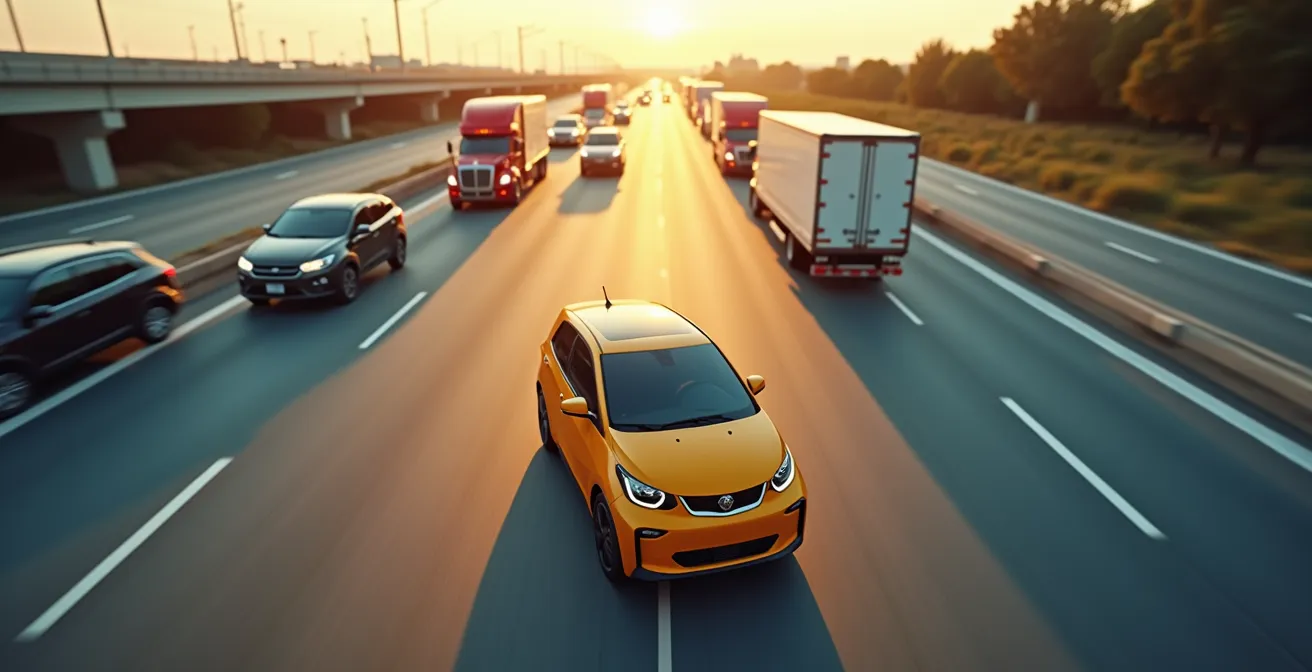
The 5-star safety rating you rely on can be dangerously misleading for a small city car in a real-world highway collision.
- Physics is not on your side; the “mass disparity” between a small car and a larger vehicle like an SUV or truck is the single biggest factor in crash severity.
- Proactive safety technology that prevents a crash, like Autonomous Emergency Braking (AEB), is far more important than features that only protect you during one.
Recommendation: Prioritize evaluating a car’s proactive safety systems and driver visibility above all else, and understand that every safety design involves a compromise.
As a parent, the thought of your teenager driving on the highway for the first time is a uniquely stressful milestone. When the car in question is a small, fuel-efficient city car, that anxiety is amplified. You’ve likely been told to look for a vehicle with a 5-star safety rating, assuming it’s a guarantee of protection. This is the conventional wisdom, the platitude repeated by dealers and reviewers alike. It feels like a simple, reliable metric in a complex and emotional decision.
But what if that rating, while well-intentioned, doesn’t tell the whole story? What if the real key to your child’s safety isn’t found in a crash test score, but in understanding the unyielding laws of physics and the hidden trade-offs of modern car design? As a crash safety analyst, I can tell you that for a small vehicle, the most important safety feature isn’t the one that helps you survive a collision—it’s the one that helps you avoid it entirely. The difference between a close call and a catastrophe often lies in technologies and design choices that are rarely discussed on the showroom floor.
This guide will move beyond the star ratings to give you a framework for thinking like a safety engineer. We will deconstruct the physics of a crash involving vehicles of different sizes, identify the proactive technologies that truly matter, and reveal the systemic compromises in car design that can create new dangers while solving old ones. The goal is to equip you not with a list of “safe cars,” but with the critical knowledge to assess any small car’s real-world survival capabilities for yourself.
To help you navigate these critical concepts, this article breaks down the essential safety considerations, from the limitations of crash ratings to the subtle design flaws you need to be aware of.
Summary: Are Modern City Cars Safe Enough for Highway Travel?
- Why a 5-Star Rating Doesn’t Always Save You in a Collision With a Truck?
- How to Verify if a Used City Car Has Autonomous Emergency Braking?
- Smart Car vs. Compact Crossover: Which Is Truly Safer in Urban Crashes?
- The Pillar Design Error That Hides Pedestrians in Modern Small Cars
- Problem & Solution: Fitting Rear-Facing Seats in Subcompacts Without Moving the Driver
- How to Configure Fall Detection Sensors Without Invading Privacy?
- The Center of Gravity Physics That Make SUVs Prone to Tipping
- Why Does Your Hybrid Car Not Achieve the Advertised MPG in Real Driving?
Why a 5-Star Rating Doesn’t Always Save You in a Collision With a Truck?
A 5-star crash test rating feels like an impenetrable shield of safety, but it’s crucial to understand what it actually measures. These tests are typically conducted by crashing a vehicle into a fixed barrier or a sled of a similar mass. This provides a standardized measure of a car’s structural integrity and restraint systems. However, a highway is not a controlled lab. On the road, the most significant danger to a city car is the immutable law of physics known as mass disparity.
When a 2,500-pound city car collides with a 5,000-pound SUV—or worse, an 80,000-pound semi-truck—the energy transfer is catastrophically unequal. The smaller, lighter vehicle will experience a much more violent change in velocity, subjecting its occupants to extreme forces, regardless of its star rating. The larger vehicle effectively acts like a brick wall. A car can have a perfectly engineered passenger cell that holds up in a test, but it’s little defense against being driven under the trailer of a large truck in what’s known as an underride collision.
Case Study: IIHS Testing Reveals Guard Failures at Real-World Speeds
In 2010, the Insurance Institute for Highway Safety (IIHS) conducted a sobering test, crashing Chevrolet Malibu sedans into semi-trailers equipped with federally-compliant rear underride guards. Even at a speed of just 35 mph, the guards, which were designed to prevent this exact scenario, failed catastrophically. The test revealed that guards meeting the 1998 federal standard were woefully inadequate for real-world conditions, allowing for severe underride that would be unsurvivable for front-seat occupants. This highlights a critical gap between regulated safety and real-world physics, as confirmed by a ProPublica investigation into these guard failures.
This doesn’t mean safety ratings are useless, but for a small car on the highway, they must be seen as the last line of defense, not the first. The primary goal must shift from surviving a crash to avoiding it altogether.
How to Verify if a Used City Car Has Autonomous Emergency Braking?
Given the physics of mass disparity, the single most important safety technology for a city car is one that prevents a collision from happening in the first place. This is where Autonomous Emergency Braking (AEB) comes in. Using cameras and radar sensors, AEB systems monitor the road ahead, warn the driver of an impending collision, and can automatically apply the brakes if the driver doesn’t react in time. For an easily distracted teenage driver, this technology is not a luxury; it’s a necessity that acts as a digital co-pilot.

The effectiveness of this proactive safety system is well-documented. Research from the IIHS shows that vehicles equipped with forward collision warning and AEB have significantly fewer front-to-rear crashes. However, especially in the used car market, it’s not always clear if a specific vehicle has this feature, as it was often an optional extra. You cannot rely on a salesperson’s word; you must verify it yourself.
Action Plan: How to Verify AEB in a Used Car
- Decode the VIN: Use the VIN decoder on the National Highway Traffic Safety Administration (NHTSA) website. This will identify the vehicle’s exact model year and trim level, which is the first step to knowing its original specifications.
- Consult the Brochure: Search online for the manufacturer’s original PDF brochure for that specific model year and trim. This document will state definitively whether AEB was included as standard equipment or was part of an optional technology package.
- Perform a Physical Inspection: Look for the hardware. Check for a camera module near the rearview mirror and/or a smooth, glossy radar panel in the center of the front grille. Finally, navigate through the car’s infotainment or dashboard settings menu to find and confirm the functionality is present and enabled.
Taking these steps ensures you are buying a car equipped with a life-saving proactive system, which is the first and most critical step in the hierarchy of survival.
Smart Car vs. Compact Crossover: Which Is Truly Safer in Urban Crashes?
The debate between a micro-car and a compact crossover often centers on a false dichotomy: the crossover’s perceived safety due to its size versus the city car’s efficiency. A parent’s instinct might be to choose the heavier compact crossover, assuming its extra mass provides more protection. However, different vehicle types embody fundamentally different safety philosophies, each with its own advantages and disadvantages, especially in the chaotic urban environment where most driving occurs.
The following table, based on principles outlined in IIHS Top Safety Pick evaluations, contrasts these two approaches. The Smart Car, for example, relies on its “Tridion safety cell,” a high-strength steel cage designed to maintain occupant survival space (passive safety). A compact crossover relies more on its higher driving position for better visibility (proactive safety) and its mass advantage in a collision.
| Safety Aspect | Smart Car | Compact Crossover |
|---|---|---|
| Primary Safety Philosophy | Passive – Tridion safety cell | Proactive – Higher driving position |
| Crash Test Performance | Good in small overlap (lightweight advantage) | Variable based on model |
| Evasive Maneuver Capability | Excellent – tiny footprint, tight turning radius | Limited – higher center of gravity, rollover risk |
| Impact on Other Road Users | Lower severity – softer front end | Higher severity – tall, blunt front |
| Mass Advantage in Collision | Disadvantage – lighter weight | Advantage – heavier vehicle |
What this reveals is a series of trade-offs. The crossover’s mass is an advantage in a crash with a smaller car, but its higher center of gravity makes it more susceptible to rollovers—a particularly deadly type of accident. Conversely, the Smart Car’s tiny footprint and tight turning radius give it superior evasive maneuverability, making it easier to dodge a hazard in the first place. The truly safer car is the one that best fits the driver’s ability to leverage its strengths and mitigate its weaknesses.
The Pillar Design Error That Hides Pedestrians in Modern Small Cars
Sometimes, a safety feature designed to solve one problem inadvertently creates another. This is a perfect example of a systemic compromise in automotive design, and one of the most dangerous is the modern A-pillar—the post that frames the windshield on either side. Decades ago, these pillars were thin, offering a wide, panoramic view. Today, they are thick, obscuring, and a significant safety hazard in their own right.
Why the change? It stems from federal regulations mandating stronger roofs to protect occupants in a rollover crash. To meet these roof-crush standards, engineers had to dramatically thicken and reinforce the A-pillars. This improved passive safety in one specific, rare type of crash, but at a severe cost to active safety in every other driving scenario. As a leading safety organization notes, this design choice has had profound consequences.
Roof-crush strength regulations forced the creation of thick pillars, improving passive safety in rollovers, but this came at the direct cost of active safety through reduced driver visibility in every other driving scenario.
– IIHS Vehicle Research Center, Insurance Institute for Highway Safety Testing Analysis
These thick pillars can create a blind spot large enough to completely hide a pedestrian, a cyclist, or even another car at an intersection. For an inexperienced driver, what they can’t see is a direct threat. Fortunately, there is a simple driving technique that can be taught to mitigate this design flaw.
- Before any turn or lane change, physically move your head forward about 6 inches.
- Then, lean back 6 inches to effectively look “around” the A-pillar from a different angle.
- This “Rock and Roll” motion creates two distinct lines of sight, revealing objects that were hidden.
- Practice this simple movement until it becomes an automatic reflex, especially when approaching intersections.
- Always perform this physical check, even if your mirrors appear to be clear.
Problem & Solution: Fitting Rear-Facing Seats in Subcompacts Without Moving the Driver
While this title often refers to the challenge of installing bulky child seats, the underlying problem is a universal one for subcompacts: the critical compromise of interior space and driver positioning. For a teenage driver, the “cargo” is not a baby seat, but friends, sports equipment, and backpacks. A small car packed with passengers and gear can force the driver to adjust their seat to an unsafe position, pushed too far forward and too close to the steering wheel and pedals.
This is not a matter of comfort; it’s a critical safety issue. An improper driving position compromises the driver’s ability to control the vehicle effectively during an emergency maneuver. More importantly, it dramatically alters their interaction with the car’s primary restraint system: the airbag. Airbags are designed to deploy with explosive force in mere milliseconds, creating a protective cushion. They are engineered to work in concert with a properly tensioned seatbelt for a driver seated at an optimal distance.
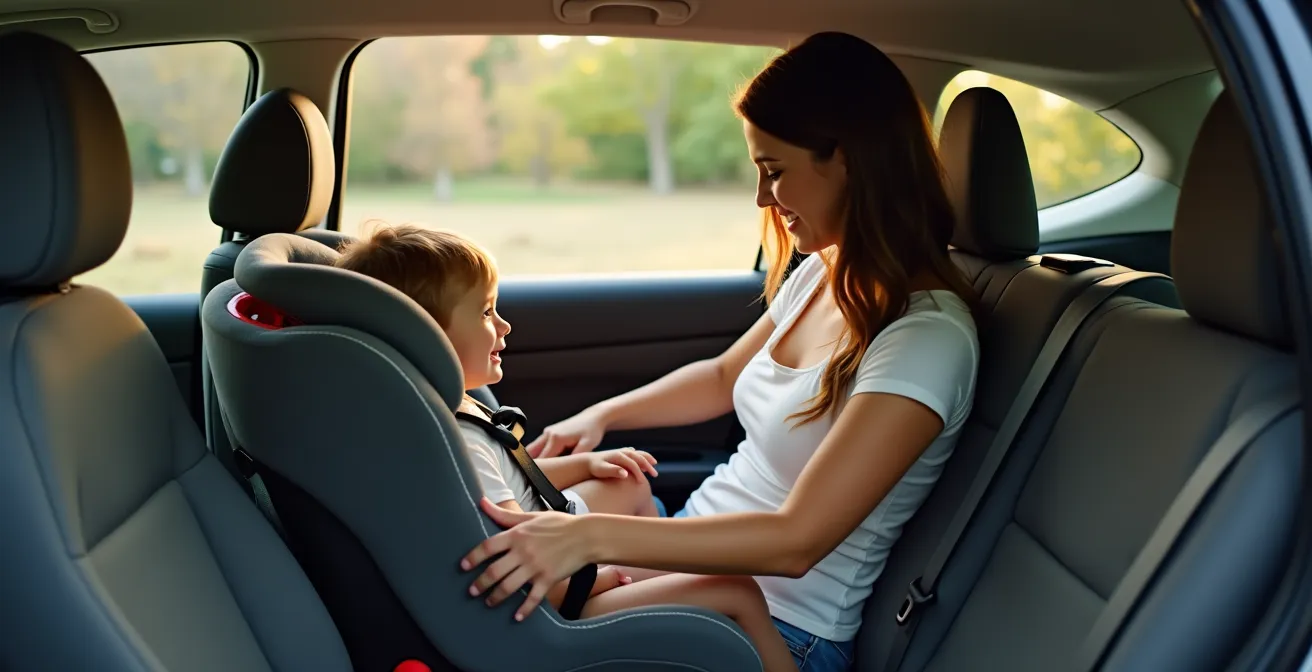
If a driver is positioned too close to the steering wheel, they risk striking the airbag module as it deploys, which can cause severe or even fatal injuries. The safety system designed to save them becomes a hazard. It is therefore imperative to teach a new driver that the first step of any journey is to establish a correct and safe driving position, even if it means limiting the number of passengers or amount of cargo. The driver’s survival space and control always take priority over convenience.
How to Configure Fall Detection Sensors Without Invading Privacy?
The term “fall detection” might evoke images of medical alert systems for the elderly, but in the automotive world, its closest equivalent is the Driver Monitoring System (DMS). This technology is, in effect, a “fall asleep” detector. Using small, infrared cameras aimed at the driver, a DMS tracks eye closure, head position, and gaze to determine if the driver is drowsy or distracted. If it detects signs of inattention, it will issue audible and visual alerts to refocus the driver on the road.
For a parent of a teenager prone to late nights or smartphone temptations, a DMS can be a powerful safety net. However, this technology also raises an immediate and valid question: privacy. The idea of a camera constantly watching your child is unsettling. Parents worry about what data is being recorded, where it’s stored, and who might have access to it. Fortunately, most modern DMS systems are designed with these privacy concerns in mind. As NHTSA’s data-driven approach to reducing fatalities evolves, these systems become more common.
These systems are a direct response to the persistent danger of distracted and drowsy driving, which remains a leading cause of crashes. By intervening before a moment of inattention becomes a tragedy, a DMS serves as another vital layer in the proactive safety onion. It’s not about surveillance; it’s about providing a crucial, real-time alert when a driver’s focus wavers.
The Center of Gravity Physics That Make SUVs Prone to Tipping
In a head-on collision, a city car is at a disadvantage due to its lower mass. However, in almost every other scenario, its low center of gravity (CoG) provides a significant stability advantage over taller vehicles like SUVs and crossovers. Physics dictates that an object with a higher CoG is inherently less stable and more susceptible to tipping or rolling over when subjected to sharp, lateral forces—such as swerving to avoid an obstacle or experiencing a tire blowout at speed.
This inherent stability is a massive, often-overlooked safety advantage for smaller cars. It works in tandem with modern proactive safety systems like Electronic Stability Control (ESC). An ESC system can brake individual wheels to correct a skid or prevent a loss of control, but it works far more effectively when the vehicle’s natural physics are on its side. Testing by the IIHS shows that the low CoG of a small car gives the ESC system a greater margin for error, resulting in smoother, more effective interventions that can prevent a rollover, which accounts for a shocking number of passenger vehicle fatalities.
However, this natural advantage can be easily compromised. A new driver might not realize that loading a roof rack with heavy items like bicycles or a cargo box dramatically raises the car’s center of gravity, making it behave more like a top-heavy SUV. It’s critical to respect the vehicle’s design limits.
Checklist: Preserving a Small Car’s Low Center of Gravity
- Respect the Limit: Never exceed the roof rack’s specified weight limit, which is typically only 75-100 lbs for small cars.
- Distribute Evenly: When using a roof rack, ensure the weight is distributed evenly across the roof to maintain the car’s balance.
- Adjust Your Speed: Reduce highway speeds by 10-15% when carrying any cargo on the roof, as this significantly alters handling dynamics.
- Remove When Unused: Always remove roof boxes, bike racks, and other carriers when they are not in use to restore the car’s natural low CoG.
- Consider Alternatives: For carrying extra gear, a trailer hitch cargo carrier is a far safer alternative as it keeps the weight much lower.
Key Takeaways
- Physics Over Ratings: In a highway crash with a larger vehicle, a small car’s low mass is the single most important risk factor, a reality that star ratings do not fully capture.
- Prevention is the Priority: Proactive safety technologies like Autonomous Emergency Braking (AEB) and good driver visibility are your first and most effective lines of defense.
- Every Feature is a Compromise: Be aware of systemic trade-offs. Stronger pillars for rollover protection create dangerous blind spots, and fuel-saving “Eco” modes can dangerously reduce throttle response needed for emergency maneuvers.
Why Does Your Hybrid Car Not Achieve the Advertised MPG in Real Driving?
On the surface, this question seems to be about fuel economy, not safety. But in the world of automotive design, the two are often linked by compromise. Many modern cars, especially hybrids and EVs, feature selectable driving modes like “Eco Mode,” designed to maximize miles per gallon (MPG) by altering the car’s performance characteristics. While this is great for your wallet and the environment, it can introduce a subtle but significant safety risk.
To save fuel, Eco Mode typically dulls the throttle response, requiring more pedal input to achieve acceleration. It may also program the transmission to shift into higher gears sooner. In normal, relaxed driving, this is perfectly fine. However, on a highway surrounded by fast-moving traffic and large trucks, this dulled response can be incredibly dangerous. A driver might need a sudden burst of acceleration to merge safely into a gap in traffic or to quickly move out of another vehicle’s blind spot. In that critical moment, a delayed or sluggish throttle response can be the difference between a safe maneuver and a collision.
This is yet another systemic compromise that a new driver must be made aware of. The mode that seems the most responsible can, in the wrong situation, remove a vital tool for accident avoidance.
Eco Mode often dulls throttle response to save fuel, which can be extremely dangerous when trying to merge quickly or accelerate out of a large truck’s blind spot on the highway.
– Cathy Chase, Advocates for Highway and Auto Safety
The lesson for a new driver is clear: while Eco Mode is fine for city driving, they should select “Normal” or “Sport” mode when entering the highway. This ensures the car’s full acceleration potential is immediately available, prioritizing their ability to react over maximizing fuel efficiency.
Frequently Asked Questions about Are Modern City Cars Safe Enough for Highway Travel?
Do driver monitoring systems record video of occupants?
Most modern DMS systems process data locally within the car’s computer and only trigger alerts without recording or transmitting video footage.
Can insurance companies access my driver monitoring data?
Some usage-based insurance programs may request access to distraction event data in exchange for discounts, requiring explicit consent from the driver.
What’s the difference between DMS and traditional dashcams?
DMS uses infrared sensors to monitor eye closure and head position for safety alerts, while dashcams record external road footage for evidence purposes.