
Contrary to popular belief, a fulfilling intellectual journey isn’t about seeing more sights, but about building a “perceptual framework” before you go. The most enriching travel is an active process of curating context—from reading lists to podcasts—that transforms passive observation into deep, meaningful learning and fundamentally rewires your brain.
For many, travel has become a frantic exercise in “checklist tourism.” We rush from one monument to the next, phone in hand, capturing proof of our presence but rarely the essence of the place. The standard advice—buy a guidebook, visit the top museums, get off the beaten path—often leads to a travel experience that feels wide but shallow, leaving a sense of unfulfilled curiosity. You’ve seen the sights, but have you truly understood them? You’ve collected photos, but have you collected insights?
The frustration is valid. It stems from a fundamental misunderstanding of what makes travel meaningful. A trip’s intellectual depth is not determined by the destinations on your itinerary, but by the mental preparation you undertake before you even leave home. The real journey is a cognitive one, a deliberate structuring of your own perception to see beyond the surface of things. It’s about building a narrative scaffold that allows every street corner, every painting, every local interaction to resonate with layers of meaning.
But what if the key wasn’t simply to see more, but to see *differently*? What if you could plan a trip designed not just for enjoyment, but for genuine neural adaptation? This guide abandons the superficial for the structural. We will explore a methodology for transforming travel from passive consumption into an active, enriching act of deep learning. We’ll delve into the neuroscience of cultural immersion, construct a framework for building preparatory knowledge, and learn to navigate the complex landscape of cultural authenticity, turning every journey into a profound educational experience.
This article provides a complete framework for this new approach to travel. The following sections are designed to guide you step-by-step, from the scientific principles of learning to the practical tools for cultural engagement.
Summary: A Guide to Intellectually Stimulating Travel
- Why Learning a New Culture Improves Neuroplasticity in Adults?
- How to Build a Reading List Before Visiting a Historic City?
- Static Museum vs. Living History Site: Which Offers Better Insight?
- The “Authentic” Experience Trap That Is Actually Staged for Tourists
- Problem & Solution: Curating Your Own Audio Tour Using Podcasts
- Why a Robot Pet Can Reduce Dementia Anxiety Without Vet Bills?
- Why Human Brains Can Only Appreciate Art for 90 Minutes?
- How to Break the “Tourist Bubble” and Connect With Locals?
Why Learning a New Culture Improves Neuroplasticity in Adults?
The desire for intellectual travel is more than a preference; it’s an intuitive drive to engage one of the brain’s most vital functions: neuroplasticity. This is the brain’s remarkable ability to reorganize itself by forming new neural connections throughout life. While often associated with childhood development, adult neuroplasticity is a powerful engine for cognitive health, and cultural immersion is one of its most potent fuels. When you step into a new culture, your brain is forced out of its habitual, energy-saving routines. Navigating unfamiliar social cues, deciphering a new language, and adapting to different rhythms of life all act as an intense workout for your neural circuits.
This isn’t just a theory; it is a well-documented neurological phenomenon. A systematic review of 80 peer-reviewed studies confirms that adults in multicultural environments demonstrate significant and measurable neural adaptation. The process of “acculturation” actively challenges the brain, forcing it to become more flexible, resilient, and better at complex problem-solving. This cognitive dissonance is where the magic happens; your brain is literally rewiring itself to accommodate new models of the world.

Consider the concrete evidence from a study on language acquisition, a core component of cultural learning. In a notable case study, American college students undergoing intensive Chinese language courses showed greater changes in their brain’s white matter—the “wiring” that connects different brain regions—compared to a control group. This demonstrates that the effort to learn and adapt provides a tangible, physical benefit to the brain’s structure. Therefore, the goal of intellectual travel is not just to acquire memories, but to actively induce this state of positive cognitive stress that fosters long-term brain health.
How to Build a Reading List Before Visiting a Historic City?
The essence of literary tourism lies in how place breathes life into narrative. Reading a novel set in a locale visitors can walk through imbues words with tangible context, enriching understanding and appreciation.
– Travel and Tour World Editorial, The New Wave of Literary Travel Report
The first step in building your perceptual framework is creating a curated reading list. This goes far beyond grabbing the most popular guidebook at the airport. A well-constructed list acts as a form of narrative scaffolding, providing the historical, social, and emotional context needed to transform a simple walk through a city into a dialogue with its past. The challenge is knowing where to start. A single-volume history can be too broad, while academic papers may be too dense. The key is a structured, multi-layered approach.
Instead of a random collection of books, think of your reading as an archaeological dig, moving from the general to the specific. This “Pyramid of Knowledge” method ensures you build a comprehensive understanding without getting lost in overwhelming detail. It allows you to appreciate both the grand sweep of history and the intimate texture of daily life in a specific era.
- The Broad Base (National History): Start with an acclaimed, award-winning national history. This provides the wide-angle context for the events that shaped your destination city.
- The City-Specific Layer (Local Histories): Narrow your focus to books specifically about the city, ideally written by local historians who offer a more nuanced, less nationalistic perspective.
- The Core Samples (Primary Sources): This is the most crucial step. Seek out diaries, letters, and documents from the historical period you are most interested in. University library databases and digital archives are invaluable resources for this.
- The Niche Veins (Specializations): Drill down into what truly interests you. This could be biographies of notable residents, histories of specific trades or guilds, or even architectural guides to a particular style.
- The Expert Curation (University Syllabi): A powerful shortcut is to search for course syllabi from local universities. A “History of Rome” course at a Roman university will have a reading list curated by a world-class expert.
By investing this time in context curation before your trip, you are no longer a passive tourist. Every piazza, every building façade, every street name becomes a reference point in a story you already know, deepening the experience immeasurably.
Static Museum vs. Living History Site: Which Offers Better Insight?
The traditional museum is the default destination for the culturally curious traveler. It offers an unparalleled collection of artifacts, preserved and presented with scholarly care. Here, you can see the actual brushstrokes of a master or the handcrafted tool of an ancient civilization. However, this model has a significant limitation: the objects are presented in a state of decontextualized isolation. A Roman vase, magnificent in its own right, is separated from the home it decorated, the food it held, and the hands that used it. The static museum provides the “what,” but often struggles to convey the “how” and “why” of daily life.
This is where living history sites offer a compelling alternative. These are not merely collections of objects but attempts to reconstruct an entire environment. By populating a historically accurate space with costumed interpreters who engage in period-specific activities and conversations, these sites provide an embodied, multi-sensory learning experience. You don’t just see a butter churn; you can smell the cream, hear the slosh, and speak to the “person” whose daily chore it was. This immersive approach can bridge the emotional and intellectual gap that a glass display case often creates.
A prime example of this model’s power can be found at York’s Kirkgate, a meticulously recreated Victorian street within the York Castle Museum. As a case study in engagement, it is remarkable. The site, first built in 1938 as the world’s first recreated street, allows visitors to step directly into a world from 130 years ago. The experience is elevated beyond simple observation by costumed guides whose interactive storytelling and period dress make the history tangible and personal. For the intellectual traveler, the choice is not about one being “better” than the other. The ideal approach is to use both: the static museum for deep focus on individual artifacts, and the living history site for understanding their place within a dynamic, functioning world.
The “Authentic” Experience Trap That Is Actually Staged for Tourists
The search for “authenticity” is a modern traveler’s holy grail. In an era of globalization, we crave experiences that feel real, untouched, and genuine. Indeed, recent industry surveys show that over 50% of UK travelers prioritize cultural authenticity when choosing a destination. This desire, however, has created a thriving market for staged authenticity—experiences that are carefully crafted to *look* real for a tourist audience. This creates the “Authenticity Paradox”: the more tourists seek out a specific “authentic” experience, the more that experience is commodified and, ultimately, rendered inauthentic.
Falling into this trap can lead to disappointment and a skewed understanding of the local culture. The “traditional” dance performed on a perfect schedule, the “local” market where vendors speak flawless English and only tourists are shopping—these are often cultural performances, not cultural practices. However, dismissing them outright is also a mistake. A staged experience can still be revealing, not for what it is, but for what it says about what the local culture *thinks* tourists want to see. The intellectual traveler’s task is not to find a mythical, untouched “realness,” but to develop the critical skills to read the signs of performance and distinguish them from the fabric of daily life.
To do this, one must become an auditor of experiences, constantly assessing the environment for subtle clues. The following checklist provides a framework for filtering and interpreting what you encounter.
Your Action Plan: Auditing an “Authentic” Experience
- Sensory Touchpoints: Take stock of the environment’s signals. Are all signs in English in a non-English-speaking country? Do you see professional photographers or film crews at work? These are potential red flags.
- Patronage Inventory: Observe who is participating. Is the establishment filled with locals, or are you surrounded exclusively by other tourists? The presence of local patrons is a strong green flag.
- Operational Coherence: Analyze the logistics. Does the event run on a slick, convenient schedule perfectly timed for tour buses, or does it operate on inconvenient hours that cater to a local lifestyle? Functional chaos often signals greater authenticity than polished perfection.
- Emotional Resonance: Engage in a reality check. Ask yourself, “Would a local person on an average day use this service or visit this place?” Trust your intuition if an experience feels more like a theatrical performance than a part of everyday existence.
- Second-Order Analysis: If an experience is clearly staged, don’t just dismiss it. Ask what it reveals. Analyze what this curated performance says about the local culture’s perception of tourists and their own heritage. This analysis itself is a valuable cultural insight.
Problem & Solution: Curating Your Own Audio Tour Using Podcasts
The standard museum audio guide presents a common problem for the intellectual traveler. While informative, it offers a single, authorized narrative. The tone is often dry, the pace is fixed, and there is no room for dissenting views or deeper dives into niche topics that might fascinate you. You are a passive recipient of a pre-packaged story. This one-size-fits-all approach is the antithesis of the curated, personalized learning journey we aim to create. The solution is to seize control of the narrative by building your own audio tour from the rich, diverse, and often free world of podcasts.
Imagine walking through the Roman Forum, listening not to a generic guide, but to a three-part playlist you’ve curated: the first episode from a mainstream history podcast giving the textbook overview, the second from a revisionist historian challenging that narrative, and the third featuring field recordings of modern Roman life to create an immersive soundscape. This multi-perspective approach transforms a walk into a dynamic intellectual debate happening right in your ears. You are no longer just a tourist; you are a researcher in the field, actively synthesizing multiple viewpoints to form your own conclusion.
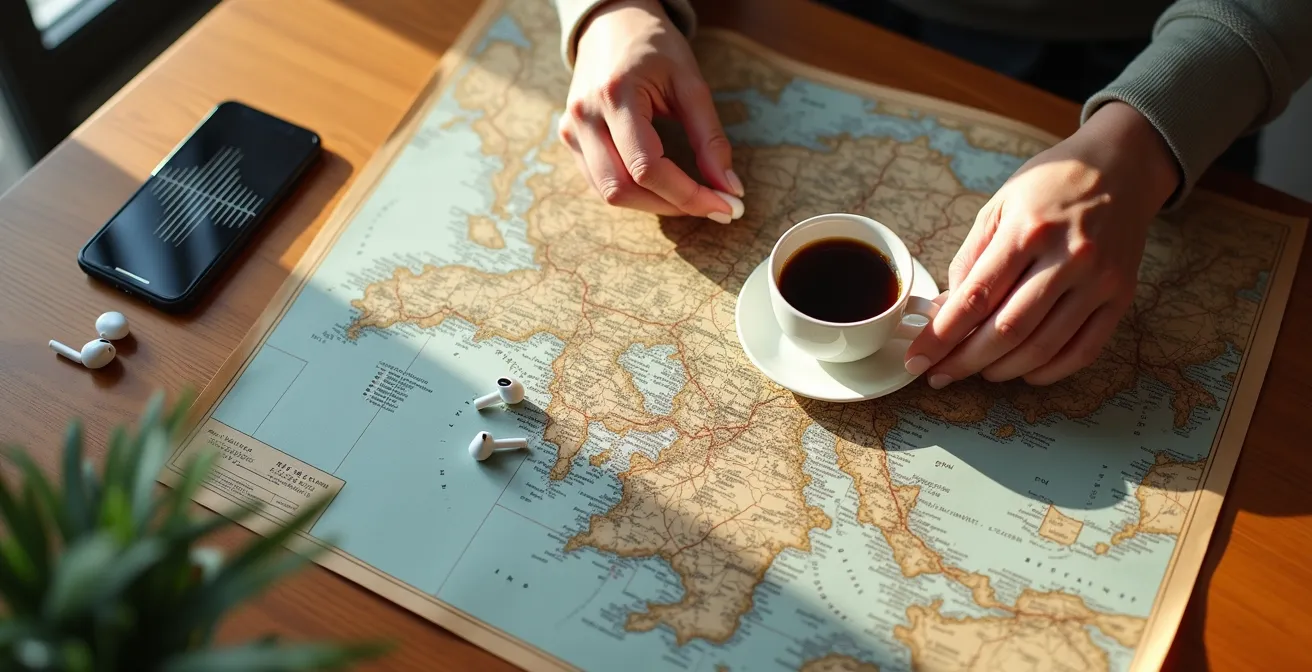
Building such a tour is easier than it sounds and requires only a bit of dedicated preparation. By leveraging podcast databases and transcription services, you can craft a deeply personal and intellectually stimulating audio experience that far surpasses any official guide.
- Targeted Searches: Use podcast transcription services to search for mentions of specific landmarks, street names, or historical figures relevant to your itinerary.
- Point/Counterpoint Playlists: Actively seek out differing perspectives. Pair a podcast from a renowned academic with one from a critical theorist or a local journalist.
- Immersive Soundscapes: Don’t limit yourself to history. Include episodes featuring local music, field recordings of city sounds, or even interviews with local artists and residents to add texture.
- Offline Preparation: Always download episodes before traveling to avoid relying on spotty public Wi-Fi or expensive mobile data.
- Pacing and Geography: Use online maps to estimate walking times between sites and trim or arrange your podcast episodes to match the physical duration of your journey.
Why a Robot Pet Can Reduce Dementia Anxiety Without Vet Bills?
At first glance, the topic of robotic pets for dementia patients may seem profoundly disconnected from intellectual travel. Yet, as a thought experiment, it offers a crucial insight into the very nature of authenticity and connection that we’ve been exploring. The core question is this: can a fabricated experience elicit a genuine emotional and cognitive response? The answer, unequivocally, is yes. Robotic pets, designed to mimic the look, feel, and sound of a real animal, have been shown to significantly reduce anxiety, loneliness, and agitation in individuals with cognitive decline, all without the logistical and financial burdens of a living creature.
The robot cat does not “love” its owner. The owner, on some level, knows the cat is not real. And yet, the interaction triggers real feelings of comfort, purpose, and affection. The brain responds to the curated stimuli—the purring, the soft fur, the gentle movements—and produces a genuine emotional benefit. The “inauthenticity” of the object is irrelevant in the face of the authenticity of the human response.
This teaches us a vital lesson for the intellectual traveler. We are often obsessed with finding the “real” thing, the “untouched” culture. But the case of the robot pet demonstrates that the value of an experience is not solely determined by its objective authenticity. Rather, its value lies in the genuine cognitive and emotional response it provokes within us. A meticulously reconstructed historical site, or even a “staged” cultural performance, can be an immensely powerful tool for learning and reflection if we engage with it on our own terms, understanding what it is and what it is not. It prompts us to shift our focus from “Is this real?” to “What real thing is this making me think and feel?”
Why Human Brains Can Only Appreciate Art for 90 Minutes?
Anyone who has attempted a marathon visit to the Louvre, the Met, or the Uffizi is intimately familiar with the phenomenon: after about an hour and a half, a sense of overwhelming fatigue sets in. The masterpieces start to blur together, intellectual curiosity wanes, and the primary desire becomes finding the nearest exit. This is not a failure of character or a lack of appreciation; it is a hard-wired cognitive limitation known as “museum fatigue” or “art fatigue.” The human brain, for all its wonders, is simply not designed for prolonged, high-stakes aesthetic and intellectual analysis.
The experience of viewing art in a major museum is incredibly demanding on our cognitive resources. It involves a constant stream of complex tasks: visual processing of color, form, and composition; accessing historical and cultural context; managing emotional responses; and making countless small decisions (“Should I read this label? Where do I go next?”). This relentless activity depletes our reserves of directed attention. After about 90 minutes, we enter a state of decision fatigue and sensory overload. The brain, seeking to conserve energy, begins to shut down its higher-level analytical functions. Appreciation gives way to exhaustion.
The solution for the intellectual traveler is counter-intuitive but essential: see less to appreciate more. Instead of planning an entire day at a single museum, treat it like a series of focused surgical strikes. Adopt a strategy of targeted immersion. Before you go, decide on a very specific goal for your visit. For example: “Today, I will only look at five specific paintings by Caravaggio,” or “This visit is dedicated solely to early Roman sculpture on the first floor.” By narrowing your focus, you protect your cognitive resources, allowing for a much deeper and more meaningful engagement with a smaller selection of art. This transforms the visit from an exhausting endurance test into a rich, rewarding, and sustainable intellectual practice.
Key Takeaways
- Intellectual travel is a cognitive skill, not a logistical one; the goal is to structure your perception.
- Building a “perceptual framework” through curated reading and listening before you travel is more critical than the itinerary itself.
- The concept of “authenticity” is often a trap; the focus should be on the meaning and insight you can derive from any experience, whether staged or not.
How to Break the “Tourist Bubble” and Connect With Locals?
The final, and perhaps most rewarding, layer of intellectual travel is human connection. Yet the advice to “talk to locals” is notoriously vague and difficult to execute. We are often insulated by the “tourist bubble”—a comfortable but isolating ecosystem of hotels, tour buses, and attractions where our interactions are transactional, not relational. Breaking through this bubble requires more than just good intentions; it requires a specific mindset and a strategic approach rooted in genuine curiosity.
The key is to shift from a goal of “knowing” to a goal of “understanding.” As curiosity expert Scott Shigeoka explains, this is the essence of deep curiosity.
Curiosity is a heart-centered pursuit. We can use it to learn about people around us, hearing their values, stories, and what makes them human. This ‘deep curiosity’ is where we don’t just have the goal of knowing; we are searching to understand.
– Scott Shigeoka, Seek: How Curiosity Can Transform Your Life and Change the World
This mindset transforms how you interact with the world. You are no longer a spectator but a humble student of humanity. This approach is perfectly embodied by the solo travels of retired teacher Marillee Carroll. As a case study from JourneyWoman highlights, she uses curiosity as her compass, becoming a collector not of souvenirs, but of knowledge, people, and experiences. Her success lies in her genuine love of learning about food, culture, and music—the very things that form the connective tissue of daily life. For the solo traveler, in particular, this deep curiosity can be a powerful tool for forging connections that would be impossible in a group.
Practically, fostering this deep curiosity involves creating opportunities for spontaneous, low-stakes interaction. This means learning a few key phrases in the local language (especially “please,” “thank you,” and “I don’t understand”), frequenting local markets or cafes during off-peak hours, and asking open-ended questions that invite stories, not just yes/no answers. By demonstrating a genuine desire to understand, you signal respect and open the door to the kind of meaningful connections that truly define an intellectually and emotionally resonant journey.
By integrating these strategies—from understanding the neuroscience of learning to the art of deep curiosity—you can fundamentally change the way you travel. The next step is to begin building the perceptual framework for your own journey, transforming your next trip into the richest learning experience of your life.