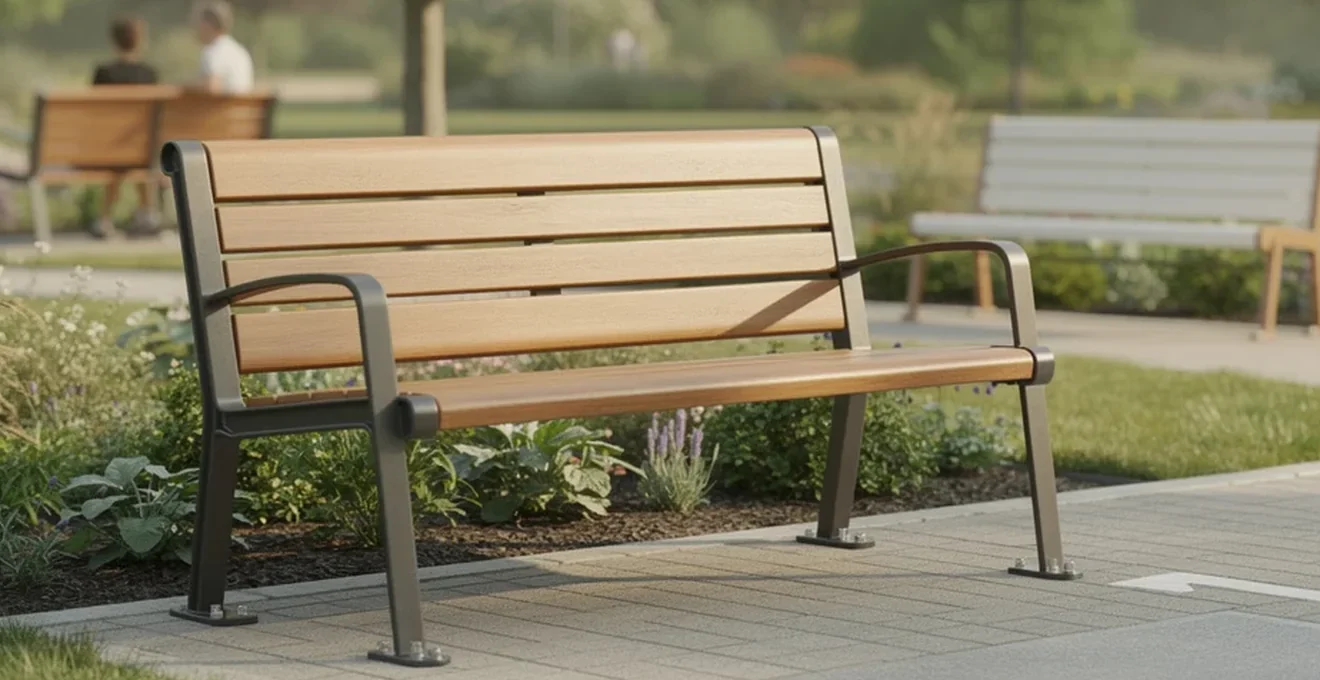
A bench in a public park or garden has to earn its place. It sits outdoors through decades of rain, frost and sun, takes constant use from every kind of visitor, and often has to resist deliberate misuse as well as ordinary wear. Choosing the right seating means balancing material durability, comfort, accessibility and security against a realistic maintenance budget. This guide covers the practical decisions behind specifying park and garden seating: material selection, weather resistance, ergonomic and accessibility standards, anti-vandal engineering, and how to plan bench placement across a site so that seating actually gets used rather than ignored.
Material selection for durable outdoor seating
The material a bench is made from determines almost everything else about its performance: how long it lasts, how much upkeep it needs, and how well it resists theft or vandalism. There’s no single correct answer here, since the right choice depends on the setting, footfall and risk profile of the site. A quiet corner of a walled garden has very different requirements to a bench at a busy transport interchange.
Hardwood timber options: iroko, oak and FSC-Certified teak
Timber remains the most familiar material for park and garden benches, prized for its warm appearance and the fact that it stays comfortable to sit on even in cooler weather, unlike bare metal or stone. Pressure-treated softwood is the most common and affordable option, suiting parks, rural sites, heritage locations and school grounds, but it typically needs re-treating every two to three years and offers a lifespan of 15 to 25 years with proper maintenance.
Hardwoods such as iroko and teak offer a longer-lasting, lower-maintenance alternative to softwood, and are a sensible upgrade where re-treatment cycles are difficult to manage. Where sustainability credentials matter to a project, FSC-certified timber confirms the wood has been responsibly sourced from well-managed forests. Left untreated, timber will gradually weather to a silver-grey finish, which many consider attractive but which is best suited to drier climates and less formal settings.
Cast iron and aluminium frame construction
Cast iron is specified for weight, strength and longevity rather than cost. Its sheer mass resists movement and casual vandalism, and a correctly finished cast-iron bench can carry a guaranteed lifespan of over 100 years, making it the longest-lasting material in this guide. Cast iron also accepts fine decorative detail, from scrollwork to cast crests and lettering, which makes it a natural fit for heritage parks, conservation areas and memorial schemes. For sites with a higher risk of vandalism or vehicle contact, ductile iron (grade 450-10) offers greater impact resistance than standard grey iron.
Steel-framed benches, often combining a galvanised steel frame with timber slats, give many of the benefits of both materials: the approachable look of timber seating with the structural stability of a metal frame underneath. This construction suits parks and mixed-use public realm schemes where a bench needs to look welcoming but perform to a higher structural standard than timber alone. Aluminium frames offer a lighter-weight alternative to steel where moving or repositioning furniture is a practical requirement, though this comes at some cost to the resistance to movement that heavier frames provide.
Recycled plastic and HDPE composite benches
Recycled plastic benches need no ongoing treatment: they don’t rot, splinter or absorb water, which makes them well suited to coastal, waterside and other low-maintenance environments where timber would deteriorate quickly. Because recycled plastic doesn’t absorb moisture, it won’t freeze and crack during winter, and it doesn’t attract insects or attract mould, which are useful properties for shared or public spaces where upkeep budgets are tight.
Beyond durability, recycled plastic seating supports sustainability goals that are increasingly part of local authority and institutional procurement. Each bench manufactured from recycled material removes plastic waste from the environment and turns it into a functional product, an argument that carries real weight in publicly funded schemes with environmental commitments. Recycled plastic benches are typically available in a range of colours and shapes, allowing them to match a classic park bench profile or a more minimalist design.
Powder-coated steel versus galvanised steel finishes
Fully galvanised and powder-coated steel benches offer the highest vandal resistance of any material alongside the lowest ongoing maintenance, making them well suited to high-footfall urban parks and sites with a known history of misuse. Galvanising protects the steel itself from corrosion, while a powder-coated top layer adds colour and an additional protective finish. Steel is also generally the most cost-effective option across a typical manufacturer’s range, which makes it a practical default for larger multi-bench schemes where budget needs to stretch across many units.
Concrete and stone seating for High-Traffic zones
Concrete and granite benches sit at the heavy-duty end of the spectrum. Their weight makes them close to immovable and effectively vandal-proof, and they suit contemporary public realm schemes, civic spaces and locations where a bench needs to double as a permanent landscape feature rather than a moveable item of furniture. Precast concrete seating is often part of modular ranges that allow flexible configurations across a site, while natural stone offers a similar sense of permanence with a more traditional finish. Maintenance requirements for concrete and granite are effectively none, and their lifespan is, for practical purposes, indefinite.
Weather resistance and Long-Term durability standards
Outdoor seating is exposed to constant environmental stress: rain, UV radiation, frost, snow and repeated temperature swings, often for 15 to 25 years or more without replacement. Specifying the wrong finish or material for the local climate is one of the most common reasons benches fail early, whether through cracking, rusting or splintering.
UV stabilisation and colour retention testing
Prolonged UV exposure fades colour and can weaken material integrity over time, particularly in plastics and painted or coated finishes. Recycled plastic and powder-coated steel products are generally formulated to resist UV degradation, helping benches retain their colour and structural performance across a long outdoor lifespan rather than fading or chalking within a few years.
Corrosion resistance in coastal and urban environments
Salt-laden coastal air accelerates corrosion in untreated metals far faster than inland urban settings. In these locations, stainless steel, galvanised finishes, or timber and recycled plastic alternatives that don’t corrode at all are generally the safer specification. Urban environments bring their own challenges, including pollution and airborne grime, but the corrosion risk is typically lower than at the coast, meaning standard galvanised and powder-coated steel usually performs well.
BS EN 581 compliance for outdoor furniture
Outdoor furniture intended for public use should meet recognised structural and safety standards covering stability, strength and durability testing. When comparing suppliers, checking that products are manufactured and tested to the relevant British or European standards gives confidence that a bench has been engineered for genuine public use rather than adapted from domestic garden furniture, which is built to a lower specification entirely.
Anti-fungal and Rot-Proof treatments for timber elements
Timber’s main long-term vulnerability is moisture retention, which leads to rot, fungal growth and eventual structural failure if left untreated. Pressure treatment during manufacture, combined with a re-treatment cycle of every two to three years, protects against this. Hardwoods such as iroko naturally resist rot and insect damage better than softwood, reducing the frequency and cost of upkeep over the life of the bench.
Ergonomic design principles for public seating
A bench that looks right but feels wrong to sit on will simply go unused. Getting the dimensions right matters as much as material choice.
Seat height and depth specifications for universal comfort
A comfortable public seat height is generally around 45cm (450mm) above ground level. Seat depth should be a minimum of around 45cm where the bench includes a backrest, while backless benches, used more as sitting plinths, can be considerably wider, with generous seat depths of 1m to 1.2m for a more lounging-style feature. Standard park benches are commonly supplied at around 1800mm in length, seating two to three adults comfortably, with typical seat depths of 300–450mm.
Backrest angle and lumbar support considerations
Not every bench design includes a backrest, and the choice affects how the seat is used. Backless seats suit brief rests or benches intended as incidental features, while a properly angled backrest is essential for anyone using a bench for a longer period, offering support that reduces strain compared with a flat, upright seat.
Armrest placement for elderly and Mobility-Impaired users
Armrests give users something to push against when standing, which is a small design detail with a significant practical impact for elderly visitors or those with limited mobility. Benches with armrests are a popular and sensible choice for parks and public spaces likely to be used by older visitors, and their inclusion is increasingly treated as a baseline expectation rather than an optional upgrade.
Accessibility and inclusive design compliance
Inclusive seating is increasingly a specification requirement rather than an optional extra, particularly for local authority and publicly funded schemes.
Equality act 2010 requirements for public seating
Public seating schemes in the UK need to consider the practical needs of all users, including those with disabilities, as part of good design practice for shared spaces. Building accessibility into the specification from the outset, rather than treating it as an afterthought, avoids costly retrofitting and ensures a park genuinely serves its whole community.
Wheelchair clearance zones and transfer space planning
Positioning at least a proportion of benches on level, hard-standing ground with clear approach space makes them usable by wheelchair users and people with pushchairs. It’s also worth leaving clear space alongside at least some benches so that a wheelchair user or pushchair can sit beside the seat rather than being limited to using the bench itself.
Tactile and contrast features for visually impaired users
Level, firm ground at the approach and around the bench, avoiding loose gravel or uneven grass immediately in front of the seat, benefits visually impaired visitors as much as wheelchair users. Clear, consistent surfacing around seating points reduces trip hazards and makes benches easier to locate and approach safely.
Vandalism prevention and Anti-Theft engineering
In urban parks, transport interchanges and unsupervised green spaces, vandalism and theft risk is a genuine specification concern, not a hypothetical one.
Tamper-resistant fixings and ground anchoring systems
How a bench is fixed to the ground matters as much as what it’s made from. Root fixing (submerged fixing) embeds the bench legs directly into a concrete foundation below ground level, giving the most secure, permanent and tamper-resistant installation, and is the most common method for parks and green spaces. Base plated (surface mounted) fixing attaches the bench to an existing hard-standing surface using bolts, typically Leibig-type fixings, and suits refurbishment schemes or locations where the surfacing needs to be preserved. Extension legs are supplied as standard for submerged installations in soft ground, giving the same stability as root fixing on grass or landscaped areas.
For any site with previous theft or vandalism issues, root fixing or submerged leg installation is generally the safer specification. Anti-vandal design also extends to fewer exposed fixings for tools to exploit, tamper-resistant bolts, and slat or panel designs that resist prising apart. Weight itself is a deterrent too: cast iron, concrete and granite benches resist both movement and theft simply through mass.
Graffiti-resistant coatings and Easy-Clean surfaces
Powder-coated steel and galvanised finishes are easier to clean than raw timber or untreated metal, helping graffiti and grime to be removed without damaging the underlying material. This is one of the reasons steel benches carry the lowest ongoing maintenance burden of the common materials, alongside their strong resistance to structural vandalism.
Fire-retardant treatments for High-Risk locations
In locations with an elevated fire risk, material choice becomes part of the safety specification. Metal, concrete and stone benches carry no combustion risk at all, while treated timber offers some resistance compared with untreated wood. For sites where arson or deliberate fire damage is a known concern, steel, cast iron or concrete seating removes the risk entirely rather than simply reducing it.
Site planning and layout strategy for park furniture
Even the best-specified bench will be under-used if it’s badly positioned. Layout deserves as much attention as material and fixing choices.
Sightline analysis and natural surveillance positioning
Benches positioned within clear sightlines of paths, entrances or other well-used areas benefit from natural passive surveillance, which can reduce the likelihood of vandalism and make users feel more comfortable and secure. Avoiding secluded, visually cut-off corners for seating is a simple but effective part of a security-conscious layout.
Shade assessment using tree canopy and pergola placement
Orientation towards views, shade or sun depending on the site significantly affects how well-used a bench actually is once installed. A bench placed in deep shade all day, or with no shelter at all in an exposed, sun-baked spot, will see far less use than one thoughtfully positioned relative to existing tree canopy or a pergola structure. Considering seasonal changes in shade and sun position, not just conditions on the day of installation, gives a more reliable result.
Footfall mapping for bench density in formal gardens
Benches should be spaced at regular intervals along main paths and desire lines, not only at “destination” points, so visitors always have somewhere to rest rather than only at the end of a long walk. In larger or more formal gardens, a bench can also work as a destination in its own right, rewarding exploration rather than simply serving a through-route. A mixed specification across a site — heavier, higher-security benches at entrances and high-footfall areas, with lighter or lower-cost designs in quieter corners — is a practical way to manage budget without compromising on the areas that need robust seating most.
Integration with drainage systems and permeable paving
Siting a bench on a hard-standing or gravel base beneath and around the seat prevents surrounding grass from wearing away with regular use and makes mowing far easier, since the bench won’t need to be moved for maintenance. Good drainage at the base of a bench also reduces standing water and mud at the approach, which matters both for general comfort and for the accessible, level surfacing that wheelchair users and pushchair users depend on.