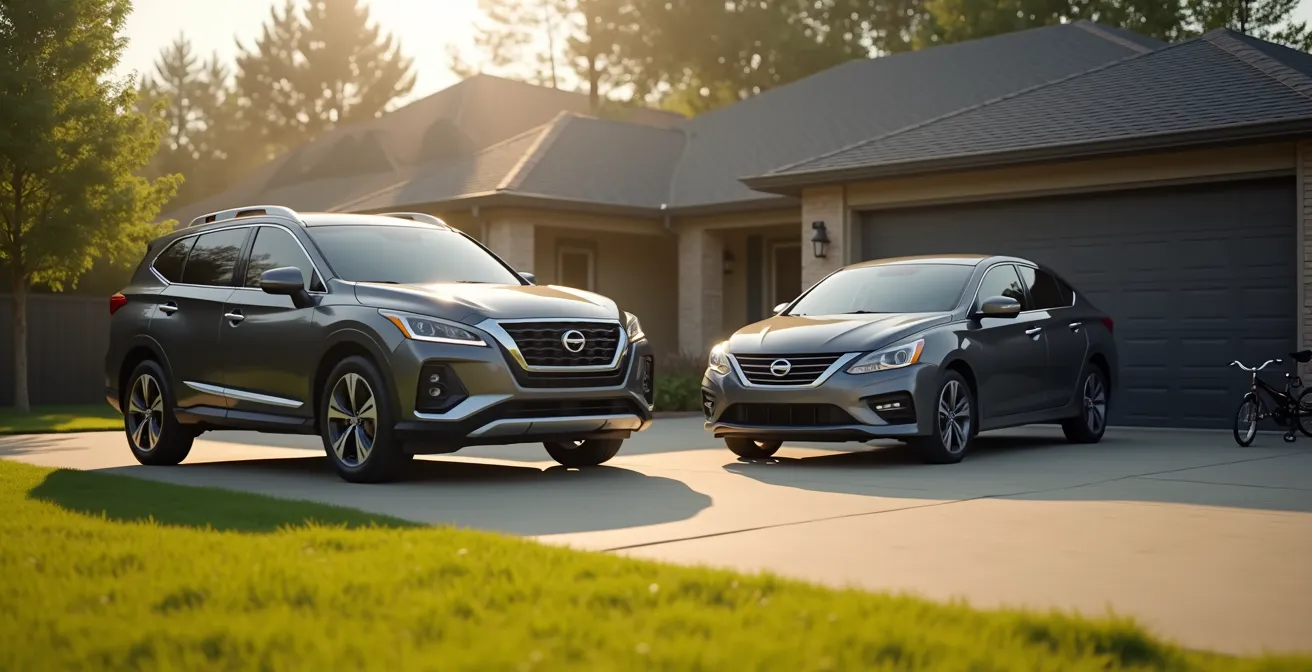
For suburban families, the perceived safety of All-Wheel Drive is largely a myth that costs thousands of dollars without adding real-world protection.
- All-Wheel Drive (AWD) improves acceleration but dangerously offers zero benefit for stopping or turning on ice and snow.
- A front-wheel-drive (FWD) car with proper winter tires consistently outperforms an AWD SUV with all-seasons for braking and cornering.
Recommendation: Save money and increase your family’s safety by investing in a high-quality set of winter tires for a FWD vehicle instead of paying the AWD premium.
For many families on a budget, car shopping involves a series of tough choices. When you see that “AWD” or “4×4” badge on an SUV, it’s easy to equate it with safety—a non-negotiable feature for protecting your loved ones, especially when the weather turns. The auto industry has masterfully marketed all-wheel drive as the ultimate solution for slippery suburban streets, a kind of magic shield against winter’s worst. You might think the extra few thousand dollars is a small price to pay for peace of mind.
But what if that expensive feature not only fails to deliver on its core safety promise but also introduces new risks and hidden costs? The common wisdom suggests AWD is a must-have for anyone who sees a single snowflake. We’re told it provides superior traction and control. Yet, this narrative conveniently ignores the fundamental laws of physics that govern a moving vehicle. The truth is far more nuanced and has significant implications for your wallet and your family’s well-being.
This article will dismantle the all-wheel drive myth from a pragmatic, money-saving perspective. We will explore the hard data on braking, the physical limitations of high-riding vehicles, and the surprising supremacy of tires. By looking beyond the marketing hype, you can make an informed, cost-effective decision that genuinely prioritizes safety, rather than just paying for a false sense of security.
To help you navigate this complex topic, we’ll break down the key considerations, from the physics of ice to the practical ergonomics of a family vehicle. This guide is structured to give you the clear, evidence-based information you need to choose wisely.
Summary: A Pragmatic Guide to Vehicle Choice for Suburban Families
- Why All-Wheel Drive Does Not Help You Stop on Ice?
- How to configure Car Seats in a High-Riding SUV Without Back Strain?
- FWD With Snow Tires vs. AWD With All-Seasons: Which Wins on Snow?
- The Center of Gravity Physics That Make SUVs Prone to Tipping
- Problem & Solution: Reducing Drag on Boxy SUVs to Save Fuel
- How to Prepare a Rear-Wheel Drive Coupé for Snow and Ice?
- Smart Car vs. Compact Crossover: Which Is Truly Safer in Urban Crashes?
- How to Take Your Daily Driver Off-Road Without Wrecking It?
Why All-Wheel Drive Does Not Help You Stop on Ice?
The single most dangerous misconception about all-wheel drive is that it helps you stop. It does not. AWD systems are designed to do one thing: send power to the wheels with the most traction to help the vehicle *accelerate* or ‘go’. They have absolutely no impact on your braking system. Stopping is a function of your tires’ grip and your brakes’ effectiveness. On a patch of ice, an AWD SUV with all-season tires has the same four useless contact patches as a front-wheel-drive sedan. The difference is that the AWD system may have given you the false confidence to drive faster, making the inevitable slide much more severe.
This isn’t just theory; it’s backed by sobering data. Drivers of AWD vehicles often overestimate their vehicle’s capabilities, leading to higher speeds in poor conditions. Research has shown this can have tragic consequences. For instance, some studies suggest a concerning trend where AWD vehicles are involved in a higher percentage of severe crashes on icy roads. In fact, one report found an associated 19-31% increase in injury crashes for AWD vehicles on ice compared to their 2WD counterparts, likely due to this very overconfidence. The system that helps you get going faster can’t save you when you need to stop suddenly.
As one driving expert bluntly put it, the physics are unforgiving. This false sense of security is a well-documented trap for even experienced drivers. As veteran driving instructor Ian Law stated in The Globe and Mail:
All-wheel drive lets you have a bigger crash
– Ian Law, Driving Instructor, The Globe and Mail
This is the crux of the issue for a suburban family. The primary safety concern isn’t accelerating from a snowy stop sign; it’s stopping before sliding into an intersection or another car. AWD offers no advantage here and may even put you at greater risk.
How to configure Car Seats in a High-Riding SUV Without Back Strain?
Beyond the drivetrain debate, the practical realities of using an SUV as a family hauler introduce their own challenges. One of the most common complaints from parents is the physical strain of installing and using car seats in a high-riding vehicle. Lifting a heavy car seat or a growing child into a cabin that sits several feet off the ground can be a recipe for back pain. The awkward angles and extended reaching motions put significant stress on your spine and core muscles. This is a daily ergonomic issue that is often overlooked in the showroom.
Proper technique is crucial to avoid injury. Instead of leaning in from outside the vehicle, which puts your back in a vulnerable, twisted position, you need to use the vehicle’s height to your advantage. This means getting into the vehicle to perform the installation. The key is to minimize reaching and twisting by positioning your body as close to the car seat as possible.
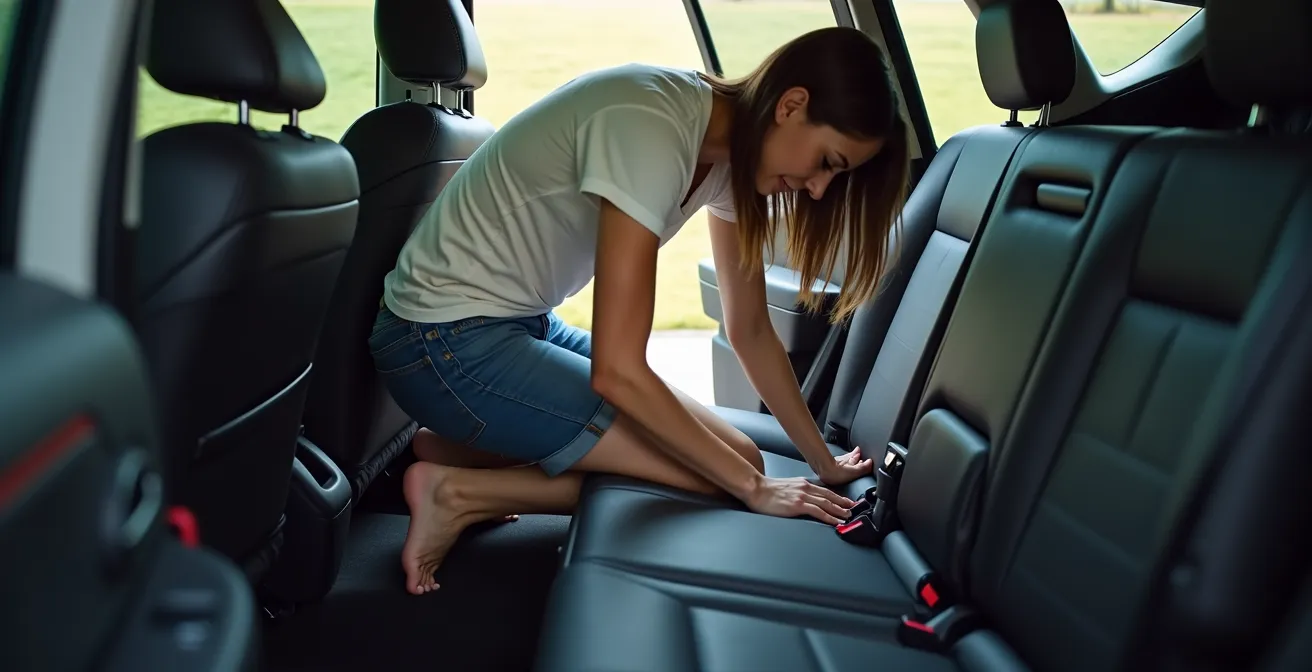
As you can see in the demonstration, kneeling on the vehicle’s seat allows you to maintain a straight back and use your body weight effectively and safely. This simple change in technique transforms the task from a high-risk maneuver to a controlled and stable process. For families with young children, this is a far more relevant daily “safety” concern than the theoretical benefits of AWD in a suburb.
Your Action Plan: Ergonomic Car Seat Installation in an SUV
- Park on level ground and engage the parking brake to prevent any vehicle movement.
- Use automatic running boards or fixed steps to maintain three points of contact (two feet, one hand) when entering the vehicle.
- Kneel on the vehicle seat rather than leaning from the outside to significantly reduce back strain.
- Position the car seat base at the edge of the seat first, then slide it back into its final position against the seatback.
- Use your body weight by pressing down with your knee or hand to compress the vehicle seat while tightening the LATCH straps or seatbelt.
- Test your installation with the ‘inch test’: the seat should not move more than one inch side-to-side or front-to-back at the belt path.
FWD With Snow Tires vs. AWD With All-Seasons: Which Wins on Snow?
This is the ultimate practical test that cuts through all the marketing noise. If an AWD SUV on factory-standard all-season tires goes up against a typical front-wheel-drive (FWD) family sedan equipped with proper winter tires, which is safer? The answer is unequivocally the FWD car with winter tires. While the AWD vehicle will accelerate from a stop more quickly, the FWD car will outperform it in the two most critical safety metrics: stopping and cornering.
Winter tires are made from a special rubber compound that stays soft and pliable in freezing temperatures, allowing them to maintain grip where all-seasons become hard and slick. Their deep, intricate tread patterns are designed to bite into snow and channel away slush and water. This is why studies consistently show that winter tires can cut stopping distances by 30% or more compared to all-seasons. That percentage can be the difference between a safe stop and a serious collision.
The performance gap isn’t minor; it’s a massive safety advantage that the drivetrain simply cannot overcome. A direct comparison of the data makes the choice for a budget-conscious family crystal clear.
| Performance Metric | FWD + Winter Tires | AWD + All-Seasons | Advantage |
|---|---|---|---|
| Stopping Distance (30mph on ice) | 35.1 feet | 53.6 feet | FWD + Winter (34% better) |
| Acceleration (0-30mph on snow) | 8.2 seconds | 5.8 seconds | AWD + All-Season |
| Cornering Stability | Superior grip | Prone to sliding | FWD + Winter |
| 5-Year Cost (tires + fuel) | $2,800 | $4,200 | FWD + Winter ($1,400 savings) |
| Emergency Maneuver Control | Predictable | Unpredictable | FWD + Winter |
This comparative performance data speaks for itself. The AWD system provides a single, lonely advantage in acceleration. In every other category that determines your ability to avoid an accident—braking, cornering, and emergency control—the vehicle with winter tires is vastly superior. For a family focused on safety and budget, investing in a set of winter tires is a far smarter and more effective use of money than paying the premium for AWD.
The Center of Gravity Physics That Make SUVs Prone to Tipping
The “bigger is safer” argument for SUVs has a dangerous blind spot: physics. SUVs, by their very design, have a higher center of gravity than traditional sedans or wagons. This inherent characteristic makes them more susceptible to rollovers, one of the most dangerous types of automotive accidents. While their large mass can be an advantage in some collision scenarios, it works against them during emergency maneuvers or when they leave the pavement.
Imagine trying to tip over a low, wide coffee mug versus a tall, slender wine glass. The wine glass, with its high center of gravity, will topple with very little effort. The coffee mug is inherently more stable. This simple analogy explains the stability difference between an SUV (the wine glass) and a sedan (the coffee mug). When an SUV swerves abruptly, the centrifugal forces act on its high center of gravity, creating a powerful tipping moment that can easily overwhelm the tires’ grip, leading to a rollover.

This isn’t a minor risk. Decades of crash data confirm this vulnerability. While modern electronic stability control (ESC) systems have significantly mitigated this risk, they haven’t eliminated it. According to NHTSA data, SUVs have a 14% to 23% chance of rollover in single-vehicle crashes, compared to just 10% for traditional cars. For a family weighing safety options, it’s critical to understand that the perceived safety of a large vehicle comes with a significant and often unmentioned trade-off in stability.
Problem & Solution: Reducing Drag on Boxy SUVs to Save Fuel
The pragmatic downsides of SUV ownership extend directly to your wallet, particularly at the gas pump. The tall, boxy shape that provides ample interior space also creates significant aerodynamic drag. Pushing that large profile through the air at highway speeds requires a great deal of energy, which translates directly to higher fuel consumption. This is a permanent financial penalty you pay for the life of the vehicle, a cost that is further amplified in AWD models, which are heavier and have more frictional losses in their drivetrain.
For a family on a budget, this continuous drain on finances matters. An equivalent FWD wagon or minivan can offer similar interior space with significantly better fuel economy, saving you hundreds, if not thousands, of dollars over the years. However, if you already own or are set on an SUV, there are practical steps you can take to mitigate this inherent inefficiency and claw back some of those fuel savings. Reducing aerodynamic drag is the most effective strategy.
Think of your SUV as a big sail. Anything that sticks out and catches the wind will make the engine work harder. By streamlining the vehicle, you can make a noticeable difference in your fuel bills. Many of the most common SUV accessories are the worst offenders. The good news is that many of these changes are simple, free, and can be done in your own driveway. Maintaining the vehicle’s original, cleaner profile is the key to maximizing its efficiency.
- Remove roof racks and crossbars when not in use, as they can reduce fuel economy by up to 10%.
- Choose narrower, highway-oriented tires over wide, knobby all-terrains, which increase rolling resistance.
- Remove aftermarket accessories like bull bars or large light bars that disrupt airflow.
- Keep windows closed at highway speeds to prevent air turbulence inside the cabin.
- Maintain proper tire pressure to reduce rolling resistance.
- Use cruise control on highways to maintain a steady speed and avoid unnecessary acceleration.
How to Prepare a Rear-Wheel Drive Coupé for Snow and Ice?
While this article focuses on FWD and AWD, it’s worth noting that even the supposedly “worst” winter vehicle—a rear-wheel-drive (RWD) car—can be made perfectly capable for suburban winter driving with the right preparation. This serves as the ultimate proof that tires and preparation trump drivetrain type. The principles are the same: maximizing grip and understanding vehicle dynamics. If a sports coupe can be made safe, a FWD family car certainly can.
The two keys to taming a RWD car in winter are the same as any other vehicle: a full set of four high-quality winter tires and adjusting your driving style. Winter tires provide the necessary grip for braking and turning. The second, and unique, step for RWD is adding weight over the drive axle. Because the powered wheels are in the back, adding a few hundred pounds of sandbags or other secured weight in the trunk dramatically increases traction for acceleration. This simple, old-school trick significantly improves the car’s ability to get moving from a stop.
From a purely financial perspective, this approach is a clear winner for a budget-conscious consumer. The total cost of preparing a RWD or FWD car for winter is a fraction of the upfront cost of an AWD system. A good set of winter tires and wheels might cost between $800 and $1,200. Compare that to the typical AWD option on a new vehicle, which often adds $2,000 to $3,000 or more to the sticker price, not to mention the ongoing fuel penalty. As a one-time purchase, a winter tire and weight preparation costs approximately $800-$1200, a stark contrast to the $3,000+ AWD premium.
This demonstrates that safe winter driving is not about buying the most complex drivetrain, but about smart, targeted investments. For suburban life, paying for AWD is often buying a solution to a problem that can be solved more effectively for much less money.
Smart Car vs. Compact Crossover: Which Is Truly Safer in Urban Crashes?
The “bigger is always safer” myth is most pervasive when considering SUVs and crossovers. It seems intuitive that being surrounded by more metal would offer more protection. While mass is a factor in physics, modern vehicle safety engineering is far more complex. A smaller, well-designed car can be surprisingly safe thanks to features like a rigid safety cell, crumple zones, and advanced airbag systems. The classic Smart Car, for example, features a “Tridion safety cell” that is incredibly strong and effective at protecting occupants in the types of collisions common in urban environments.
However, the safety equation has more than one variable. One of the most overlooked aspects of vehicle safety is the danger a vehicle poses to *others*, particularly pedestrians and cyclists. Here, the design of SUVs and light trucks presents a significant and well-documented problem. Their high front-end profile and blunt bumpers are more likely to cause severe injuries upon impact. Instead of striking an adult pedestrian in the legs, as a sedan would, an SUV’s front end often impacts the torso and head, leading to far more devastating outcomes.
This isn’t a small statistical anomaly; it is a major public safety concern. According to data from the National Highway Traffic Safety Administration (NHTSA), the danger is clear. In fact, an NHTSA analysis on pedestrian safety has shown that the largest percentage of pedestrian fatalities occur in crashes involving SUVs and light trucks. So, while you may feel safer inside your large crossover, you are piloting a vehicle that is statistically more lethal to the community around you. For a family living in a suburb with kids playing, walkers, and cyclists, this is a serious ethical and safety consideration that goes beyond personal protection.
True safety is about the entire transportation ecosystem, not just the occupants of one vehicle. The choice of a large SUV has external consequences that are often ignored in the pursuit of feeling secure.
Key Takeaways
- AWD is for ‘Go,’ Not ‘Stop’: All-wheel drive only helps with acceleration; it provides zero benefit for braking or steering on slippery surfaces.
- Tires Are Supreme: A front-wheel-drive vehicle with winter tires is safer and has better stopping power than an all-wheel-drive vehicle with all-season tires.
- SUVs Have Inherent Disadvantages: Their high center of gravity makes them more prone to rollovers, and their boxy shape leads to higher fuel consumption, costing you more over time.
How to Take Your Daily Driver Off-Road Without Wrecking It?
After dismantling the myths around AWD for suburban driving, it’s fair to ask: what is four-wheel drive *actually* for? The answer is off-road and severe, unplowed conditions—environments most suburban families will never encounter. Taking a vehicle off-pavement requires more than just a 4×4 badge; it demands specific preparation to avoid expensive damage. Understanding these requirements highlights the vast difference between true off-road capability and the marketing sold to suburbanites.
The single most important preparation is managing your tires and protecting your vehicle’s underbelly. Off-road, you need to “air down” your tires—reducing the pressure to around 20-25 PSI. This increases the tire’s footprint, providing dramatically better traction on soft surfaces like sand or mud and allowing the tire to conform to obstacles like rocks. This is the opposite of on-road driving, where high pressure is needed for efficiency. You also need to physically inspect the path, know your vehicle’s approach and departure angles, and protect critical components like the oil pan with skid plates.
This level of preparation underscores the point: 4×4 systems are specialized tools for challenging environments. They are not general-purpose safety nets. For the rare occasion you might face a dirt road to a campsite, a standard FWD car driven slowly and carefully will almost always suffice. Paying a premium for a 4×4 system for that “one time” you might need it is financially illogical, especially when it offers no tangible benefit for the 99.9% of your daily, paved-road driving.
Before making your next vehicle purchase, evaluate your actual, daily driving needs against these facts. Don’t pay a multi-thousand-dollar premium and a permanent fuel penalty for a feature that doesn’t improve safety in your suburban environment. A smarter, more economical choice is often the safest one.