
True connection with locals isn’t about finding the most “authentic” spot; it’s about shifting your mindset from a consumer of experiences to an observant participant in a living social ecosystem.
- Language is not a tool for transaction but an act of vulnerability that signals respect and opens doors to genuine interaction.
- Your environment shapes connection. Choosing a lived-in homestay or a walkable neighborhood intentionally builds opportunities for casual, repeated encounters.
Recommendation: Instead of asking, “Is this authentic?”, start asking, “Where is my money going?” and “How can I participate respectfully in modern local life?”
There is a sensation familiar to many travelers: the feeling of being behind glass. You see the vibrant street life, you smell the food, you hear the unfamiliar sounds, but you are not quite part of it. You are an observer, a spectator moving through a series of curated sights and experiences. This is the “tourist bubble”—a comfortable but ultimately isolating space that prevents the very thing many of us travel for: genuine human connection. The common advice is to “learn a few phrases,” “get off the beaten path,” or “eat where the locals eat.” While well-intentioned, these are merely actions on a checklist.
What if the key to breaking the bubble wasn’t a set of actions, but a fundamental shift in perspective? An anthropologist doesn’t enter a new culture with a to-do list; they enter with a framework of observation, a desire to understand the underlying social dynamics, and a respect for the existing ecosystem. This guide proposes a similar approach. It’s about moving from a mindset of a ‘consumer of experiences’ to that of an ‘observant participant.’ It’s about understanding that connection isn’t something you find, but something you cultivate through humility, awareness, and intentionality.
This article will guide you through this mindset shift. We will explore how a few well-chosen phrases can change your social standing, how to select accommodation that fosters community, and how to read the cultural landscape around you—from body language to the very architecture of the city. The goal is to equip you not with a map of hidden gems, but with the observational tools to discover them for yourself, through the most reliable guides of all: the people who call that place home.
To navigate this anthropological approach to travel, the following sections will deconstruct the layers of local interaction. From language and lodging to dining and decoding a city’s history, each part offers a new lens for seeing and engaging with the world around you.
Summary: An Anthropologist’s Guide to Breaking the Tourist Bubble
- Why Learning 20 Local Phrases Changes How You Are Treated?
- How to Choose a Homestay That Is Safe and Culturally Rich?
- Lonely Planet vs. Local Bartender: Who Gives Better Recommendations?
- The Gesture Mistake That Can Offend Your Hosts Instantly
- Problem & Solution: Overcoming the Fear of Dining Alone in a Foreign City
- The “Authentic” Experience Trap That Is Actually Staged for Tourists
- High-Density Walkability vs. Suburban Space: Which Fosters More Social Ties?
- How to “Read” a City’s History Through Its Architecture?
Why Learning 20 Local Phrases Changes How You Are Treated?
The common advice to “learn the basics” often stops at “hello,” “please,” and “thank you.” From an anthropological perspective, this transactional approach misses the point entirely. Language is not merely a tool for acquiring goods or services; it is the primary vehicle for cultural reciprocity. Attempting to speak the local language, however poorly, is an act of vulnerability. It signals that you are not there to impose your own cultural norms but to respectfully engage with theirs. This small effort fundamentally shifts your position from an entitled tourist to a humble guest, a change that locals perceive and appreciate immediately.
The goal isn’t fluency, but connection. Instead of just greetings, focus on phrases that open a dialogue and demonstrate genuine curiosity. A phrase like, “My [language] is terrible, please speak slowly,” shows humility and invites patience. Asking, “This looks delicious, what is it called?” at a food stall can lead to a conversation far more memorable than simply pointing. These are not just words; they are social invitations. They communicate, “I see you, I value your culture, and I am willing to be a student.” With travel increasingly focused on deep connection— 56% of all travel in 2024 was focused on cultural heritage—this linguistic effort is the first and most powerful step in transforming a trip into a meaningful exchange.
Focus on learning phrases that foster dialogue and show you are an observant participant, not just a consumer. This includes:
- Vulnerability Phrases: “I’m sorry, my [language] is not very good. Can you help me?”
- Conversational Invitations: “I’m a visitor here. What is a local band I should listen to?” or “What is a traditional dish I must try?”
- Active Listening Phrases: “How do you say that?” or “Could you please repeat that more slowly?”
This approach transforms language from a barrier to a bridge, demonstrating respect that is often returned with warmth and openness.
How to Choose a Homestay That Is Safe and Culturally Rich?
Your choice of accommodation is one of the most significant decisions you will make in shaping your travel experience. A sterile hotel room is a cultural vacuum, reinforcing the tourist bubble. A well-chosen homestay, conversely, can become your primary field site for observant participation. The global homestay market is booming, with the authentic homestay segment reaching a market revenue of USD 19.58 billion in 2024, precisely because travelers are seeking this deeper connection. But not all homestays are created equal. The key is to distinguish a commercialized guest room from a genuinely lived-in space.
When vetting potential homestays, look for anthropological clues in the photos and descriptions. Are there personal touches like family photos, well-used books on the shelves, or handmade art? These are signs of a “lived-in” environment, which is a strong indicator of an authentic cultural exchange opportunity. A 2024 study on homestay success factors confirms this. The research emphasized that the host’s motivation for genuine cultural sharing, combined with a safe and caring environment, was far more important than modern amenities. A space with a well-used kitchen and personal artifacts signals an opportunity for real interaction, not just a transaction.
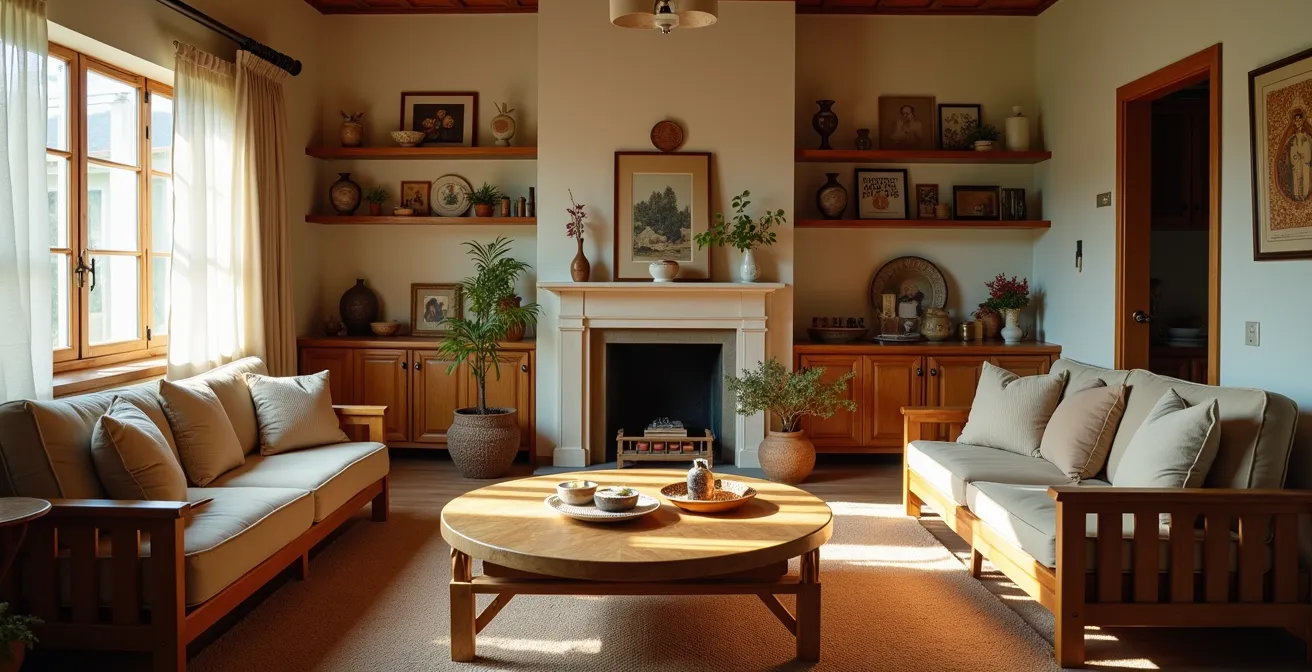
Look beyond reviews that praise cleanliness and location. Seek out comments that mention the host’s willingness to share stories, offer home-cooked meals, or provide advice on local life. A host who sees themselves as a cultural ambassador, rather than just a landlord, is the greatest asset you can find. This environment provides a safe, low-pressure context to practice your new language skills, ask “silly” questions, and begin to understand the rhythm and nuances of daily life outside the tourist centers.
Case Study: The “Lived-In” Factor in Homestay Success
A recent study analyzing homestay success found that the most significant contributors to positive traveler experiences were not luxury features but rather the host’s demonstrable care and the presence of genuine cultural artifacts. Researchers noted that spaces with personal books, well-used kitchens, and family mementos were perceived as offering a more authentic opportunity for cultural exchange. This “lived-in” quality, combined with a host’s genuine motivation for sharing their culture, was a stronger predictor of a meaningful stay than location or price.
Lonely Planet vs. Local Bartender: Who Gives Better Recommendations?
Guidebooks like Lonely Planet are invaluable tools. They provide historical context, professionally vetted information on major attractions, and a reliable safety net for planning. They are excellent at answering the “what”—what is this building, what is the national dish, what are the top five things to see? However, from an anthropological standpoint, they present a static, generalized version of a culture, often months or even years out of date. To break the tourist bubble, you must seek out the “living” knowledge that answers the “how” and “where”—how do locals experience this city, and where do they go to celebrate, relax, or eat well *this week*?
This is where the local bartender, a shopkeeper, or a person you meet in a park becomes an indispensable resource. Their knowledge is real-time, personal, and rooted in the immediate context. They can tell you about the new restaurant with the brilliant young chef, the free concert happening in the square tonight, or the neighborhood market that isn’t in any guidebook. This is not to say their advice is without bias; it will be shaped by their personal tastes and limited geographic scope. The key is to see this not as a flaw, but as an authentic data point within the local social ecosystem.
The act of asking for a recommendation is itself a form of connection. It requires rapport-building and trust. It’s a conversation, not a query. The goal isn’t just to get a “better” recommendation, but to engage in the process of discovery. Using a guidebook is like reading a textbook; asking a local is like attending a lecture given by an expert on their own life. Both have value, but only one leads to a genuine human connection.
To make the most of both resources, it’s helpful to understand their distinct strengths and weaknesses. The following table illustrates the trade-offs between static, vetted information and dynamic, local insight.
| Aspect | Guidebook (Lonely Planet) | Local Bartender/Resident |
|---|---|---|
| Information Type | Historical context, famous dishes, established attractions | Current favorites, hidden spots, seasonal events |
| Time Relevance | May be 6-12 months outdated | Real-time, up-to-date information |
| Bias Type | Commercial bias, tourist-centric view | Personal taste bias, limited geographic scope |
| Best For | Understanding ‘what’ and historical background | Discovering ‘where’ and ‘how’ locals experience it |
| Reliability | Consistently available, professionally vetted | Variable quality, requires rapport-building first |
The Gesture Mistake That Can Offend Your Hosts Instantly
Communication is far more than words. As an observant participant, paying attention to non-verbal cues—gestures, personal space, eye contact—is a critical component of contextual literacy. What is a friendly gesture in one culture can be deeply offensive in another. The “thumbs up” sign, an innocuous symbol of approval in much of the Western world, is a rude insult in parts of the Middle East and West Africa. Pointing with your index finger is considered impolite in many Asian cultures, where one should use an open hand or a chin-point instead. These are not trivial details; they are the unspoken rules of the social ecosystem.
Making a mistake is almost inevitable. The fear of causing offense can be paralyzing, but the solution is not to become rigid and withdrawn. Instead, the anthropological approach is to observe first, act second, and have a strategy for graceful recovery. Mirroring the energy and physical expressions of those around you is a safe starting point. Notice how people greet each other, how much space they leave between them in conversation, and how they signal for a waiter’s attention. This active observation minimizes the chance of a misstep.
When you do make a mistake—and you will—the recovery is more important than the error itself. A sincere, immediate apology, often combining a universal gesture (like placing your hands together with a slight bow) and a learned phrase (“I apologize, I am still learning your customs”), can turn a moment of awkwardness into a moment of connection. It demonstrates humility and a genuine desire to learn. This process is how we develop true cultural competence, an outcome that a Global Ties U.S. study found is reported by 82% of exchange program participants who engage in such cross-cultural interactions.
Action Plan: Graceful Recovery from Cultural Missteps
- Master the universal apology: Combine a gesture of respect (like hands together or a hand on your heart) with a sincere facial expression. This non-verbal cue is often understood even without words.
- Learn the recovery phrase: Memorize “I apologize, I’m still learning your customs” in the local language. This shows humility and acknowledges your position as a guest.
- Observe before you act: In a new social setting, take a moment to watch how locals interact. Mirror the general level of formality, personal space, and gesturing you see.
- Focus on context: Understand that the meaning of a gesture can change depending on the situation. A casual gesture among friends might be inappropriate in a formal setting.
- Use positive gestures: Instead of only worrying about what to avoid, actively learn and use gestures of gratitude or respect that are unique to the culture.
Problem & Solution: Overcoming the Fear of Dining Alone in a Foreign City
Dining alone in an unfamiliar city can be one of the most intimidating experiences for a traveler. The feeling of being conspicuously solitary can be so powerful that many retreat to their rooms with takeout, missing out on one of the most vital cultural experiences a place has to offer. The problem is often one of framing: we see ourselves as a “person dining alone.” An anthropological shift in mindset reframes this as an “observer conducting fieldwork.” Your meal is no longer about lonely consumption but about observant participation in a local ritual.
The solution is to give yourself a mission. This “mission-based dining” strategy turns potential awkwardness into an engaging quest. Instead of focusing on your solitude, you focus on your task. Your mission could be to sample three local cheeses, to document the etiquette of noodle slurping, or to sketch the interior of the cafe. One solo traveler in Paris reported great success by turning their cafe visits into a research project on different varieties of “fromage,” transforming a potentially lonely experience into an adventure. This reframing gives you a purpose and makes you an active participant rather than a passive, self-conscious diner.
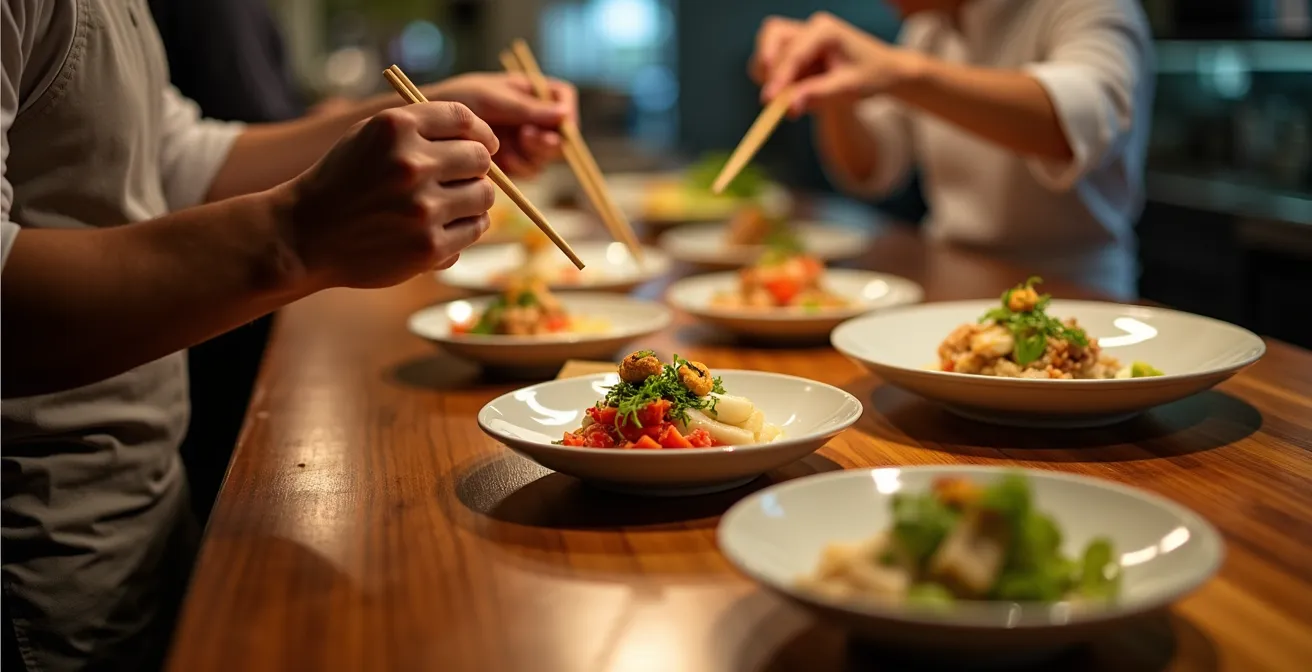
Choosing the right environment is also key. Seek out establishments with counter or bar seating. These spaces are socially designed for solo individuals. Sitting at the counter of a ramen shop, a tapas bar, or a diner naturally places you in a low-pressure interactive zone with staff and fellow diners. Instead of a “blocking prop” like a phone, bring an “inviting prop”—a physical map, a postcard, or a book about the region. These items signal curiosity and can act as natural conversation starters, bridging the gap between you and the social ecosystem around you.
By adopting these strategies, you are not just “dealing with” dining alone. You are transforming it into one of the most powerful tools for connection available to a traveler. It’s an opportunity for quiet observation, unexpected conversations, and a deeper understanding of the local culture, one bite at a time.
The “Authentic” Experience Trap That Is Actually Staged for Tourists
The quest for “authenticity” is one of the great paradoxes of modern travel. We journey thousands of miles to find something “real,” only to be presented with experiences that are often carefully constructed for our consumption. These can range from a “traditional” village where residents put on costumes when the tour bus arrives to a cultural performance that exists solely for tourists. While often enjoyable, these staged events create a barrier to understanding the modern, living culture of a place. The pursuit of a romanticized, often fictional past can blind us to the complex and fascinating reality of the present.
The anthropological perspective encourages a critical shift in our definition of authenticity. Instead of seeking an untouched, pre-modern ideal, we should seek to understand and engage with Modern Local Life. This means recognizing that a bustling, modern coffee shop where students and office workers meet is just as “authentic” as a thatched-roof hut—and often, far more relevant to the contemporary social ecosystem. A significant portion of travelers are drawn to these events, with tourism statistics showing that 30% of travelers say they chose a destination because of a specific cultural or heritage event. The trap is not the event itself, but mistaking it for the entirety of the culture.
A powerful way to escape this trap is to change the question you are asking. As one travel researcher astutely points out, this shift in focus is crucial for a more meaningful exchange.
The most meaningful connection is often found in Modern Local Life, not a romanticized past. Ask ‘Where is my money going?’ instead of ‘Is this authentic?’
– Travel researcher, Travel authenticity analysis
This simple question—”Where is my money going?”—is a powerful analytical tool. Does your money support a local family-run business, an independent artist, or a community cooperative? Or does it flow to a large, foreign-owned corporation that stages experiences? Following the money trail often leads you away from the polished tourist traps and toward the small, vibrant enterprises that form the true backbone of the local economy and culture.
High-Density Walkability vs. Suburban Space: Which Fosters More Social Ties?
The physical layout of a place profoundly influences the social opportunities within it. An anthropologist would call this the study of proxemics—how space and distance impact interaction. For a traveler, understanding this concept is key to intentionally placing yourself in environments ripe for connection. A high-density, walkable urban neighborhood is a natural incubator for “weak ties”: the brief, repeated, informal encounters with the same people, such as the baker you see each morning or the dog walker you pass in the park. These micro-interactions build a sense of familiarity and belonging, slowly integrating you into the local social fabric.
In contrast, sprawling suburban or car-dependent areas require a more deliberate strategy. Social life is less spontaneous and more structured around planned events. Here, connection is found by actively seeking out “third places”—the term sociologists use for neutral social hubs outside of home (the first place) and work (the second place). These are the community’s living rooms: farmers’ markets, public libraries, local sports games, community centers, and festivals. The 2024 Travel & Tourism Development Index highlighted this dynamic, emphasizing that travelers can leverage these different environments by adapting their strategies.
Your itinerary should be a social map, not just a geographical one. In a dense city like Florence, your plan might be to visit the same small cafe for your morning espresso every day, allowing recognition to blossom into conversation. In a suburban area like the American Sun Belt, your plan would involve researching and attending a weekend craft fair or a high school football game. The goal is to time your movements to coincide with local rhythms, showing up where and when local life unfolds. This requires a shift from a sight-seeing mindset to a social-centric one, where the destination is not a monument, but a context for human interaction.
Case Study: Leveraging “Third Places” for Social Connection
The 2024 Travel & Tourism Development Index analyzed how urban design impacts social connection. It found that high-density walkable areas naturally create numerous ‘weak tie’ connections through repeated, casual encounters in cafes, parks, and shops. These unplanned interactions are crucial for fostering a sense of community. In contrast, suburban areas, which lack this density, require more intentional connection strategies. The report emphasized that successful social integration in these spaces relies on leveraging ‘third places’—planned community hubs like farmers’ markets, workshops, and local festivals—as essential platforms for tourist-local interaction.
Key Takeaways
- The most critical factor for genuine connection is a mindset shift from a ‘tourist consumer’ to an ‘observant participant’ in the local culture.
- Authenticity is found not in staged historical reenactments, but in the everyday rhythms and interactions of modern local life.
- Developing ‘contextual literacy’—the ability to read non-verbal cues, social spaces, and even architecture—is a skill that unlocks deeper understanding and respect.
How to “Read” a City’s History Through Its Architecture?
Buildings are more than just structures; they are historical documents written in stone, steel, and glass. For the observant traveler, architecture is a language that tells the story of a city’s values, conflicts, and transformations. Learning to read this language elevates you from a passive sightseer to an active investigator, using the built environment as a tool for understanding the local psyche. This is the ultimate expression of contextual literacy. Instead of just identifying a building as “Baroque” or “Modernist,” you ask “Why?” Why are the roofs shaped this way? Why did they switch from brick to concrete in this era? What political or economic movement does this grand public building represent?
Start by looking for the “scars” and “seams.” A wall pockmarked with patched bullet holes tells a story of conflict more viscerally than any museum plaque. The “seam” where a medieval alley meets a 19th-century boulevard reveals a history of urban renewal and changing social priorities. Contrast the “high” architecture of state buildings and cathedrals with the “low” architecture of working-class housing. This high/low analysis often reveals deep truths about power, wealth, and social stratification throughout a city’s history.
Most importantly, use your architectural observations as a bridge to conversation. This is where your fieldwork connects you back to the people. As one urban planning expert suggests, your observations are social currency.
Architecture serves as a conversational bridge. Instead of just identifying styles, use observations as conversation starters with locals: ‘I’ve noticed these unique curved roofs. Is there a special story behind that?’
– Urban planning expert, Architectural tourism study
This type of informed, specific question shows a level of interest and observation that is far more engaging than a generic “Where are you from?”. It demonstrates that you are not just looking, but seeing. It opens the door for a local to share a piece of their heritage, transforming a simple architectural feature into a story and a moment of genuine human connection. Reading a city’s architecture is not an academic exercise; it is an active, engaging way to connect with the soul of a place and its people.
By shifting your mindset from a tourist to an observant participant, you transform travel from a passive activity into an active, immersive experience. The next time you plan a trip, don’t just think about what you want to see; think about how you want to participate. Your journey toward genuine connection begins with that single, powerful shift in perspective.