
The secret to a relaxing beach trip with toddlers isn’t a longer packing list; it’s a better operating system for managing time, gear, and safety.
- Structure your beach time to completely avoid the midday sun, creating a natural break for naps and recharging.
- Organize your beach bag into modular, purpose-driven kits to find exactly what you need in seconds.
- Prioritize proactive safety systems, like “touch supervision” in the water, over reactive panic.
Recommendation: Shift your mindset from ‘packing for every possibility’ to ‘creating systems that prevent problems before they start’.
The picture-perfect family beach vacation: toddlers giggling as they chase gentle waves, a warm sun, and the blissful sound of the ocean. We’ve all seen the ads. But as parents, we know the reality often involves a frantic search for sunscreen, meltdowns from overheating, and a constant, low-grade anxiety about water safety. It feels less like a vacation and more like a high-stakes logistical operation on sand.
Many guides will tell you to pack more snacks, bring more toys, or simply “be prepared.” While well-intentioned, this advice often leads to hauling more gear and feeling even more overwhelmed. The truth is, a genuinely stress-free beach day isn’t about what you bring, but how you operate. It’s about moving from a reactive mindset to a proactive one by implementing simple, effective systems for every part of the day.
This isn’t just another packing checklist. This is the strategic playbook I’ve developed over years of beach trips with little ones. We will deconstruct the day and build it back up with proven systems that address the biggest stress points: time management, packing chaos, environmental hazards, and even those unexpected midnight fevers. By adopting a “systems thinking” approach, you can finally reclaim the relaxation you deserve and create the happy beach memories you’ve been dreaming of.
text
To help you navigate these strategies, this guide is broken down into specific systems you can implement immediately. Here’s a look at the key areas we’ll cover to transform your next beach vacation.
Summary: The Proven Systems for a Flawless Toddler Beach Day
- Why You Should Avoid the Beach Between 11 AM and 3 PM?
- How to Pack a Beach Bag so You Can Find Sunscreen in Seconds?
- Public Access vs. Private Resort Beach: Which Is Safer for Kids?
- The Water Current Trap That Even Good Swimmers Don’t See
- Problem & Solution: Setting Up Wind-Resistant Shade for Nap Time
- AI Chatbot vs. Nurse Hotline: Who Gives Safer Advice for Midnight Fevers?
- How to configure Car Seats in a High-Riding SUV Without Back Strain?
- How to Get Into Nautical Sports Without Breaking the Bank?
Why You Should Avoid the Beach Between 11 AM and 3 PM?
The single most effective system for a better beach day has nothing to do with gear—it’s about time. Toddler skin is incredibly delicate and susceptible to burning. Instead of battling the sun with constant sunscreen reapplication and flimsy hats, the smartest strategy is to simply not be on the beach when the sun is at its most dangerous. According to skin cancer prevention experts, UV rays are strongest between 11am and 3pm. Treating this four-hour window as a mandatory “off-the-beach” period is a non-negotiable system for safety and sanity.
This isn’t a restriction; it’s an opportunity. This built-in break prevents overheating, exhaustion-fueled meltdowns, and the most severe sunburn risk. It creates a natural rhythm for your day, centered around a relaxing midday reset. Use this time strategically for a leisurely lunch in the cool indoors, a guaranteed nap in a dark, air-conditioned room, and a chance for everyone to recharge. Planning for an early morning beach session followed by a late afternoon return is far more enjoyable than a grueling, all-day sun-drenched marathon.
To make this system work, reframe your thinking. The goal is quality beach time, not quantity. A happy, energetic toddler enjoying the beach from 4 PM to 6 PM is infinitely better than a crying, sunburned one at 1 PM. This midday break is also the perfect time to restock your beach bag, clean sandy gear, and reapply sunscreen 15 minutes before you head back out for your second session. Embracing this schedule transforms the most stressful part of the day into a relaxing and productive pause.
How to Pack a Beach Bag so You Can Find Sunscreen in Seconds?
The cavernous, all-in-one beach tote is a primary source of parental stress. When your toddler has sand in their eyes, the last thing you want is to be frantically digging past towels and snacks to find the wet wipes. The solution is to abandon the “one big bag” approach and adopt a modular packing system. This involves using several smaller, purpose-driven pouches or packing cubes within your main bag.
Think of your beach bag as a filing cabinet. Each pouch is a folder with a specific job: one for “Sun Care” (sunscreens, hats, aloe), one for “First Aid,” another for “Snacks & Hydration,” and a crucial one for “Clean-Up” (wipes, diapers, hand sanitizer, a bag for wet clothes). This system prevents cross-contamination (no sandy granola bars!) and, most importantly, allows you to grab exactly what you need in seconds. Color-coding the pouches can make it even faster—”Blue is for sun care, green is for snacks.”
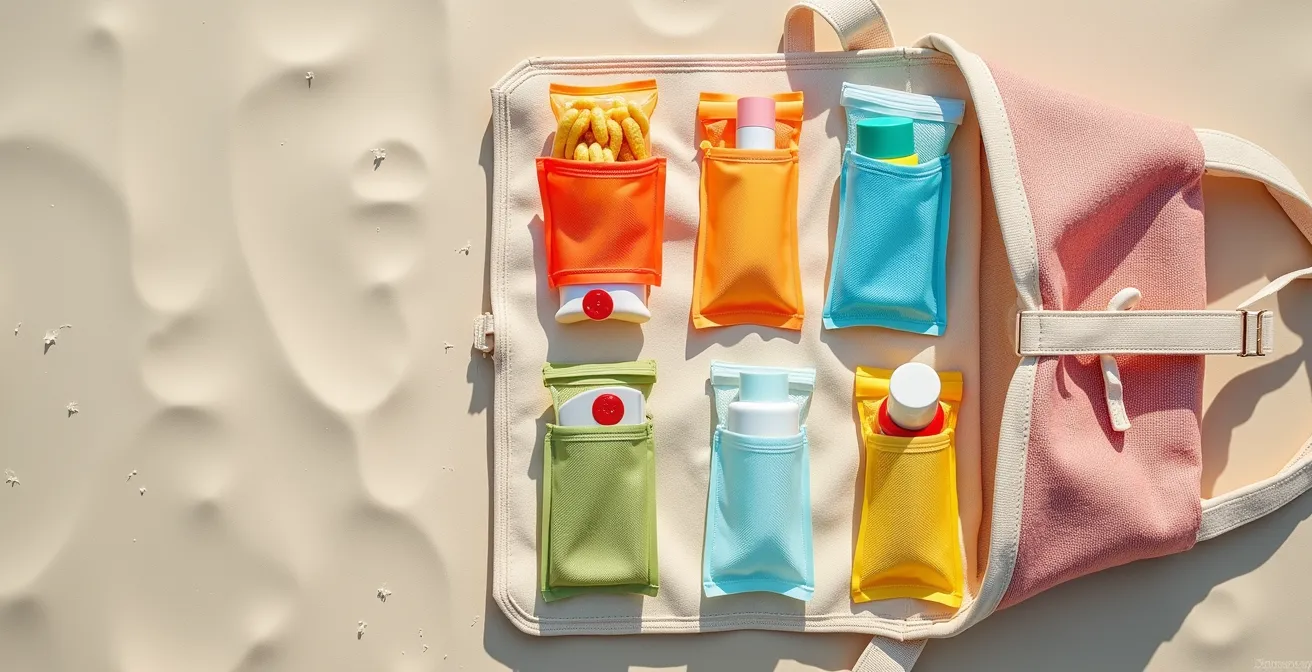
This method doesn’t just organize your gear; it organizes your response to common beach-day problems. Instead of thinking “Where is the band-aid?”, you simply think “Grab the red pouch.” This small shift dramatically reduces mental load and stress in the moment.
Case Study: The Modular Pod System
Moms on Call CEO Morgan, faced with managing beach trips for five toddlers, found success by implementing a modular pod system. She designated separate, waterproof pouches for sun care, snacks, first aid, and clean-up supplies. This systematic approach eliminated the frantic searching common with large beach bags and reportedly reduced packing time by half, proving the efficiency of a “systems thinking” approach to beach logistics.
Public Access vs. Private Resort Beach: Which Is Safer for Kids?
Not all beaches are created equal, especially when it comes to toddler safety. The choice between a public access beach and a private one managed by a resort involves a series of trade-offs in environmental control. While public beaches offer freedom and local flavor, private resort beaches often provide a more controlled and predictable environment, which can be a significant advantage for parents of young children.
The key differences lie in crowd control, maintenance, and the availability of immediate assistance. Private beaches limit access to guests, resulting in fewer people and making it easier to keep a visual on your child. They are also typically cleaned and maintained regularly, reducing the risk of encountering broken glass, trash, or other hazards. Perhaps the most critical factor is the reliable presence of lifeguards. The chance of drowning at a beach with lifeguards is 1 in 18 million, according to the U.S. Lifesaving Association, a statistic that powerfully underscores their value.
The following table breaks down the safety factors to consider when making your choice. While a private beach often has the edge on paper, a well-chosen and less-crowded public beach can be perfectly safe with the right supervision strategy.
| Safety Factor | Public Beach | Private Resort Beach |
|---|---|---|
| Crowd Control | Unpredictable, varies by day/season | Limited to resort guests |
| Lifeguard Presence | Varies, may have designated hours | Typically full-day coverage |
| Beach Hazards | May include debris, unleashed dogs | Regularly maintained and cleaned |
| Supervision Strategy | Requires hypervigilance, bright clothing | Controlled perimeter reduces wandering risk |
| Emergency Access | Public services, variable response time | On-site medical staff, faster response |
The Water Current Trap That Even Good Swimmers Don’t See
For many parents, the biggest fear at the beach is a big wave or deep water. However, one of the most deceptive dangers lies in just a few inches of water. Longshore currents are currents that run parallel to the shore, often in the trough between the beach and a sandbar. They may not look powerful, but they can easily knock a toddler off their feet and pull them down the beach faster than a parent can react. The National Weather Service warns that children are especially susceptible to longshore currents, even in very shallow areas.
This is why the most critical water safety system is non-negotiable: “touch supervision.” This isn’t just watching your child from a beach chair. It’s an active, physical commitment. The American Academy of Pediatrics provides a clear and essential directive on this matter.

Touch supervision means having an adult beside them, within arm’s reach, whenever they’re in the water, keeping one hand on them while they float, paddle or play
– American Academy of Pediatrics, Beach Safety Guidelines
This system eliminates the risk of being swept away by an unseen current, being knocked over by a small shore-break wave, or the common toddler tendency to put sandy, wet hands (or just sand) in their mouth. If your toddler is in or near the water’s edge, an adult must be right there, with the ability to reach out and grab them instantly. There are no exceptions to this rule.
Problem & Solution: Setting Up Wind-Resistant Shade for Nap Time
A successful beach nap can be the key to a full, happy day. But getting a toddler to sleep with the sun, heat, and wind is a major challenge. The first part of the system is creating a stable, secure shade structure. A beach tent that collapses in the wind is worse than no tent at all. To prevent this, you need a wind-defense setup.
The core principle is to anchor your tent securely and use your environment to your advantage. Start by positioning the tent so its back or smallest side faces the prevailing wind. When securing it, don’t just pile sand into the anchor bags; dig a hole and bury the filled sandbags at least 8 inches deep for maximum stability. Use spiral sand anchors for the guylines and make sure they are driven at least 12 inches into the sand. Finally, create a low windbreak on the windward side using heavy coolers and beach bags. This multi-layered approach creates a surprisingly calm and stable oasis.
However, a stable tent isn’t enough. You also need to create a sleep-conducive environment inside it. The key is familiarity and blocking out stimulation.
Case Study: The Beach Tent Acclimatization System
Simply putting a toddler in a new tent and expecting them to sleep often fails. A successful tactic involves “acclimatizing” the child to the space beforehand. Parents who introduced the beach tent as a fun play space for 20 minutes before naptime reported significantly better nap success. The most effective strategy involved bringing familiar items from home, such as a favorite blanket and a portable white noise machine, inside the tent. According to Moms on Call, this system created a sleep-conducive environment that led to 80% better nap success despite the distracting beach surroundings.
AI Chatbot vs. Nurse Hotline: Who Gives Safer Advice for Midnight Fevers?
A vacation can be quickly derailed by an unexpected health issue, like a sudden fever in the middle of the night. In that moment of panic, it’s tempting to turn to the quickest source of information, whether that’s a search engine or an AI chatbot. While these tools can provide general information, they cannot offer personalized, medically sound advice. When it comes to your child’s health, your system should always prioritize access to qualified human professionals.
The debate isn’t really “AI vs. nurse”; it’s about being prepared versus being unprepared. The safest source of advice is the one you’ve set up before you even leave home. This means having a direct line to a trusted medical resource. As the Children’s National Hospital notes, many childhood issues on vacation, such as fevers, can stem from environmental factors like overexposure to the sun. They emphasize that “overexposure to sunlight before age 18 is most damaging to the skin,” highlighting the need for a prepared medical response plan for everything from sunburn to fevers.
Your goal is to create a digital first-aid protocol on your phone so you’re not scrambling for information when you need it most. This system ensures you have reliable contacts and information at your fingertips, regardless of your location or internet connectivity.
Your Digital First-Aid Travel Checklist
- Pre-save your pediatrician’s after-hours number and your insurance company’s 24/7 nurse hotline number directly in your phone contacts.
- Download your health insurance provider’s app before you travel and log in to ensure it’s working. Many have “find a doctor” or telemedicine features.
- Before leaving, map the nearest urgent care center and hospital to your hotel and save the addresses in your phone’s map app for offline access.
- Take a screenshot of the front and back of your insurance cards and save them to a “favorites” album on your phone for easy, offline retrieval.
- Create a note in your phone with your child’s key medical history: any known allergies, current medications and dosages, and date of birth.
How to configure Car Seats in a High-Riding SUV Without Back Strain?
The journey to and from the beach can be a surprising source of physical strain and logistical chaos. Lifting a tired, sandy toddler into a high-riding SUV without tweaking your back, all while trying to minimize sand contamination, requires a dedicated system. The process can be broken down into two parts: managing the environment (the car) and managing your body mechanics (the lift).
First, the sand. The most effective method is proactive containment. Before you even leave for the beach, lay large, old towels over the car seats and floor area where your kids will be. Then, keep a separate “clean bag” in the car with a change of clothes and a bottle of water. Before getting in the car, do a quick rinse of sandy feet and hands and change your toddler into their clean, dry clothes. This “towel and transfer” technique is a game-changer for keeping your car’s interior and the car seat itself from becoming a sandbox. One study of family travel habits noted that families using this method reported 90% less sand contamination in their vehicles.
Second, the lift. Protecting your back is crucial. Twisting while lifting is a recipe for injury. The key is to get your body as close and parallel to the car seat as possible. Here’s the ergonomic technique:
- Open the SUV door as wide as possible and slide the front seat all the way forward to create maximum space.
- If possible, place one knee on the vehicle’s seat or floor. This brings your center of gravity lower and closer to the car seat.
- Hold your child close to your chest and slide them in horizontally, using your leg and arm muscles, not your lower back.
- Keep your spine as straight as you can throughout the movement and consciously avoid any twisting motions.
- If your SUV has a running board, use it as a step to gain height and reduce the lifting distance.
This deliberate, two-part system turns a dreaded task into a smooth, painless procedure.
Key Takeaways
- The ‘Midday Reset’ System: Avoid the beach between 11 AM and 3 PM to eliminate the biggest sun risks and prevent toddler meltdowns.
- The Modular Packing System: Use color-coded pouches for sun care, snacks, and first aid to find anything in your beach bag in under 5 seconds.
- The ‘Touch Supervision’ System: Maintain arm’s-reach contact with your toddler in or near the water at all times as a non-negotiable safety rule.
How to Get Into Nautical Sports Without Breaking the Bank?
As your toddlers grow, their curiosity about the water will expand beyond splashing at the shore. They’ll see kayaks, paddleboards, and boats and want to join in. While introducing them to nautical sports is a fantastic way to build their confidence, it can also be an expensive endeavor. The system here is one of staged exposure and low-cost experimentation. Avoid the temptation to buy gear or book expensive lessons right away.
The goal is to gauge your child’s interest and comfort level with minimal financial commitment. Start with free and cheap activities that expose them to the nautical world. Visiting a local marina to watch sailboats, taking a short public ferry ride, or even just watching lifeguard demonstrations can build excitement and familiarity with being on the water. These small steps let you see what piques their interest without spending a dime on gear they might use only once.
Once you see genuine interest, you can progress to low-commitment rentals. This staged approach allows you to introduce new experiences gradually and cost-effectively, ensuring you only invest in what your family truly enjoys.
Case Study: The Progressive Water Sports Introduction Model
A successful model observed among families in Clearwater Beach involved a clear, staged approach to water sports. They began with inexpensive, toddler-friendly introductions, such as using a $20 inflatable boat in the shallows. Based on the child’s reaction, they then progressed to a 30-minute pedal boat rental for around $40. Only after seeing sustained interest did they consider a formal kayak lesson. This progressive method saved families an average of $500 compared to those who immediately purchased equipment or booked expensive tours, proving the value of a slow and steady approach.
Ultimately, transforming your family beach vacation from stressful to serene is about this one crucial mindset shift: stop packing for problems and start building systems to prevent them. By proactively managing your time, gear, and safety protocols, you trade anxiety for confidence, allowing you to be present and create the joyful memories that last a lifetime.