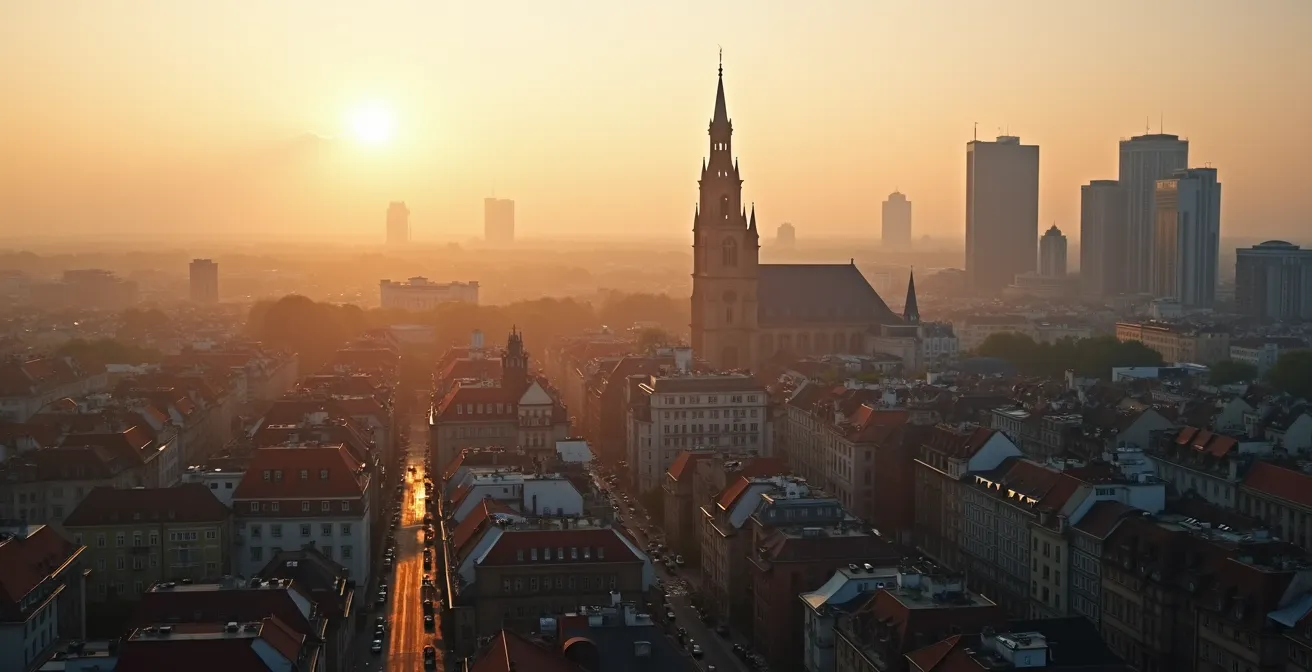
To truly understand a city, you must look past individual landmarks and learn to read the architectural narrative of its streets—a story of power, economy, and social values.
- Architectural details reveal more than style; they expose the philosophical and economic priorities of an era.
- The tension between perfect restoration and authentic decay is a visual dialogue about how a city chooses to remember its past.
- Public spaces and street layouts are not accidental; they are designed expressions of a city’s attitude towards community and control.
Recommendation: On your next trip, approach the city as an urban detective. Start with a hypothesis about its history and use the buildings themselves as primary evidence to prove or disprove it.
You’re walking through the winding streets of an ancient city. The stone facades are a tapestry of centuries, whispering tales you can’t quite decipher. You see the beauty, but you feel a frustrating disconnect—a sense that the real story is just out of reach. What does that peculiar window shape mean? Why does this narrow alley suddenly open into a grand plaza? The common advice is to memorize architectural styles or to simply “look up.” You might learn to spot a Corinthian column or a Gothic arch, but this often feels like collecting facts rather than understanding the narrative.
This approach treats buildings like museum artifacts in a catalog, static and separate. It misses the point. A city is not a collection of objects; it is a living, breathing organism, an urban palimpsest where layers of history are constantly written, erased, and rewritten. The key to understanding it isn’t found in a textbook of styles, but in learning to read the relationships between buildings, the flow of streets, and the very choices made in stone and mortar. But what if the secret wasn’t about identifying what a building *is*, but decoding *why* it is the way it is?
This guide offers a different perspective. It will equip you with the tools of an urban archaeologist, transforming you from a passive tourist into an active interpreter. We will explore how to read the narrative of space, from the strict regulations of a historic district to the subtle design cues that dictate social life. We will delve into the economic forces that shape a city’s skyline and the philosophical battles waged between restoration and decay. By the end, you will not just see buildings; you will read the city’s architectural DNA, uncovering the human story of ambition, conflict, and daily life embedded in its very fabric.
This article provides a framework for looking at cities with new eyes. The following sections will guide you through the specific clues and methods you can use to decode the rich history written on the walls of any urban landscape.
Summary: Decoding the Architectural DNA of a City
- Why You Can’t Change the Windows in a Historic District?
- How to Distinguish Gothic From Baroque in 3 Details?
- Restored Façade vs. Authentic Decay: Which Tells the Real Story?
- The “Old Town” Premium That Doubles the Price of Coffee
- Sequencing Your Walk: Following the Chronological Growth of the City
- Problem & Solution: Renovating Non-Conforming Structures Legally
- The Design Mistake That Removes Public Seating and Kills Street Life
- How to Plan a Trip That Satisfies Your Intellectual Curiosity?
Why You Can’t Change the Windows in a Historic District?
The frustration is common: a homeowner in a picturesque historic district wants to install modern, energy-efficient windows but is blocked by a seemingly inflexible preservation commission. This isn’t arbitrary aesthetic policing; it’s a calculated act of economic and cultural stewardship. Historic districts are governed by strict regulations because their collective character is a fragile, and valuable, asset. The uniformity of details like windows, rooflines, and materials creates a cohesive “sense of place” that is the very engine of its appeal. Changing one element, like a window, can begin to unravel this carefully maintained fabric.
The logic is rooted in maintaining property value and economic vitality. As Marvin Windows expert Charles McBrien notes, the benefits are tangible: “Homes in neighborhoods that are protected by historic preservation regulations often have higher property values, are less susceptible to fluctuations in the real estate market, and experience a lower rate of foreclosures.” These regulations act as a form of collective insurance, protecting every owner’s investment by ensuring the neighborhood’s unique character—its primary draw—remains intact. This is the micro-economic reason behind the strict rules.
On a macro level, this preservation has a powerful ripple effect. The authentic atmosphere of these districts attracts tourism, which becomes a significant economic driver for the entire city. In fact, research into the economic benefits of historic preservation shows that heritage tourism can generate an average of $336.24 in spending per visitor. That high-priced coffee in the old town square isn’t just for the ambiance; it’s part of a complex economic ecosystem built on the foundation of those very window regulations. So, when you see a district of perfectly preserved windows, you’re not just looking at old glass; you’re seeing a key pillar of the local economy.
How to Distinguish Gothic From Baroque in 3 Details?
Standing before two grand, ancient European churches can be bewildering. Both are ornate, imposing, and clearly from a distant past. But are they Gothic or Baroque? Moving beyond simple identification to understanding the *intent* behind the style is key to reading the building’s story. Rather than memorizing a checklist of features, focus on the core philosophy each style communicates. You can distinguish them by observing the “story” they tell through three key visual indicators: their use of energy, structure, and light.
First, consider the direction of energy. Gothic architecture is all about verticality. Its pointed arches, ribbed vaults, and soaring spires pull your eyes and spirit upward, aspiring toward the heavens. The energy is contained, focused, and directed toward a singular, divine point. Baroque, in contrast, is explosive. It’s a theatrical, centrifugal force. Curved facades, dramatic sculptures, and swirling decorations push energy outward, engaging the viewer in an emotional, dynamic spectacle on earth. Gothic is an arrow to God; Baroque is a divine drama unfolding around you.
Next, analyze the structural logic. Gothic architecture is famously honest; it wears its skeleton on the outside. The load-bearing elements—the flying buttresses, the ribbed vaults, the pointed arches—are all visible. You can read how the building stands just by looking at it. It is a masterpiece of engineering made beautiful. Baroque, on the other hand, often conceals its structure behind an opulent, decorative skin. The primary goal isn’t to show you *how* it’s built, but to create an overwhelming emotional effect. The structure serves the drama, rather than defining it.
Finally, pay attention to the philosophy of light. In a Gothic cathedral, light is filtered, mystical, and otherworldly. Stained-glass windows transform sunlight into a vibrant, colored haze, creating a space that feels separate from the outside world. The goal is contemplation and mystery. Baroque architects used light for drama. They mastered chiaroscuro—the strong contrast between light and shadow—to highlight specific features, create a sense of movement, and evoke powerful emotions. Light in a Baroque church is an active participant, a spotlight in a divine play.
Restored Façade vs. Authentic Decay: Which Tells the Real Story?
As you wander a historic city, you’ll inevitably encounter two contrasting sights: a building restored to its imagined former glory, with pristine stonework and a fresh coat of paint, and another left to the elements, its facade a beautiful, crumbling tapestry of moss, cracks, and patina. This presents a central question in preservation: which building tells the “real” story? Is history best served by erasing the ravages of time or by embracing them as part of the narrative? The answer is a complex and ongoing debate.
The argument for restoration is one of clarity and legacy. Proponents believe that to understand a building’s original intent, we must see it as its architect and first inhabitants did. This approach aims to halt decay and present a clear, educational version of the past, preserving the architect’s vision for future generations. It treats the building as a finished masterpiece whose most important story is the moment of its creation. The subsequent centuries of wear, tear, and alteration are seen as noise that obscures the original signal. This philosophy values the origin story above all else.
The philosophy of “authentic decay,” however, argues that the passage of time is itself the most important part of the story. From this perspective, a building is not a static object but a living document. Every crack, stain, and patch of moss is a paragraph in its biography, testifying to centuries of weather, historical events, and human interaction. To erase this patina is to tear pages from the book. This view, famously championed by figures like John Ruskin, sees beauty in imperfection and finds historical truth in the evidence of age. The building’s story is not just its birth, but its entire life.
This visual dialogue between the restored and the weathered is the essence of the urban palimpsest. One shows a single, frozen moment; the other reveals the continuous flow of history.
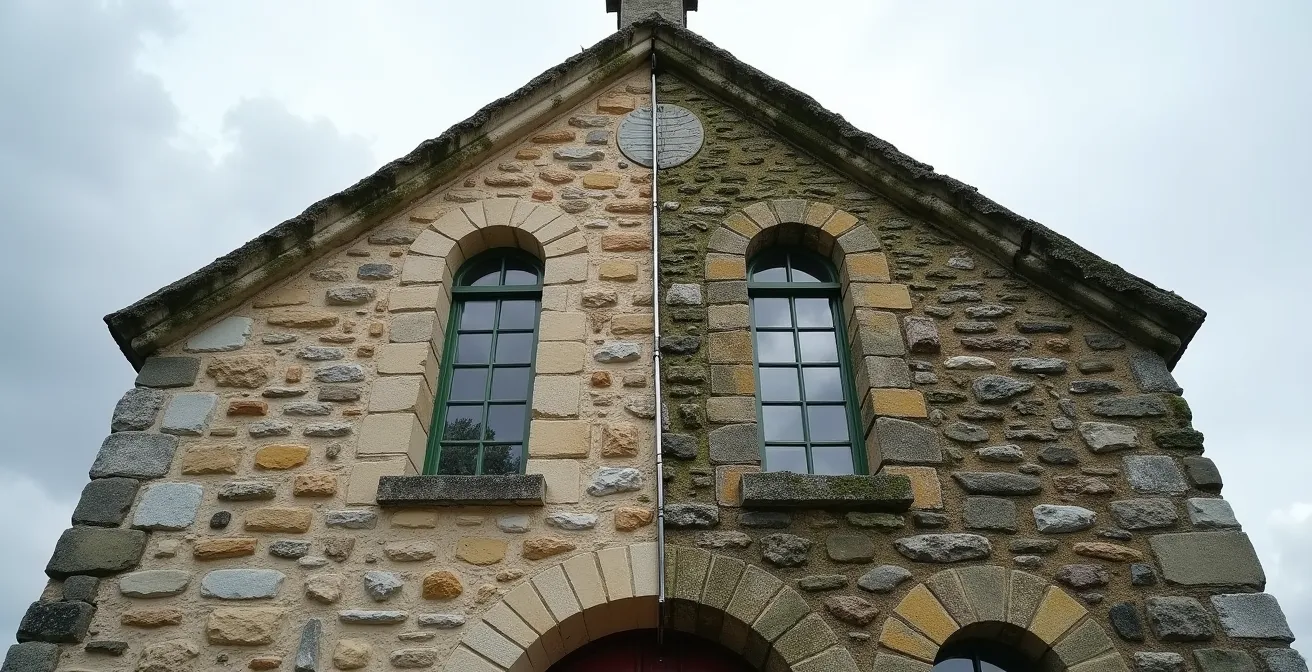
As this image illustrates, the two are not mutually exclusive but parts of a larger conversation. Official guidelines often seek a middle ground. As the U.S. National Park Service states in its influential standards, “The Standards are to be applied to specific rehabilitation projects in a reasonable manner, taking into consideration economic and technical feasibility.” This acknowledges that neither extreme is always possible or desirable. The “real” story is often found in the tension between the two—a city’s ongoing choice of what to save, what to restore, and what to let gracefully age.
The “Old Town” Premium That Doubles the Price of Coffee
That expensive cup of coffee you buy in a charming, cobblestone square is priced for more than just caffeine. You’re paying an “Old Town premium,” an invisible surcharge for the privilege of sitting within a beautifully preserved historic environment. This premium isn’t just market opportunism; it’s the direct economic outcome of successful historic preservation. The meticulously maintained facades, car-free streets, and authentic atmosphere create a powerful consumer demand, turning these districts into prime real estate for commerce.
The economic logic is straightforward: authenticity sells. For travelers, visiting historic landmarks consistently ranks among the top activities. This high demand allows businesses in these zones to command higher prices. But the story is more complex than simple supply and demand. The premium is also a reflection of the significant investment—both public and private—required to maintain that authenticity. Preservation is a costly endeavor, involving specialized labor, expensive materials, and navigating dense regulations. The higher prices for goods and services are, in part, how the economic ecosystem of the district sustains itself.
Case Study: The Historic District Economic Ripple Effect
The renovation of the Joplin Muir Block building in Missouri is a clear example of the economic footprint of preservation. This single project created a powerful multiplier effect. It employed specialized craftsmen, required the sourcing of local materials, and, by restoring a key building, sparked “pride-of-place” investment that increased the value of adjacent properties. This demonstrates how preserving one historic structure can uplift an entire area, creating a virtuous cycle of investment and rising value that ultimately underpins the “Old Town premium.”
Therefore, the premium on your coffee is not a simple rip-off. It is the financial expression of a district’s success. It represents the return on investment for decades of preservation efforts. It pays for the master stonemason who repaired the fountain in the square, the enforcement of zoning laws that keep out inappropriate modern structures, and the public infrastructure that makes the area pleasant to walk through. When you see high prices in a historic quarter, you are seeing a sign that the strategy of preservation is working, creating a place so desirable that people are willing to pay more to be in it.
Sequencing Your Walk: Following the Chronological Growth of the City
To truly read a city, you must understand its biography, and the best way to do that is to walk through its chapters in the correct order. Cities grow like trees, with a historic core and successive rings of development expanding outward over time. By consciously sequencing your walk from the oldest part of the city to the newest, you can physically experience its evolution. This “urban tree ring” method transforms a random stroll into a chronological journey, revealing the city’s growth patterns and the historical forces that shaped them.
Your first task is to identify the original settlement, or the “architectural DNA” of the city. This is often the medieval core, characterized by narrow, winding streets that predate the logic of the automobile. Look for a dense cluster of the oldest buildings, often centered around a cathedral, a market square, or a fortress. This is Chapter One of the city’s story. From here, the narrative unfolds. Look for the first major expansion: often, a grand circular boulevard. These roads frequently trace the path of demolished medieval walls, marking the moment the city felt secure enough to break out of its defensive shell.
As you move further from the core, you enter new historical eras. Follow the railway lines. These iron arteries were the vectors of 19th-century industrial growth. The architecture here will shift to reflect the Industrial Revolution: brick factories, grand train stations, and rows of worker housing. The grid plan might appear, a sign of rational, large-scale planning. Beyond this industrial ring, you’ll likely find the suburban developments of the 20th century, with their distinct post-war architecture, cul-de-sacs, and car-centric design. Each ring has its own architectural language, telling the story of the technology, economy, and social values of its time.
Action Plan: The Urban Tree Ring Method
- Identify the core: Start your walk by finding the medieval or original settlement patterns, recognizable by their narrow, winding streets and central public spaces like a market or cathedral.
- Find the first ring: Locate where old city walls were likely torn down and replaced by grand boulevards, which often form a circular or semi-circular road around the core.
- Trace industrial expansion: Follow the path of railway lines leading out from the center to discover the 19th-century growth areas, characterized by factories and worker housing.
- Map suburban rings: Look for post-war residential developments further out, identifiable by their curving streets, cul-de-sacs, and distinct mid-century architectural styles.
- Spot anomalies: Actively question any “leapfrog” development. If the city seems to have jumped over an area, investigate the reason—was it a geographical barrier, a private estate, or an industrial zone?
By following this chronological path, the city ceases to be a confusing jumble of buildings. It becomes a coherent narrative, where each transition from one “ring” to another marks a pivotal moment in its history. This method provides a powerful structure for your exploration, allowing you to read the grand story of the city’s growth in the sequence it was written.
Problem & Solution: Renovating Non-Conforming Structures Legally
One of the greatest challenges in keeping historic cities vibrant is dealing with “non-conforming structures”—buildings that are historically significant but no longer suit modern needs. Think of a cavernous 19th-century church in a city facing a housing crisis, or an old warehouse in a neighborhood that has become residential. Demolition would be a tragic loss of the city’s urban palimpsest, but leaving them empty leads to decay. The solution lies in the sophisticated practice of adaptive reuse, a process that requires navigating a complex web of legal and design standards.
The core problem is that historic preservation laws were often written with pure restoration in mind—returning a building to its exact original state. This rigid approach can be a death sentence for buildings whose original function is obsolete. However, a more flexible and pragmatic approach is gaining traction. This involves differentiating between three distinct actions: “Restoration” (returning to a past state), “Renovation” (updating for modern use), and “Rehabilitation” (making a historic property functional for a new purpose). The 2024 ACHP report on adaptive reuse highlights successful projects where, for example, institutional buildings were converted to housing while maintaining their essential historic character, as noted in a study on successful adaptive reuse strategies. This demonstrates that a building’s life can be extended by changing its function without erasing its history.
This shift toward flexibility is being championed at the highest levels. Sara C. Bronin, Chair of the U.S. Advisory Council on Historic Preservation (ACHP), has argued for a reinterpretation of federal standards to “allow greater flexibility in changing floor plans, adding interior atria, [and] reconfiguring large assembly spaces.” This is not a call to abandon preservation, but to make it smarter. It’s an acknowledgment that the best way to save a historic building is to give it a viable economic future. For the curious traveler, spotting a successful adaptive reuse project—like luxury lofts in an old factory or a public library in a former bank—is like seeing history and the future in a dynamic, living dialogue. It’s a sign of a city that is not just preserving its past, but actively investing in it.
The Design Mistake That Removes Public Seating and Kills Street Life
You may have walked through a public square that, despite being aesthetically pleasing, felt strangely sterile and empty. The reason is often subtle but profound: the absence of simple, comfortable places to sit. The decision to limit or design public seating in a way that discourages lingering is one of the most common and damaging mistakes in urban design. This practice, often part of a broader strategy known as “hostile architecture,” actively kills street life by communicating a clear message: this space is for passing through, not for staying.
The narrative of space is powerfully told through its seating. A long, open bench invites strangers to sit together, to rest, to watch the world go by. It facilitates spontaneous social interaction and turns a simple plaza into a community living room. Conversely, benches with individual armrests or segmented seats are deliberately designed to prevent people—particularly the homeless—from lying down. While often justified under the guise of orderliness or security, the practical effect is to make public space less comfortable and welcoming for everyone. It prioritizes control over community.
This design choice has a cascading effect on the social and economic health of a street. When people don’t linger, the “eyes on the street”—a concept famously articulated by urbanist Jane Jacobs—disappear. This can make a space feel less safe, creating a vicious cycle where fewer people want to spend time there. Furthermore, a lack of public seating hurts local businesses. People who are resting are more likely to notice a shop window, decide to get an ice cream, or simply enjoy the atmosphere, contributing to the area’s economic vitality. A street without seating is a street without potential customers at rest.
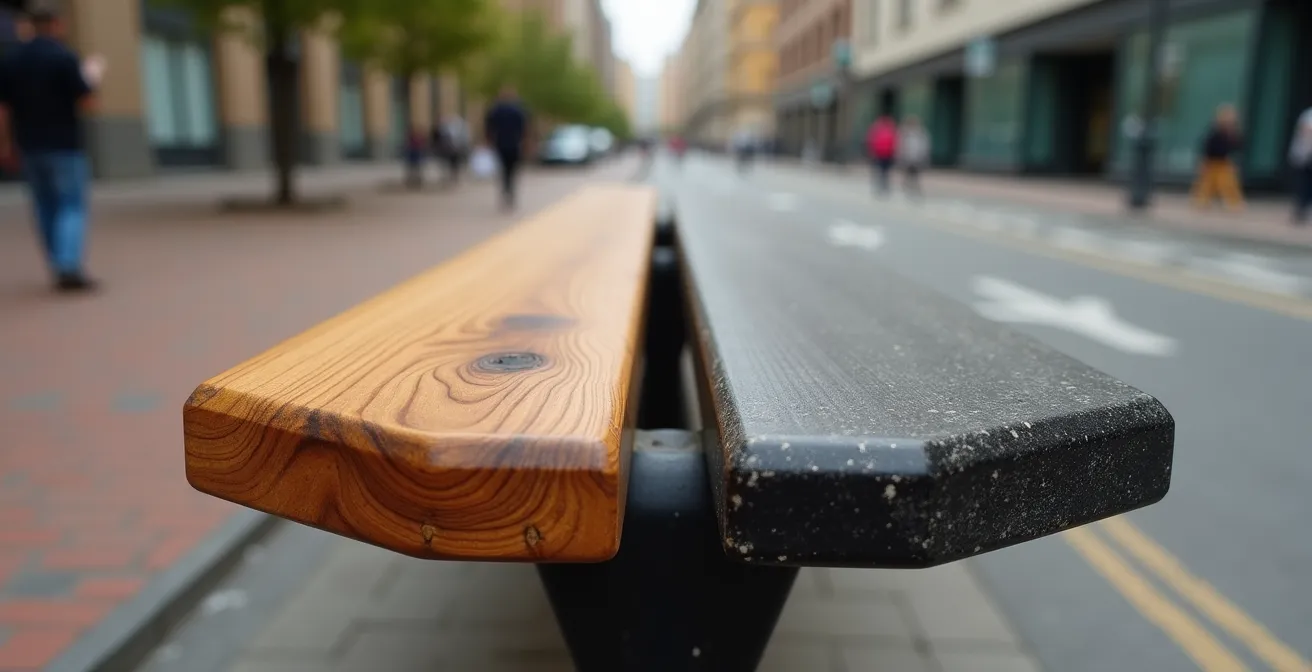
The contrast is stark, as this image shows. The choice between a continuous, welcoming surface and a divided, defensive one is a choice between two different visions of public life. One embraces the unpredictable, sometimes messy, reality of a vibrant community. The other seeks to sanitize and control public behavior at the cost of vitality. When you are reading a city, pay close attention to its benches. They are one of an urban area’s most honest storytellers, revealing its true attitude towards its citizens far more than any official slogan or monument.
Key Takeaways
- True architectural literacy is not about naming styles, but about interpreting the human stories of power, economy, and community embedded in buildings.
- A city is an “urban palimpsest,” where the tension between meticulous restoration and authentic decay tells a story about its relationship with time and memory.
- The most telling historical clues are often found not in grand monuments, but in the subtle design of public spaces and the chronological layout of the city’s growth.
How to Plan a Trip That Satisfies Your Intellectual Curiosity?
A truly satisfying journey for a curious traveler is not a passive sightseeing tour, but an active investigation. To transform your trip from a checklist of landmarks into an intellectual adventure, you need to approach your destination like an urban detective conducting a field study. This means moving beyond the “what” (seeing the famous cathedral) to the “why” (understanding why it was built there, in that style, at that time). The key is to arrive with a question, a theory you want to test, and to use the city’s architecture as your primary evidence.
Start your planning not with a list of sites, but with a hypothesis. Based on some pre-trip research, form a theory about the city’s historical identity. Was it a center of religious power, a nexus of trade, or a military stronghold? This question will become the organizing principle of your exploration. For example, if you hypothesize the city’s identity was built on mercantile wealth, you can create a thematic day dedicated to the “economic footprint.” Your route would connect the old guild halls, the historic marketplace, the merchants’ grand houses, and the workers’ quarters, allowing you to read the story of trade and labor in the urban landscape.
This investigative method requires a few key tools and techniques. Use digital tools like historical map overlays on your phone to see what has vanished; the ghost of a city wall or a filled-in canal can be as revealing as a standing building. Your primary method, however, should be observation. As you walk your thematic routes, actively look for “pattern breaks”—sudden shifts in architectural style, street width, or building scale. These anomalies are crucial clues. Why does a row of humble brick houses suddenly give way to ornate stone mansions? The answer could reveal an old class boundary or a pivotal moment of economic change. Finally, don’t be afraid to “interview” the locals. Ask a shopkeeper or a resident about a building that seems out of place; you might uncover a hidden history that no guidebook contains.
This approach elevates travel beyond simple tourism. It becomes a personal research project, a quest to answer a question you’ve posed yourself. Here is a method to structure your investigation:
- Form a pre-trip theory: Research the city’s historical role and predict where its power and wealth were displayed architecturally.
- Create thematic days: Plan a “Power & Control” route (cathedral, courthouse, fortress) or a “Trade & Labor” path (guild halls, markets, worker housing).
- Use digital archaeology tools: Compare historical maps on overlay apps to visualize vanished structures and see how the city has changed.
- Document pattern breaks: Take note of where architectural styles suddenly change and actively investigate the historical reason for the shift.
- Interview locals: Ask about buildings that “don’t fit” or have interesting stories to uncover the city’s hidden oral histories.
Start applying this new lens on your next journey. Don’t just see the sights; read the city. Every street is a sentence, every facade is a word, and you now have the grammar to understand their meaning. The story is waiting for you.