
The key to a successful 3-day city break isn’t a packed itinerary, but a strategic one that minimizes hidden “energy taxes.” Instead of trying to do more, this guide focuses on eliminating logistical friction, cognitive overload, and physical fatigue. By understanding the systems that govern a city—from transit to museum design—you can see more with less effort, turning a frantic rush into an efficient and enjoyable exploration.
The 3-day city break presents a classic traveler’s dilemma: the intense desire to experience everything versus the harsh reality of limited time and energy. You arrive with a list of must-see sights, ready to conquer the city, but by day two, your feet are aching, your mind is numb, and the joy of discovery has been replaced by the pressure of a checklist. The common advice—”plan ahead,” “don’t overschedule”—is well-intentioned but misses the point. It treats the symptom, not the cause.
The real saboteurs of your short trip aren’t the long queues or the ambitious schedule. They are the invisible “energy and time taxes” you pay throughout the day: the 15 minutes spent deciphering a subway map, the mental drain of navigating a sprawling museum, and the physical toll of simply standing still. These small frictions accumulate, leading to decision fatigue and physical burnout long before you’ve ticked off your main attractions.
But what if the secret to efficiency wasn’t about moving faster, but about moving smarter? The true art of the 3-day trip lies in understanding and neutralizing these hidden drains. It’s about shifting from a mindset of “cramming it all in” to one of “strategic energy management.” This requires a new perspective—seeing the city not just as a collection of sights, but as a system to be navigated with intelligence.
This guide will deconstruct the common pitfalls of urban exploration. We will provide a framework to help you master public transport quickly, make savvy financial choices on passes, sequence your days for maximum efficiency, and, most importantly, conserve your most precious resources: your time and energy. Prepare to replace exhaustion with exhilaration.
To navigate this new approach, here is a breakdown of the strategies we will cover, designed to help you build a smarter, more sustainable itinerary.
Summary: A Strategic Guide to the 3-Day City Break
- Why Standing in Museums Is More Tiring Than Walking?
- How to Master a Foreign Subway System in Your First Hour?
- City Pass vs. Individual Tickets: Doing the Math for Your Specific Trip
- The Distraction Trap That Teams of Thieves Use on Tourists
- Sequencing Your Day: Grouping Sights by Neighborhood to Save Time
- High-Density Walkability vs. Suburban Space: Which Fosters More Social Ties?
- Why Driving the Last Mile Takes Longer Than Scooting It?
- How to Visit a Huge Museum Without Getting “Museum Fatigue”?
Why Standing in Museums Is More Tiring Than Walking?
One of the most underestimated “energy taxes” on a city break is static fatigue. Many travelers find a two-hour museum visit more exhausting than a two-hour walk, and there’s a physiological reason for it. When you walk, your leg muscles contract and relax, acting as a pump that helps circulate blood back to your heart. When you stand still, this “muscle pump” is inactive. Your heart has to work harder against gravity to circulate blood, and blood can pool in your legs. This leads to a feeling of heavy-leggedness and overall lethargy, draining your energy far more quickly than gentle movement.
This physical drain is compounded by cognitive overload. Early research highlighted that museum visitors maintain high interest for only about 30 minutes before attention starts to wane. You’re not just standing; you’re actively processing vast amounts of visual information, which is mentally taxing. The combination of physical stasis and mental exertion is a potent recipe for burnout. Recognizing this allows you to reframe a museum visit not as a leisurely stroll, but as a high-intensity activity requiring a specific strategy.
To combat this, the solution isn’t to avoid museums but to manage your visit strategically. Wear supportive shoes with good cushioning, as this is your first line of defense against static load. More importantly, consciously alternate between standing and moving. Instead of shuffling slowly from piece to piece, walk at a normal pace to one section, spend a focused 10-15 minutes there, then walk briskly to another wing. Use the museum’s layout to your advantage by creating a walking circuit. Finally, take your breaks outside the museum in a park or quiet square, not in the crowded, overstimulating museum café. This combination of proper footwear, purposeful movement, and strategic breaks actively counteracts the hidden energy tax of standing still.
How to Master a Foreign Subway System in Your First Hour?
Arriving in a new city and facing an unfamiliar subway map can be a major source of anxiety and a significant time sink. The key to mastering it quickly is to stop trying to understand the entire system at once. Instead, focus on a “minimum viable knowledge” approach. Your goal in the first hour is not to become a local expert, but to confidently navigate between your accommodation and your first one or two anchor attractions. This drastically reduces the initial cognitive load.
Before you even descend into a station, orient yourself above ground. Identify a major landmark near your hotel—a tall building, a river, a large park. This landmark becomes your permanent compass point. Then, for your first journey, focus only on three pieces of information: the name of your starting station, the name of your destination station, and the name of the final stop on the line you need (the direction of travel). Ignore everything else. Many travelers waste precious mental energy trying to memorize transfer points and intermediate stops for a trip they’ll only make once.
This is where visual aids and preparation become crucial. Having the name and address of your destination written in the local language on your phone or a piece of paper can be a lifesaver when asking for help. It eliminates communication barriers and ensures you’re given the correct directions. Use the map to understand the logic of the system, not to memorize routes.
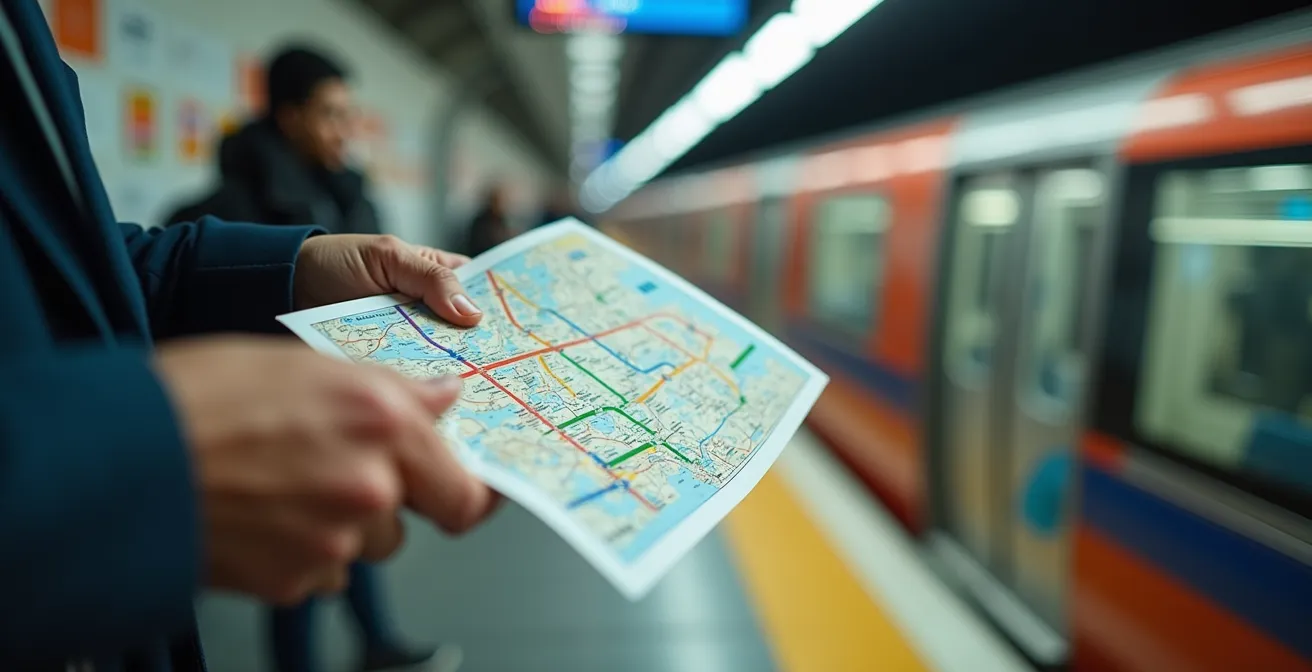
As the image suggests, the map is your tool, not your master. Once you complete your first one or two journeys, your brain will start to create a mental model of the city’s layout. You’ll begin to understand that the “walkable” area around a station is larger than you thought, or that two lines that look far apart on the map are actually connected by a short walk above ground. By starting small and building confidence, you transform the subway from a source of stress into your most powerful tool for efficient exploration.
City Pass vs. Individual Tickets: Doing the Math for Your Specific Trip
The “buy a city pass” advice is everywhere, often promising significant savings. While passes can be valuable, they are not a one-size-fits-all solution. The decision to buy one should be a calculated choice based on your travel style, not a blind leap of faith. The marketing often highlights maximum potential savings, with some claiming that CityPASS can save travelers up to 40% on major attractions. However, realizing these savings depends entirely on your pace and priorities.
The fundamental trade-off with most passes is flexibility versus cost. All-inclusive passes, which offer unlimited attractions for a set number of days, are best for fast-paced travelers who plan to visit several high-ticket sites each day. Attraction-based passes, which let you choose a set number of sights from a larger list, offer a middle ground. For relaxed travelers who prefer spontaneity and may only visit one major attraction per day, buying individual tickets is almost always cheaper and less stressful.
This table breaks down the value proposition based on different travel rhythms. It’s a critical tool for moving beyond marketing hype and making a data-driven decision for your specific trip.
| Travel Style | Best Pass Option | Potential Savings | Key Consideration |
|---|---|---|---|
| Fast-paced (3-5 attractions/day) | All-Inclusive Day Pass | Up to 50% | Must start early and plan route |
| Moderate (2-3 attractions/day) | Attraction-based Pass | 30-40% | Choose high-value attractions |
| Relaxed (1-2 attractions/day) | Individual Tickets | Minimal | More flexibility, less pressure |
| First-time visitor | Classic City Pass | 35-45% | Covers major must-sees |
Case Study: The Seattle CityPASS Reality Check
To illustrate the point, consider a real-world example. A traveler visiting Seattle’s Space Needle ($42), Chihuly Garden ($35), and Seattle Aquarium ($30) would pay $107 if buying tickets individually. The CityPASS, priced at $97, offered a modest saving of just $10. However, the pass’s value could have been increased by swapping one of those for a higher-value option like the Argosy Harbor Cruise ($39). The key takeaway is that savings are not automatic; they are generated by your specific choices. Before buying any pass, list your “must-see” attractions, sum their individual entry fees, and compare that total to the pass price. This simple exercise is the only way to know if it’s truly worth it for you.
The Distraction Trap That Teams of Thieves Use on Tourists
While exploring a bustling city, your biggest vulnerability isn’t just a moment of carelessness; it’s a moment of calculated distraction. Professional thieves, especially in crowded tourist hubs, rarely rely on brute force. They exploit cognitive overload. Their primary weapon is the “distraction trap,” where one person creates a sudden, attention-grabbing event—spilling a drink, dropping a map, asking for directions with unusual urgency—while an accomplice uses that split second of diverted attention to steal a wallet or phone. This is a form of logistical friction with severe consequences.
Understanding this tactic shifts your security mindset from passive awareness (“be careful”) to active defense (“reduce my target profile”). The goal is to make yourself a less appealing target by minimizing opportunities for distraction and theft. This starts with your gear. Use a cross-body bag worn on the front of your body or an anti-theft backpack. Never put a phone or wallet in your back pocket. These simple physical barriers make a grab-and-run attempt significantly more difficult, encouraging thieves to look for an easier mark.

As depicted, navigating a dense crowd requires a state of relaxed alertness, not paranoid tension. Your situational awareness should be focused on the space immediately around you. Be particularly vigilant in “squeeze points” like subway doors, escalators, and revolving doors, as these are prime locations for creating artificial bumps and distractions. Furthermore, smart itinerary planning plays a role in security. Grouping your attractions by area reduces unnecessary transit through crowded hubs, thereby minimizing your exposure to potential threats. Staying in central, well-lit locations near public transport also cuts down on long, vulnerable walks late at night. By building security into your logistics, you free up mental energy that would otherwise be spent on constant worry.
Sequencing Your Day: Grouping Sights by Neighborhood to Save Time
The advice to “group sights by neighborhood” is a classic travel tip, but its true power lies in “strategic sequencing.” It’s not just about what you see, but *when* and in what *order* you see it. An inefficient sequence can cost you hours in transit and significant amounts of energy, even if the attractions are geographically close. The goal is to create a logical flow that minimizes backtracking, aligns with your energy levels, and capitalizes on optimal visiting times.
A day’s itinerary should be built around one or two “anchor” attractions—the high-priority museums or landmarks that are the main reason for being in that neighborhood. Then, surround these anchors with smaller, more flexible “orbit” sights: a scenic viewpoint, a unique shop, a famous cafe. This structure gives your day purpose without making it rigid. Crucially, schedule the most cognitively demanding activities, like large museums or historical sites requiring concentration, for the morning (ideally between 10 a.m. and 1 p.m.) when your mind is freshest. Save more relaxed activities, like parks or neighborhood strolls, for the afternoon when your energy naturally wanes.
Case Study: A Blogger’s Efficient London Itinerary
A travel blogger applied this strategy to London’s Westminster area with remarkable results. They started the day with an early morning visit to the Houses of Parliament for photos, taking advantage of the soft light and minimal crowds. Next, a short 5-minute walk led them to Westminster Abbey right at its 9 a.m. opening, beating the tour bus rush. Afterward, they strolled through St. James’s Park towards Buckingham Palace for the Changing of the Guard. This tight, logical sequence completely eliminated an estimated 45 minutes of transit time that would have been wasted by zigzagging across the city, while also ensuring each sight was experienced at its best.
To implement this, use a digital map to plot your anchors and orbits before you go. Look at walking times and public transport routes between them. This pre-visualization helps you spot logistical flaws in your plan. Building a smart sequence turns your itinerary from a simple list into a powerful tool for time and energy conservation.
Action Plan: Your Day Sequencing Checklist
- Anchor Points: Identify the 1-2 non-negotiable “anchor” attractions for each day.
- Orbit Options: List smaller, flexible “orbit” sights (cafes, parks, viewpoints) located within a 15-minute walk of each anchor.
- Energy Mapping: Schedule the most mentally demanding anchors (e.g., large museums) for the morning and save relaxing orbits for the afternoon.
- Logistical Check: Use Google Maps to verify walking/transit times between your sequenced points to eliminate backtracking and identify the most efficient route.
- Buffer Zones: Intentionally schedule two 90-minute “empty” slots in your day to allow for spontaneous discoveries or simply to rest and recharge.
High-Density Walkability vs. Suburban Space: Which Fosters More Social Ties?
While the high density of a city center offers unparalleled walkability and access to attractions, it comes at the cost of constant stimulation. This environment, rich with social opportunities, can paradoxically lead to social withdrawal as travelers become overwhelmed and seek to block out the noise. For a short trip, the key isn’t to choose between a dense urban core and a quiet suburb, but to learn how to find “pockets of suburban space” within the city itself. These are your strategic recharge stations.
These pockets are quiet, low-stimulation environments that allow your brain and body to recover from the “energy taxes” of a dense urban landscape. They are the city’s hidden courtyards, public libraries, university campuses, church gardens, or elevated parks. Intentionally building these sanctuaries into your itinerary is not a waste of time; it’s an investment in your stamina. Spending just 20-30 minutes in one of these quiet zones can be more restorative than an hour in a crowded coffee shop.
Case Study: The Urban Sanctuary Strategy
Travel experts advocate for actively identifying these oases. A traveler in Manhattan, for example, reported feeling significantly refreshed after spending just 20 minutes reading in Bryant Park between visits to the MoMA and the New York Public Library. This short, intentional break allowed them to tackle their afternoon activities with renewed focus, while a companion who pushed through without a break experienced significant fatigue and irritability. The strategy is to punctuate high-density exploration with moments of planned tranquility, creating a sustainable rhythm for your day.
These spaces are more than just places to rest your feet. They are opportunities to observe local life at a slower pace, fostering a different kind of connection to the city. You might see office workers having lunch, students studying, or residents walking their dogs. This passive social observation can feel more authentic and grounding than the transactional interactions at major tourist sites. By balancing high-density sightseeing with these moments of suburban-like calm, you get the best of both worlds: efficient exploration and sustainable energy.
Why Driving the Last Mile Takes Longer Than Scooting It?
In a dense city, the “last mile”—the final leg of a journey from a transit hub to your destination—is often the most inefficient. While a car or taxi might seem like the comfortable choice, it frequently becomes a trap of one-way streets, congestion, and the near-impossible hunt for parking. This is where understanding the “micro-mobility threshold” becomes a game-changer for the time-crunched traveler. For short urban distances, driving is often the slowest option.
Micro-mobility, such as e-scooters and bike-sharing services, is purpose-built to solve this last-mile problem. These options allow you to bypass traffic, use dedicated lanes, and travel directly from point to point without worrying about parking. They turn a frustrating 20-minute journey by car into a pleasant 5-minute ride. The key is knowing when to use them. As a general rule:
- Walking is unbeatable for distances under 1 kilometer (about 0.6 miles), especially in scenic historic districts where the journey itself is part of the experience.
- E-scooters or bikes are optimal for the 1-3 kilometer range (0.6 to 1.8 miles). This is the sweet spot where walking is too slow and public transit is inefficient.
- Public transit or ride-sharing remains the most efficient choice for distances over 3 kilometers or when crossing multiple distinct neighborhoods.
Case Study: Micro-mobility Efficiency in Paris
An analysis of tourist travel patterns in Paris revealed the power of this threshold. Visitors who used e-scooters for journeys between 1 and 3 kilometers saved an average of 15 minutes per trip compared to those who waited for a bus or tried to find parking for a rental car. The study confirmed that trips under 1km were consistently faster on foot. This demonstrates a clear principle: choosing your mode of transport based on distance is a critical tactic for maximizing your time.
This isn’t just about speed; it’s about reducing logistical friction. The time and mental energy saved by not navigating traffic or searching for parking can be reinvested into enjoying your destination. The next time you face that 2km gap between the subway station and the museum entrance, grabbing a scooter isn’t lazy—it’s strategic.

Key Takeaways
- True travel efficiency comes from minimizing “energy taxes” like physical fatigue and cognitive load, not just from a packed schedule.
- Strategic sequencing of attractions based on geography and your own energy levels is more effective than simply grouping them by neighborhood.
- The best transportation method (walking, scooter, or transit) depends on a clear “micro-mobility threshold” based on distance.
How to Visit a Huge Museum Without Getting “Museum Fatigue”?
“Museum fatigue” is a real phenomenon that can derail an entire afternoon of a city break. It’s the feeling of mental and physical exhaustion that sets in when faced with an overwhelming amount of art and information. Research by museum expert Beverly Serrell found that this isn’t just a feeling; it’s a measurable decline in engagement, noting that visitors often become apathetic after less than 20 minutes in a gallery. The mistake most travelers make is entering a world-class museum like the Louvre or the Met with a vague goal of “seeing everything.” This is a recipe for burnout.
The solution is to abandon the completist mindset and adopt a “surgical strike” approach. Your visit should be a planned mission, not a random wander. The most effective strategy is to decide what you want to see *before* you enter. A brilliant hack is to start your visit in the gift shop. Look at the postcards. The 10-15 artworks featured there are what the museum itself considers its highlights. Take a picture of the ones that interest you, use the museum map to locate them, and make seeing those your primary goal.
Another powerful technique is to create a personal theme or scavenger hunt. Instead of trying to appreciate every genre, you could decide to only look for “depictions of storms,” “portraits of people with dogs,” or “every blue painting you can find.” This gamifies the experience, giving your brain a filter that makes the vast collection manageable and engaging. It turns a passive viewing into an active search, which is far less draining on your cognitive resources.
Finally, impose a strict time limit. Decide beforehand that you will spend a maximum of 90 minutes to 2 hours in the museum, and then you will leave, no matter what. This forces you to be decisive and focus on what truly matters to you. It’s far better to leave wanting more than to be dragged out in a state of total exhaustion. A well-executed 90-minute visit where you are engaged and energized is infinitely more valuable than a four-hour slog that leaves you too tired for anything else that day.
By shifting your focus from a simple checklist of sights to a strategic management of your energy and time, you transform the entire experience of a 3-day city break. The goal is not to see everything, but to fully enjoy what you do see. Adopting this mindset—eliminating hidden energy taxes, sequencing your day intelligently, and making conscious choices about how you move and rest—is the ultimate key to unlocking a rich, rewarding, and sustainable short trip. Apply these principles to your next adventure and discover how much more you can experience when you’re not exhausted.