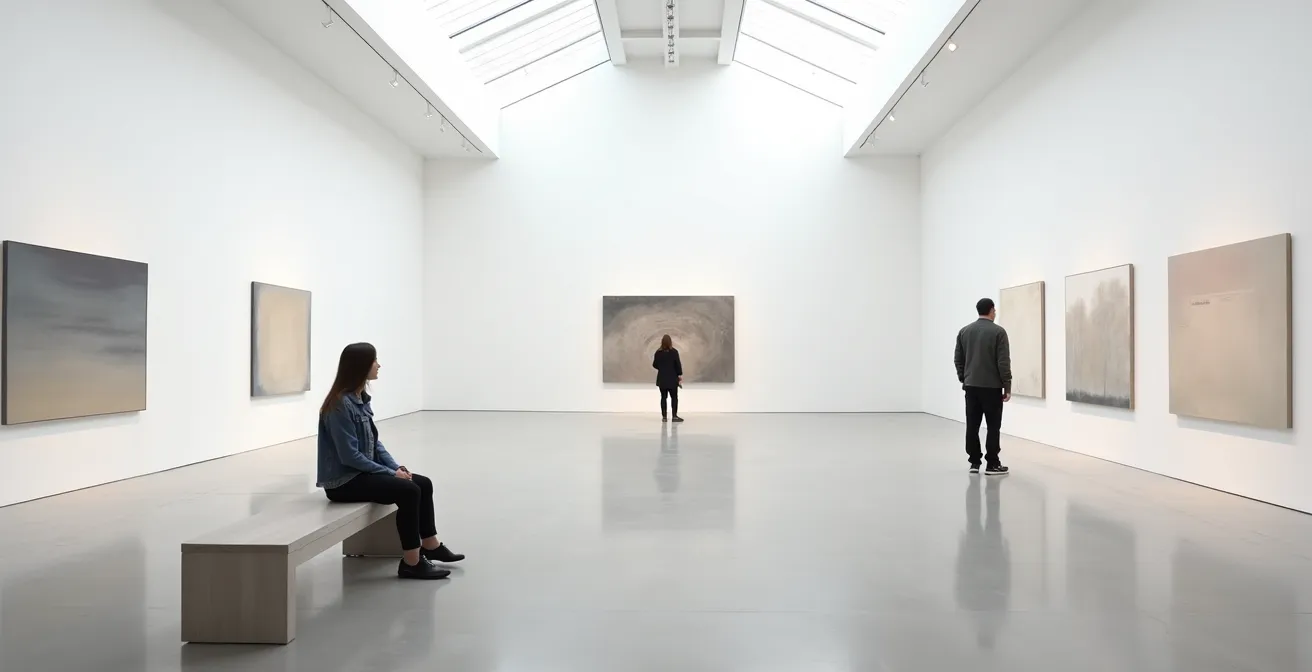
Most people think beating museum fatigue means rushing through a checklist of famous works. The opposite is true: it requires seeing less, but with greater intention.
- Your brain has a finite “cognitive budget” for art, which depletes rapidly after just 30-60 minutes of focused viewing.
- Strategic planning isn’t about efficiency; it’s about curating a personal narrative and deliberately ignoring what’s not on your path.
Recommendation: Treat your visit not as a test of endurance, but as a conversation with a few select masterpieces.
You stand in a vast hall of the Louvre, the Met, or the British Museum. The initial thrill of being surrounded by masterpieces is intoxicating. But an hour later, a familiar fog descends. The paintings begin to blur, the sculptures feel repetitive, and a profound exhaustion sets in. This is “museum fatigue,” a phenomenon that turns a cultural pilgrimage into a test of endurance. For many, the default solution is to simply “take breaks” or “not try to see everything,” but this advice misses the core of the problem. It treats the symptom, not the cause.
What if the secret to a fulfilling visit wasn’t about better stamina, but a better strategy? As a curator, I can tell you that the most rewarding museum experiences are not about consumption, but about connection. It’s an act of personal curation. You must shift your mindset from a visitor trying to check off a list to a connoisseur engaging in a deliberate dialogue with art. This requires understanding not only the art, but also the limitations of your own mind.
This guide isn’t about seeing more; it’s about seeing deeper. We will explore the cognitive science that dictates your attention span, the strategic planning that transforms your visit into a narrative, and the simple-yet-profound behavioral shifts that protect both the art and your experience. Forget the marathon; it’s time to learn how to curate your own perfect exhibition.
To navigate this new approach, we will explore the essential strategies that turn an overwhelming space into an intimate gallery. This guide breaks down the process, from understanding your own cognitive limits to reading the history embedded in the very walls of the museum.
Summary: How to Visit a Great Museum Without “Museum Fatigue”?
- Why Human Brains Can Only Appreciate Art for 90 Minutes?
- How to Plan a “Top 10” Route Before You Even Enter?
- Audio Guide vs. Reading Plaquettes: Which Retains More Information?
- The Oil Residue Mistake That Destroys Ancient Artifacts
- Problem & Solution: Visiting the Mona Lisa Without Fighting the Crowd
- Static Museum vs. Living History Site: Which Offers Better Insight?
- Why Accessibility Is a Curator’s Secret Weapon
- How to “Read” a City’s History Through Its Architecture?
Why Human Brains Can Only Appreciate Art for 90 Minutes?
The feeling of museum fatigue isn’t a sign of a short attention span or a lack of cultural appreciation; it’s a biological reality. Think of your ability to engage with art as a finite resource, a “cognitive budget.” Every painting you analyze, every sculpture you contemplate, and every historical fact you absorb makes a withdrawal from this budget. Unfortunately, this budget is smaller than most people realize. In fact, research shows that after just 30 minutes, attention and comprehension begin to decline noticeably.
The primary culprit is cognitive overload. A 2024 study that used eye-tracking technology in exhibitions revealed the intense mental effort involved. It found that text- and video-based elements provoked larger pupil dilations, a direct physiological indicator of increased cognitive processing. Your brain isn’t just passively seeing; it’s actively working to decode visual information, access historical context, process emotional responses, and connect what you’re seeing to your existing knowledge. After about 60 to 90 minutes, your cognitive bank account is effectively empty. Pushing past this point leads to “semantic satiation,” where even the most beautiful masterpieces become meaningless shapes and colors.
Recognizing this limit is the first step toward a better visit. Instead of fighting it, you must work with it. The goal is to maximize the quality of your engagement during that peak 60-minute window, rather than extending the quantity of your visit into hours of diminishing returns. True appreciation happens when your mind is sharp, not when it’s exhausted.
Therefore, the strategic visitor doesn’t try to extend their time but rather increase the value within their natural window of peak attention.
How to Plan a “Top 10” Route Before You Even Enter?
Entering a vast museum without a plan is like setting sail on the ocean without a compass. You will drift aimlessly and quickly become lost and exhausted. The solution is not just to pick a few famous works, but to craft a narrative thread for your visit. This is the essence of personal curation: you decide the story you want to experience. Before you even step inside, take a moment to ask yourself what you want to get out of the visit. Is it to see the evolution of portraiture? To follow the use of a specific color? Or to trace the influence of a single artist?
Once you have a theme, no matter how simple, the museum map becomes your script. Professional museum guide Nick Gray, known for his “Museum Hack” methodology, recommends a brilliant first step: go directly to the museum’s café. Here, rested and away from the entrance hall’s chaos, you can study the map and build a personalized route. This strategic pause allows you to identify your key “anchor” artworks and design an efficient “orbit” around them, eliminating the exhausting zigzagging that plagues most visitors. This act of deliberate planning transforms you from a passive wanderer into an active explorer with a mission.

As you can see, this moment of focused preparation is the true start of your visit. It sets the tone for intentional engagement. There are several effective strategies for structuring this plan, each suited to different goals and time constraints.
This table outlines a few methodologies you can adopt to structure your personal tour, as detailed in an analysis of different planning strategies.
| Strategy | Best For | Time Commitment | Effectiveness |
|---|---|---|---|
| Story Spine Method | Art history enthusiasts | 2-3 hours | High retention through narrative |
| Anchor & Orbit | First-time visitors | 1.5-2 hours | Reduces zigzagging fatigue |
| Reverse Engineering | Limited time visitors | 45-90 minutes | Maximum impact, minimal exhaustion |
| Highlights Only | Tourist groups | 1-2 hours | Covers famous works efficiently |
By selecting a strategy that aligns with your interests and energy, you ensure your cognitive budget is spent on appreciation, not on navigation.
Audio Guide vs. Reading Plaquettes: Which Retains More Information?
In the quest to absorb as much information as possible, many visitors make a critical error: they try to use multiple channels of information at once. They listen to the audio guide while simultaneously reading the wall plaque, believing they are doubling their intake. In reality, they are dividing their attention and retaining almost nothing. This is due to a concept known as dual-coding theory. Your brain processes auditory and visual information through separate channels. When you try to read and listen to different streams of information about the same object, you create cognitive interference, effectively cancelling both out.
As a curator, I see this every day. A visitor stands before a masterpiece, headset on, eyes darting back and forth from the art to the text, their expression one of frantic confusion rather than thoughtful contemplation. They are caught in a mental crossfire. The key to effective learning and retention in a museum is to commit to a single channel per artwork. Either put the audio guide away and read the plaque, allowing yourself to build a visual memory of the text alongside the art, or put your trust in the audio guide and truly *look* at the artwork while you listen.
As Museum Education Researchers from a study on dual-coding theory in museums succinctly state, this choice is paramount for memory formation:
Trying to read the plaque while listening to the audio guide is ineffective. Choose one channel per artwork to maximize retention by creating distinct visual and auditory memories.
– Museum Education Researchers, Study on dual-coding theory in museums
By making this conscious choice, you allow your brain to form a strong, uncluttered memory, turning a fleeting glance into a lasting impression.
The Oil Residue Mistake That Destroys Ancient Artifacts
As a curator, my primary role is preservation. The greatest threat to the longevity of an artifact is not time, but human interaction. Even the most seemingly innocent action can have catastrophic, irreversible consequences. Visitors often believe that “Do Not Touch” signs apply only to deliberate contact, but accidental brushes from a backpack or the simple residue from our hands can be just as destructive. The oils, salts, and acids on our skin can etch into stone, corrode metal, and stain delicate fabrics over time. Your presence in a gallery is not neutral; it actively changes the environment.
The most dramatic example of this is the fate of the Lascaux Cave in France. Discovered in 1940, these 17,000-year-old paintings were a perfect time capsule. After opening to the public in 1948, the cave was inundated with up to 1,500 visitors daily. The carbon dioxide from their breath, the heat from their bodies, and the foreign microbes they introduced caused a cascade of destruction. Green mold, white fungus, and calcite veils began to obscure the ancient art. Within 15 years, the damage was so severe that the cave was permanently closed to the public in 1963. Today, only scientists are allowed limited access, and tourists visit a replica. Lascaux is a permanent, heartbreaking reminder that an artifact, once damaged, is lost forever.

This profound fragility is why respecting the barrier—both physical and invisible—is the visitor’s most sacred duty. Every person who enters a museum should adopt a “Hippocratic Oath” of viewership: first, do no harm.
Your Action Plan: The Visitor’s Hippocratic Oath
- Wear your backpack on your front in crowded galleries to avoid accidental contact with artworks or vitrines.
- Maintain at least an arm’s length of distance from all unprotected artifacts and display cases.
- Avoid sudden stops or abrupt changes of direction in narrow passages to prevent collisions.
- Keep your voice at a low volume, as strong sound waves can cause micro-vibrations in delicate pieces.
- Never use flash photography, as the intense burst of light can cause cumulative fading and damage to pigments over time.
Your respect and mindfulness are the first line of defense in preserving our shared cultural heritage for future generations.
Problem & Solution: Visiting the Mona Lisa Without Fighting the Crowd
There is perhaps no greater symbol of museum fatigue than the scrum of phones and elbows in front of the Mona Lisa. The desire to see a “superstar” artwork is understandable, but the reality is often a frantic, unsatisfying experience. A curator at New York’s Metropolitan Museum of Art discovered that most people look at paintings for an average of just 17 seconds. For iconic pieces, this brief glance is spent jostling for position rather than actually *seeing* the art. The problem is that most visitors follow the same predictable path, creating human traffic jams around a handful of famous works while entire galleries sit empty.
The solution is to engage in what we call “counter-programming.” Instead of making a beeline for the main attraction upon arrival, do the exact opposite. Museum expert Nick Gray advocates for the “Irish goodbye” approach: when you enter the museum, head to the less famous sections first. While the crowds flock to the Mona Lisa or the Venus de Milo, you can have entire galleries of masterpieces to yourself. Explore these quieter wings during the first hour of your visit, when your cognitive budget is at its peak.
Then, when the initial wave of visitors begins to tire and moves on, you can circle back to the main attractions during the mid-day lull. You will encounter a smaller, more dispersed crowd, allowing you a much clearer view and a more contemplative experience. This simple reversal of expectations allows you to spend quality time with both the famous and the overlooked treasures of the collection. It is the ultimate act of “deliberate ignorance” paying off—by ignoring the crowd’s momentum, you curate a superior experience for yourself.
By zigging when everyone else zags, you trade a frustrating checklist item for a genuine moment of connection with a masterpiece.
Static Museum vs. Living History Site: Which Offers Better Insight?
The traditional museum, with its rows of priceless artifacts behind glass, is just one model for experiencing the past. An increasingly popular alternative is the “living history” site, where historical contexts are recreated and populated by reenactors. The question of which offers better insight depends entirely on what you seek to understand. Neither is inherently superior, but they serve two very different curatorial purposes and engage your brain in fundamentally different ways.
A static museum is a temple of the exceptional. It showcases the objects that were valuable, durable, and important enough to survive the centuries. Here, you engage with the authentic object—the very canvas an artist touched, the very tool a craftsperson used. This provides an unparalleled connection to artistic mastery and material history. However, this experience demands a higher cognitive load; you must mentally reconstruct the context in which these objects existed. As a result, museum fatigue risk is significantly higher.
A living history site, by contrast, is a laboratory of the everyday. It excels at showing the mundane, disposable, and ephemeral realities of life that traditional museums often miss. The focus is less on authentic objects (which are often replicas) and more on authentic context. The multi-sensory experience—the smell of woodsmoke, the sound of a blacksmith’s hammer—aids what is called “embodied cognition,” making the learning process feel more natural and less mentally taxing. It answers the question, “What did it *feel* like to be alive then?”
| Aspect | Static Museum | Living History Site |
|---|---|---|
| Authenticity Focus | Original objects in controlled environment | Recreated context with replica objects |
| Sensory Engagement | Primarily visual, limited touch/smell | Multi-sensory: sounds, smells, textures |
| Best For Learning | Artistic mastery and preserved artifacts | Daily life and practical skills |
| Cognitive Load | Higher – requires more mental processing | Lower – embodied cognition aids memory |
| Museum Fatigue Risk | Higher after 90-120 minutes | Lower due to variety and movement |
A static museum tells you what was saved, while a living history site tells you how people lived. A truly rounded understanding of history requires appreciating both.
Why Accessibility Is a Curator’s Secret Weapon
When most people hear “accessibility” in a museum context, they think of ramps and elevators for wheelchair users. While these are vital, they are only the beginning. From a curator’s perspective, true accessibility is about designing an experience that is welcoming and manageable for *everyone*. It is a secret weapon against museum fatigue because features designed for specific needs often have universal benefits, helping every visitor conserve their precious cognitive budget.
Consider the strategic use of so-called accessibility features. Using an elevator instead of climbing three flights of stairs isn’t “cheating”; it’s a smart way to conserve physical energy that can then be spent on mental engagement with the art. Seeking out designated quiet spaces or low-sensory rooms isn’t just for visitors with sensory sensitivities; it’s an ideal strategy for anyone needing a moment to reset their cognitive palate between intense galleries. Even large-print guides can reduce the eye strain and mental fatigue that affects all visitors after an hour of reading small plaques.
With aging populations worldwide and a growing understanding of neurodiversity, building these features into the core experience is no longer a niche concern but a fundamental principle of good curatorial practice. By actively seeking out and using these resources, you are not taking them away from those who need them most; you are participating in a universally designed experience. A truly accessible museum is one where every visitor, regardless of age or ability, has the tools to manage their own energy and curate a sustainable, enriching visit.
The next time you visit a museum, ask for an accessibility map. It will not only show you the most efficient routes but also reveal the hidden infrastructure designed to make your visit better.
Key Takeaways
- Your brain’s attention for art is a finite resource; spend your “cognitive budget” wisely on works that truly matter to you.
- Plan your visit like a curator: define a personal theme and deliberately ignore everything that doesn’t fit your narrative.
- Your presence has a physical impact; respect artifacts by maintaining distance, moving mindfully, and never touching.
How to “Read” a City’s History Through Its Architecture?
The skills you cultivate to navigate a museum—selective attention, narrative-seeking, and contextual analysis—do not have to end when you walk out the door. The city itself is the largest museum of all, and its architecture is the most prominent collection. Before you even enter a museum, its building serves as the very first artifact you should “read.” A grand, repurposed palace like the Louvre tells a story of cultural democratization, of royal power converted to public access. A stark, modern building signals a deliberate break with tradition, a statement about the art contained within.
This practice of “reading” architecture extends to the entire urban landscape. Look at the materials: stone foundations speak of ancient wealth and a desire for permanence, traditional brick suggests medieval trade and craftsmanship, while gleaming glass and steel towers represent modern economic power and technological ambition. These are the city’s geological layers, telling a story of what was valued in each era.
Extend your curatorial eye beyond the official monuments. The grand cathedrals and palaces tell the official story, the narrative of power and wealth. But it is the vernacular architecture—the old shopfronts, the humble houses, the repurposed factories—that reveals how ordinary people truly lived and worked. By learning to see the city as a collection of architectural artifacts, you transform a simple walk into a deep, historical exploration. The museum teaches you the language; the city is where you become fluent.
Your next trip can be transformed by this mindset. Start looking at the buildings around you not just as structures, but as storytellers waiting to be heard.
Frequently Asked Questions on How to Visit a Great Museum Without “Museum Fatigue”?
How can building materials reveal a city’s history?
Stone foundations indicate ancient wealth and permanence, brick walls suggest medieval craftsmanship, while glass and steel represent modern economic power and technological advancement.
What do ‘architectural scars’ tell us?
Filled-in archways, patched war damage, or modern additions reveal traumas, transformations, and changing needs. These inconsistencies are honest storytellers of adaptation and survival.
Why contrast official and vernacular architecture?
Grand buildings (cathedrals, palaces) show official narratives and power, while vernacular structures (old shops, houses) reveal how ordinary people actually lived and worked.