
Cultured meat is often presented as a perfect food solution, but its true safety, nutritional value, and environmental impact are far more complex than marketing suggests.
- The energy footprint of current production methods can be significantly higher than conventional meat, challenging its “green” status.
- While free from slaughter, the process relies on complex, industrially produced growth media that may introduce unknown allergen risks.
- The nutritional profile is engineered, not natural, and may lack the complex micronutrients found in animals raised in a natural ecosystem.
Recommendation: As a consumer, your power lies in demanding transparency. Prioritize understanding the specific production methods and ingredient sourcing over broad marketing claims before deciding if it’s right for you.
The promise of cultured meat is undeniably compelling. Imagine a world where you can enjoy a juicy burger or a tender chicken breast, produced without animal slaughter, using a fraction of the land and water. For the health-conscious consumer, this technology seems to tick all the boxes: ethical, sustainable, and clean. The headlines celebrate a future of guilt-free protein, positioning cellular agriculture as the definitive answer to the problems of our modern food system.
But as with any major technological leap, the reality is far more nuanced. To truly assess whether lab-grown meat is a safe and nutritious choice for your family, we must look beyond the marketing and adopt the mindset of a scientist. This involves scrutinizing the process at a cellular level, understanding its systemic footprint on our environment, and acknowledging what we still don’t know. The key isn’t to simply accept or reject the technology, but to ask the right questions.
This article will dissect the science behind cultured meat, from the energy it consumes to its nutritional reality, even using analogies from other advanced technologies to clarify the stakes. We will explore the potential for unforeseen consequences, like new allergies, and demystify the complex process of turning a single cell into a steak. Ultimately, we will equip you with a framework for interpreting future food labels, empowering you to make a truly informed choice based on scientific understanding, not just promises.
To navigate this complex topic, we will break down the key scientific, environmental, and personal choice factors. This structured exploration will give you the tools to assess not only cultured meat but other novel food technologies you may encounter.
Summary: A Scientific Assessment of Cultured Meat’s Place on Your Plate
- Why Cultured Meat Might Use More Energy Than Traditional Chicken Farms?
- How Do Scientists Turn a Single Cell Into a Steak Without Slaughter?
- Lab Burger vs. Grass-Fed Beef: Which Has Better Micro-Nutrients?
- The Protein Structure Mistake That Could Trigger New Allergies
- Problem & Solution: How to Read Future Labels to Know What You Are Eating
- Vegan Diet or No Car: Which Choice Reduces Emissions More Drastically?
- Why Traditional Chemo Kills Healthy Cells While Targeted Therapy Doesn’t?
- Can Individual Lifestyle Changes Really Impact Global Climate Trajectories?
Why Cultured Meat Might Use More Energy Than Traditional Chicken Farms?
One of the most powerful arguments for cultured meat is its potential to reduce the environmental toll of animal agriculture. While it dramatically cuts down on land and water, the story of its energy consumption and carbon footprint is far more complex. The process of growing cells in a sterile, controlled bioreactor is energy-intensive, and the source of that energy is critical. Initial analyses suggest that, under current methods, the environmental benefit is not as clear-cut as once hoped.
The core of the issue lies in the purification of the growth media—the nutrient-rich broth that feeds the cells. To prevent contamination by bacteria or other microbes, this media must be refined to pharmaceutical-grade purity. This purification process, involving steps like steam sterilization and filtration, demands a tremendous amount of energy. According to a recent analysis from the University of California, Davis, this issue is significant. As researcher Derrick Risner notes, “If companies are having to purify growth media to pharmaceutical levels, it uses more resources, which then increases global warming potential.” In fact, the same UC Davis research reveals that the global warming potential of lab-grown meat using these purified media is projected to be four to 25 times greater than that of conventional retail beef.
However, this doesn’t mean cultured meat is doomed from a climate perspective. The key variable is the production process, which could evolve to become more efficient. A shift from a pharmaceutical-grade process to a less-purified “food-grade” process could drastically reduce emissions, especially if the facilities are powered by renewable energy.
| Production Method | CO2 Emissions per kg | Energy Source Impact |
|---|---|---|
| Pharmaceutical-grade process | 250-1,000 kg CO2 | High purification energy needs |
| Food-grade process | 10-75 kg CO2 | Lower with renewable energy |
| Conventional beef (global average) | 100 kg CO2 | Includes methane from cattle |
This data, highlighted in a comparative analysis of production methods, shows that the technology’s future climate impact depends entirely on innovation and scaling. The initial promise of a low-carbon protein source is conditional on solving this systemic footprint challenge.
How Do Scientists Turn a Single Cell Into a Steak Without Slaughter?
The transformation from a single animal cell into a structured piece of meat is a feat of biotechnology known as cellular agriculture. It bypasses the need for a whole animal, focusing instead on cultivating the desired tissues—muscle, fat, and connective tissue—in a controlled environment. The entire process hinges on providing cells with the exact conditions they need to proliferate and differentiate, mimicking the biological processes that occur inside an animal’s body.
The journey begins with a small sample of cells, often stem cells, painlessly collected from a living animal via biopsy. These cells are the “seeds” for the meat. They are placed in a bioreactor, which is essentially a high-tech stainless steel tank that provides a sterile, temperature-controlled, and oxygen-rich environment. Inside, the cells are submerged in a growth medium, a carefully composed liquid formula containing all the necessary building blocks for life: amino acids, glucose, vitamins, salts, and crucial signaling molecules known as growth factors.
To give the final product structure and texture, scientists use a “scaffold.” This is an edible, often plant-based material that the cells can cling to as they multiply and organize themselves into the familiar fibers of muscle tissue. This final step, known as differentiation, is what turns a soupy mass of cells into a recognizable food product. Dutch company Meatable, for example, has refined this technique to create ground meat from pig cells, demonstrating a process that can turn stem cells into finished patties in as little as 12 days within their specialized bioreactor environments.

As the illustration above shows, this process is about creating a microscopic support system that encourages cells to form complex, three-dimensional tissues. The key phases are:
- Acquisition: Stem cells are acquired and banked from an animal through a simple biopsy.
- Proliferation: Cells are grown to high densities in bioreactors, fed with an oxygen-rich culture medium.
- Feeding: The cells are nourished with a precise diet of amino acids, glucose, vitamins, and growth factors.
- Differentiation: Scaffolding is used to trigger the cells to turn into muscle, fat, and connective tissues.
- Harvesting: The fully formed tissues are harvested, prepared, and packaged into final products like burgers or nuggets.
This method represents a paradigm shift, moving food production from the farm to the lab, with a focus on cellular precision.
Lab Burger vs. Grass-Fed Beef: Which Has Better Micro-Nutrients?
One of the central questions for any health-conscious consumer is whether a lab-grown burger is nutritionally equivalent to one from a cow that grazed on pasture. The answer is complex. On one hand, cellular agriculture offers the potential for complete control over the final product’s nutritional content. Scientists can, in theory, dial up the protein, reduce saturated fat, or even fortify the meat with added vitamins like B12, which is a major focus for the industry.
However, replicating the intricate nutritional matrix of traditional meat is a monumental challenge. A grass-fed cow, for example, consumes a diverse diet of plants, which results in a unique profile of micronutrients, fatty acids (like Omega-3s and conjugated linoleic acid), and other bioactive compounds in its meat. This is a product of a complex biological ecosystem. Cultured meat, grown on a standardized, industrially-produced growth medium, may be bio-identical in its primary protein structure but may not be nature-identical in its micronutrient complexity.
Currently, comprehensive, peer-reviewed data directly comparing the full micronutrient profiles of cultured meat and various types of conventional meat is scarce. As researchers in the field often point out, many unknowns and knowledge gaps remain regarding the final nutritional quality of these novel products. The focus has been on matching the macronutrient profile (protein, fat) and basic sensory characteristics (taste, texture). The more subtle, yet vital, components that contribute to the overall health value of food are still an active area of investigation.
While the nutritional debate continues, the environmental benefits in other areas are more established. For instance, Oxford research indicates that cultured meat requires up to 99% less land and 82-96% less water than conventional livestock farming. The challenge for the industry is to achieve this environmental efficiency while also delivering a product that is, at minimum, nutritionally equivalent—and ideally superior—to its farm-raised counterpart.
The Protein Structure Mistake That Could Trigger New Allergies
While cultured meat eliminates many of the safety risks associated with conventional farming, such as bacterial contamination from slaughterhouses (e.g., E. coli, Salmonella), it introduces a new set of considerations that regulators and scientists are carefully examining. The novelty of the process itself—growing animal tissue outside of an animal—means we must be vigilant about potential unforeseen health effects, including the risk of new allergies.
The primary concern revolves around the growth medium and the potential for unintended changes in protein structure. The nutrient-rich solutions used to grow cells require a complex mix of amino acids, sugars, and growth factors. These components are often sourced from energy-intensive industrial processes and may introduce residues or compounds that could act as allergens. If a novel protein or a modified version of a known protein is created during the cell differentiation process, it could theoretically trigger an immune response in some individuals.
Another area of consumer concern, and a significant communication challenge for the industry, is the nature of the cells themselves. To achieve the scale needed for commercial production, many companies use “immortalized” cell lines. These are cells that have been modified to divide indefinitely, much like cancer cells. While it’s crucial to state that these are not cancerous cells and pose no risk of causing cancer, this shared trait of continuous division creates public apprehension. As one consumer sentiment analysis notes, “Many consumers express implicit concern about whether cultured meat uses ‘cancerous’ cells.” This highlights the need for transparent communication to explain the science accurately.
Many consumers express implicit concern about whether cultured meat uses ‘cancerous’ cells – they are not cancerous, but share the trait of continuous division, which creates communication challenges for the industry
– Sentient Media Analysis
The regulatory pathway for these products is rigorous, with agencies like the FDA in the United States requiring extensive safety data. However, as a new food category, long-term effects are still unknown. This doesn’t mean the food is unsafe, but it underscores the importance of post-market surveillance and ongoing research as these products become more widely available.
Problem & Solution: How to Read Future Labels to Know What You Are Eating
As cultured meat moves from the lab to the marketplace, the single most powerful tool for the consumer will be the product label. However, what that label will say—and what it will be allowed to say—is currently a battleground. The central problem is a lack of standardized terminology, which can lead to confusion and prevent consumers from making informed choices. Terms like “clean meat,” “cell-based meat,” “cultivated meat,” and “lab-grown meat” all refer to the same product but evoke very different consumer reactions.
The solution lies in developing what can be called informed sovereignty: the ability to decode a label to understand the product’s origin and process, regardless of the marketing terms used. Several U.S. states have already preempted this issue, not always in favor of transparency. For example, Missouri, Texas, and South Carolina have passed legislation limiting the use of the word ‘meat’ on cultured meat packaging. More drastically, Florida and Alabama enacted outright bans on the production and sale of cultured meat in 2024, highlighting the political and cultural hurdles the technology faces.
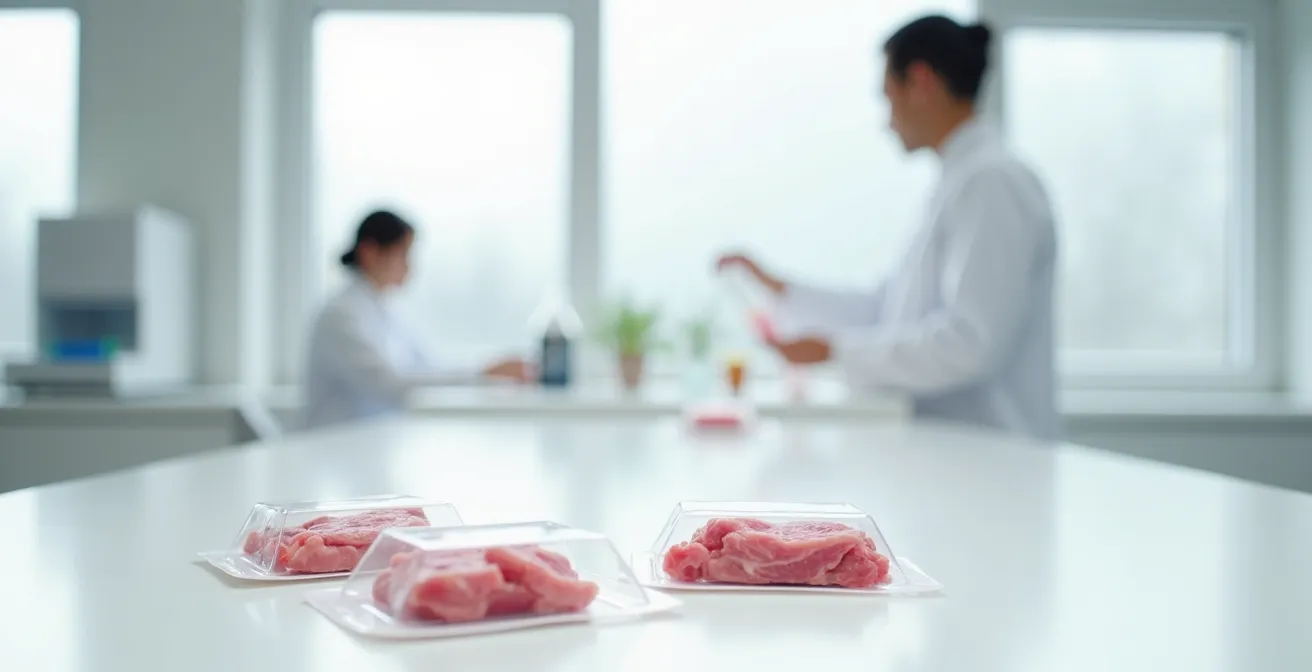
As these products roll out, you will need to become a food detective. The front of the package will feature appealing marketing language, but the real information will be in the ingredient list and the official product designation. Here is a checklist to help you vet these future products.
Action Plan: How to Vet a Cultured Meat Product
- Identify the Official Name: Look past marketing terms like “clean meat.” Find the legally required designation on the package (e.g., “cell-cultivated chicken,” “cultured beef”). This is your first clue to the product’s origin.
- Scrutinize the Ingredients: The ingredient list is key. Look for mentions of the growth medium components. Does it list plant-based factors, or is the source of the nutrients less clear? This indicates the level of transparency.
- Verify On-Pack Claims: If the package claims it’s “eco-friendly,” cross-reference that with what you know about the production process. Is it likely from a high-energy “pharmaceutical-grade” process or a more efficient one powered by renewables?
- Assess Source Transparency: Does the company provide information about the source of its original cells? Some brands may market this (e.g., “from a prize-winning chicken”), while others will remain anonymous. More transparency generally builds more trust.
- Make an Informed Decision: Based on the information gathered, decide if the company has provided enough transparency for you to feel confident in the product. Your choice sends a market signal about the level of disclosure you expect.
Vegan Diet or No Car: Which Choice Reduces Emissions More Drastically?
The debate around cultured meat is part of a much larger conversation: what is the most effective way for an individual to reduce their personal environmental footprint? Often, this discussion boils down to highly publicized choices, such as giving up your car versus changing your diet. Both are significant lifestyle shifts, but their impacts differ in nature and scale. A head-to-head comparison reveals the profound impact of our food choices.
Going car-free primarily reduces your direct carbon dioxide emissions from burning fossil fuels. This is a substantial and important reduction. However, adopting a vegan diet addresses a wider array of environmental issues simultaneously. The global food system is a massive contributor to climate change, and animal agriculture is its most impactful component. According to the Food and Agriculture Organization (FAO) of the United Nations, livestock farming accounts for 14.5% of global greenhouse gas emissions—a share comparable to the entire transportation sector.
But the impact goes beyond emissions. A vegan diet directly tackles issues of land and water use in a way that giving up a car does not. Animal farming is the single largest driver of deforestation and biodiversity loss globally. As one environmental assessment comparing dietary and transportation impacts notes, “A vegan diet has a huge positive impact on land use and water use, which the ‘no car’ choice doesn’t address directly.”
A vegan diet has a huge positive impact on land use and water use, which the ‘no car’ choice doesn’t address directly.
– Environmental Assessment, Analysis of dietary vs transportation impacts
This doesn’t mean transportation choices are unimportant. Rather, it reframes the scale of our dietary impact. It shows that shifting our protein source—whether to plants or potentially to less resource-intensive cultured meats—is one of the most powerful levers an individual has for systemic environmental change. It’s not an “either/or” choice, but an acknowledgment that what’s on our plate has a direct and massive connection to the health of the planet.
Why Traditional Chemo Kills Healthy Cells While Targeted Therapy Doesn’t?
To better understand the scientific ambition and potential risks of a technology like cultured meat, it’s helpful to look at an analogy from a different field: cancer treatment. For decades, the primary tool was traditional chemotherapy. Chemo works by attacking all rapidly dividing cells in the body. Since cancer cells divide quickly, it’s effective against them. However, other healthy cells in our body—like those in hair follicles, the stomach lining, and bone marrow—also divide quickly. Chemotherapy cannot tell the difference, so it kills them too, leading to its well-known and severe side effects.
In recent years, a more sophisticated approach has emerged: targeted therapy. These advanced drugs are designed with molecular precision. Scientists first identify a specific genetic marker or protein that is unique to the cancer cells. The drug is then engineered to seek out and attack only the cells that carry that specific marker, leaving most healthy cells unharmed. It’s the difference between a blunt instrument that causes widespread collateral damage and a precision tool that acts like a key fitting a specific lock.
This distinction offers a powerful lens through which to view the promise and peril of cellular agriculture. The goal of cultured meat is to be a form of targeted therapy for our food system—to precisely cultivate only the tissue we want (muscle and fat) without the “collateral damage” of raising a whole animal (high land use, methane emissions, slaughter). It is an attempt at ultimate efficiency and control at the cellular level.
However, just as even targeted therapies can have off-target effects or lead to drug resistance, the precision of cellular agriculture is not yet perfect. The challenges with energy-intensive purification, potential allergens from growth media, and achieving a complete nutrient profile are the “side effects” of this new technology. It reminds us that even when we aim for cellular precision, biology is a complex system, and intervening in it can have unforeseen consequences.
Key Takeaways
- Cultured meat’s environmental benefit is not guaranteed; its energy consumption during production is a major hurdle that must be overcome through innovation.
- The process relies on creating meat with cellular precision in a bioreactor, a complex feat of biotechnology that is still evolving.
- While potentially safer from pathogens, cultured meat introduces new questions about nutritional completeness and the risk of novel allergens from growth media.
Can Individual Lifestyle Changes Really Impact Global Climate Trajectories?
Faced with the immense scale of global climate change, it’s easy to feel that individual actions are merely a drop in the ocean. Yet, the science is clear: collective individual choices create the market demands and social norms that drive systemic change. While large-scale policy and corporate action are indispensable, consumer behavior is the engine that can accelerate or stall that progress. Our choices about what we eat, how we travel, and what we buy send powerful economic and political signals.
The global food system is a perfect example of this dynamic. As a whole, the global food system contributes about 30% of greenhouse gas emissions annually. This massive figure is not the result of a single entity’s decision, but the cumulative effect of billions of individual food choices made every day. When a significant number of consumers shift their purchasing habits—for example, by reducing meat consumption or opting for locally grown produce—it forces the entire supply chain to adapt. Supermarkets change their inventory, food companies invest in new products, and farmers adjust their practices.
This is precisely the context in which the cultured meat debate is so significant. The decision to try, adopt, or reject cultured meat is more than a personal dietary choice; it’s a vote for a particular vision of the future of food. Supporting it could accelerate investment and innovation, potentially leading to a more efficient and sustainable protein source down the line. Conversely, consumer skepticism or rejection could signal that the market prefers other solutions, such as plant-based alternatives or a return to smaller-scale, regenerative agriculture.
Therefore, your individual choice has a very real impact. It is a participation in the large-scale, real-time experiment of redesigning our food system. Whether cultured meat becomes a climate solution or an energy-intensive novelty will depend not only on the scientists in the lab but also on the collective decisions of informed consumers like you.
Ultimately, becoming an informed consumer in the 21st century requires a new kind of literacy—the ability to look past marketing and assess new technologies on their scientific merits and systemic impacts. Start today by applying this critical mindset not just to cultured meat, but to all the novel food choices that will undoubtedly appear on your grocery shelves in the years to come.
Frequently Asked Questions About Cultured Meat
What unknown factors exist in cultured meat nutrition?
While scientists can control macronutrients like protein and fat, current environmental and nutritional assessments reveal many unknowns and gaps in knowledge regarding the complex micronutrient quality of cultured meat. Replicating the full spectrum of vitamins, minerals, and beneficial fatty acids found in traditionally raised meat is a significant challenge that requires further investigation.
How do consumers respond to different naming conventions for lab-grown meat?
Consumer perception is heavily influenced by terminology. Studies show that consumers are generally more receptive to cultured meat when it is presented with positive or neutral framing, such as ‘clean meat’ or ‘animal-free meat,’ compared to more scientific or sterile terms like ‘lab-grown meat’ or ‘in-vitro meat.’