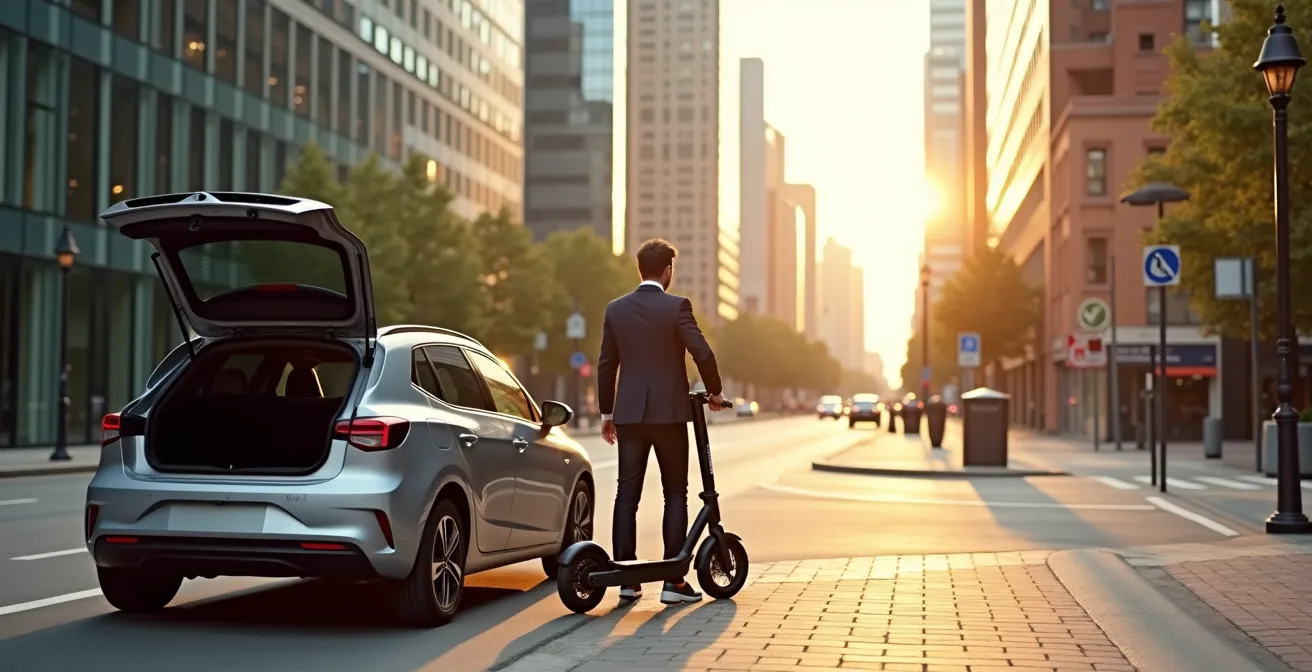
The key to an efficient urban commute isn’t just owning a car and an e-scooter; it’s engineering a seamless logistical system that eliminates last-mile friction.
- Driving the final mile is a losing battle against congestion and the hunt for parking.
- A true multimodal strategy requires planning your “transition hub,” selecting the right gear, and implementing a robust security protocol for both assets.
Recommendation: Stop thinking in terms of separate trips. Start designing your commute as a single, integrated operation from your driveway to your office door.
The daily urban commute often feels like a multi-act drama of frustration. You expertly navigate suburban roads only to hit the wall of city-center gridlock. The final mile—that short distance from the edge of the congestion zone to your actual destination—becomes the most time-consuming and stressful part of the journey. Many commuters intuitively grasp the solution: park the car and switch to a form of micro-mobility, like an electric scooter. This “park-and-ride” concept is a good start, but it’s often executed with little strategy, leading to its own set of inefficiencies.
The common approach is simply to throw a scooter in the trunk and hope for the best. This overlooks critical logistical challenges: where to park, how to secure the scooter without it becoming a rattling projectile, and what to do if the perfect parking spot is blocks away from a safe bike lane. The true potential of this hybrid model is often lost to friction at the point of transfer. What if the solution wasn’t just to own two vehicles, but to treat them as a single, integrated mobility unit? The key isn’t just *what* you do, but *how* you architect the entire process.
This guide moves beyond the basic idea of a car-and-scooter combo. We will delve into the logistics of creating a truly seamless “Park & Ride 2.0” system. We will analyze the time-cost of the last mile, compare the practicalities of different micro-mobility options, establish security protocols for your assets, and strategize the perfect transition point. By focusing on the logistical details, you can transform your commute from a daily battle into a streamlined, efficient, and even enjoyable experience.
To navigate this strategic approach, we will explore the key components required to build your personal integrated commute system. The following sections break down everything from the initial problem to the final execution, providing a clear roadmap for mastering multimodal urban travel.
Contents: How to Combine a Compact Car and e-Scooter for the Ultimate Urban Commute?
- Why Driving the Last Mile Takes Longer Than Scooting It?
- How to Secure an e-Scooter inside a Compact Trunk Without Damage?
- Folding Bike or Electric Scooter: Which Fits Better in a City Car Boot?
- The Locking Mistake That Gets Your Commuter Bike Stolen from the Car Rack
- Problem & Solution: Finding Parking Spots That Are Close to Bike Lanes
- Vegan Diet or No Car: Which Choice Reduces Emissions More Drastically?
- High-Density Walkability vs. Suburban Space: Which Fosters More Social Ties?
- How to Protect Your Car From Damage When Parking on the Street Daily?
Why Driving the Last Mile Takes Longer Than Scooting It?
The core inefficiency of urban driving isn’t the highway portion of a commute; it’s the final, agonizing stretch within the dense city core. This “last mile” is a battleground of one-way streets, delivery trucks, and, most significantly, the hunt for parking. The time lost circling blocks for a space is not trivial. For instance, an INRIX study revealed that drivers spend an average of 107 hours annually searching for parking in a city like New York. This single activity is a massive time sink that completely negates the speed advantage a car might have over shorter distances.
Furthermore, this search for parking is a primary contributor to the very traffic you’re trying to avoid. It’s a vicious cycle: the more people who are looking for parking, the worse the congestion becomes for everyone. In fact, some studies have estimated that up to 30% of urban congestion is caused by drivers hunting for a spot. By choosing to drive this final mile, you are actively participating in a system that guarantees delays. Your car, an asset of speed and efficiency on the open road, becomes a liability in a high-density environment.
An e-scooter fundamentally inverts this equation. Its value is not in raw speed but in its ability to bypass the two main chokepoints of urban car travel: traffic congestion and parking. While a car is stuck in a queue, a scooter can utilize dedicated bike lanes. When a driver begins the 15-minute search for a parking spot, a scooter rider has already arrived, locked their device to a bike rack, and is walking into their office. The concept of last-mile velocity isn’t about top speed; it’s about the total time from your planned parking “hub” to your destination’s door, and in that metric, the scooter is almost always superior.
How to Secure an e-Scooter inside a Compact Trunk Without Damage?
An e-scooter is a precisely engineered machine, not a piece of luggage. Treating it as such is the first step toward creating a reliable integrated mobility unit. Simply tossing it into the trunk invites damage to both the scooter’s delicate components and your car’s interior. The goal is to eliminate logistical friction—the rattles, shifts, and potential damage that occur during transit. A properly secured scooter is silent, stable, and ready for immediate deployment.
The first step is creating a clean and stable environment. Before placing the scooter, ensure your trunk is clear of loose items that could become projectiles during a sudden stop. The scooter should be folded according to the manufacturer’s instructions and placed flat to distribute its weight evenly. Using bungee cords or adjustable straps is non-negotiable. Secure the main frame of the scooter to the anchor points in your trunk to prevent any forward, backward, or lateral movement. This not only protects your gear but is a critical safety measure.
Beyond physical security, thermal conditions are a major factor. The electronics and battery of an e-scooter are sensitive to extreme temperatures. As one commuter notes, this is a crucial consideration:
Temperature matters a lot! Don’t store your e-scooter in hot car trunks in summer.
– Circooter.com, Electric Scooter Storage Guide
A hot trunk can significantly degrade battery life and potentially damage electronic components over time. On hot, sunny days, park in a shaded spot or a garage if possible, or minimize the time the scooter spends in the sealed vehicle. Implementing a consistent procedure for stowing your scooter ensures its longevity and reliability.
Action Plan: Securing Your E-Scooter for Transit
- Clear the Stage: Remove all loose items, debris, and clutter from the trunk to create a dedicated, clean space for the scooter.
- Fold & Position: Correctly fold the scooter using its primary mechanism and position it flat on the trunk floor, ensuring weight is distributed evenly.
- Anchor the Asset: Use bungee cords or adjustable straps to firmly secure the scooter’s frame to your car’s built-in trunk anchor points.
- Secure the Periphery: Use additional cords to tie down any other essential items in the trunk (like a helmet or bag) to prevent them from shifting and hitting the scooter.
- Final Check: Give the scooter a firm shake to ensure there is no movement. It should feel like a part of the car itself.
Folding Bike or Electric Scooter: Which Fits Better in a City Car Boot?
The choice between a folding bike and an e-scooter is a critical decision in designing your multimodal system. Both are effective last-mile solutions, but their physical characteristics directly impact the efficiency of your transition from driver to rider. The decision hinges on three factors: folded dimensions, deployment speed, and trunk space efficiency. An e-scooter typically folds into a long, thin profile, while a folding bike collapses into a bulkier, more square-like shape. For a compact car with limited or oddly shaped trunk space, the scooter’s form factor is often easier to accommodate alongside other items.
The second major consideration is deployment speed. The time it takes to get your micro-mobility vehicle out of the car and ready to ride is a key part of your overall last-mile velocity. E-scooters generally have a significant advantage here. Most models can be unfolded and powered on in a matter of seconds with a single latch or lever. A folding bike, with its more complex frame, pedals, and seat adjustments, often requires 30 to 60 seconds to fully deploy. While this may seem minor, these seconds add up over a daily commute, creating logistical friction that can make the process feel cumbersome.
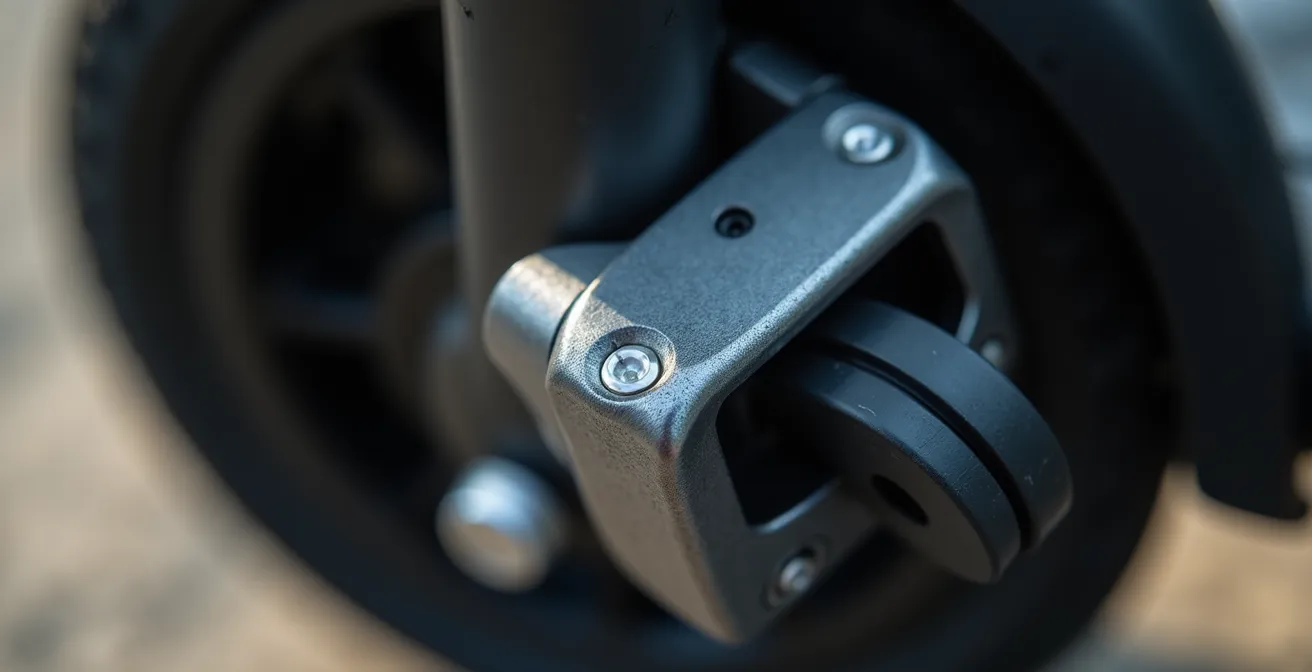
The details of the folding mechanism, as seen in the precision-engineered components above, are what dictate this speed and reliability. Ultimately, the best choice depends on your specific vehicle and priorities. The following table breaks down the key differences based on a recent comparative analysis.
| Feature | E-Scooter | Folding Bike |
|---|---|---|
| Folded dimensions (typical) | 132 x 58 x 31 cm | 85 x 65 x 35 cm |
| Deployment time | Seconds | 30-60 seconds |
| Weight range | 10-30 kg | 12-20 kg |
| Trunk space efficiency | Long thin profile | Bulkier square shape |
| Multi-modal transport ease | Easy to carry on public transit | More cumbersome |
The Locking Mistake That Gets Your Commuter Bike Stolen from the Car Rack
For commuters using an external car rack for a bike or a larger scooter, the security strategy must shift. Your vehicle is no longer just transport; it’s a potential target. The single most common and critical mistake is focusing security solely on the bike or scooter itself while neglecting the rack. Professional thieves often don’t bother cutting a high-quality bike lock; they simply unbolt the entire rack from the car and deal with the lock later in a private location. Therefore, your Asset Security Protocol must be a layered system that secures the micro-mobility device to the rack, and the rack to the vehicle.
The primary vulnerability is that many factory-installed racks are designed for convenience, not high security. Thieves can exploit this. The solution is to add a secondary layer of protection. Use a heavy-duty chain or a thick cable lock to loop through your bike/scooter frame, through the rack, and then around a permanent part of your car’s chassis or tow hitch if possible. This makes a simple “rack-and-run” theft significantly more difficult and time-consuming.
Beyond the rack itself, quick-release components are another major vulnerability. Wheels, seats, and even some scooter batteries can be removed in seconds without tools. Replace standard quick-release skewers with locking security skewers that require a special key. For e-scooters, consider using a separate, smaller lock to secure a removable battery to the frame if you plan to leave it unattended. A visually complex setup, with multiple types of locks and visible security measures, acts as a powerful deterrent. Most opportunistic thieves are looking for a quick, easy score, and they will likely move on to a simpler target.
Problem & Solution: Finding Parking Spots That Are Close to Bike Lanes
The ideal multimodal commute hinges on a seamless handover between car and scooter. This requires finding what can be termed a “Transition Hub”—a parking location that is not only available and affordable but also strategically positioned at the edge of the city’s micro-mobility infrastructure. Parking a mile away from the nearest protected bike lane defeats the purpose, forcing you to navigate dangerous, high-traffic streets on a small vehicle. The solution lies in proactive, strategic scouting, not reactive, desperate searching.
Your first step is digital reconnaissance. Use mapping applications like Google Maps to overlay traffic data, parking garage locations, and, most importantly, the bike lane network. Identify several potential parking zones on the periphery of the most congested downtown areas that offer direct access to a major cycling artery leading toward your destination. Commuter-focused apps like Citymapper can be invaluable, as they integrate public transport, cycling, and micro-mobility options into their route planning. This allows you to model different transition points and see their impact on your total travel time.
Once you have a shortlist of 3-5 potential transition hubs, conduct a physical survey on a weekend or during off-peak hours. Traffic will be lighter, allowing you to assess the area’s safety, the real availability of parking, and the quality of the bike lane connections. Save these optimal points in your phone’s map app. Having multiple pre-vetted options gives you the flexibility to adapt to changing traffic or parking conditions on any given day. This proactive planning is the cornerstone of an efficient system, aligning with the core principle of micro-mobility. As mobility research firm SWARCO states, it’s about bridging the final gap:
Micromobility means providing vehicles that people can use for the last mile – from their front door to the subway. This includes bicycles, small electric cars and electric scooters.
– SWARCO Mobility Research, SWARCO Mobility Future Report
Vegan Diet or No Car: Which Choice Reduces Emissions More Drastically?
For many commuters, adopting a multimodal strategy is as much about reducing their environmental impact as it is about saving time and money. While large-scale lifestyle changes like switching to a vegan diet are known to drastically cut an individual’s carbon footprint, the impact of eliminating last-mile driving should not be underestimated. The key is understanding that this choice isn’t just about the emissions from your own tailpipe; it’s about removing a vehicle from the most inefficient and polluting part of the traffic system.
Driving in stop-and-go city traffic is notoriously inefficient. The constant acceleration and deceleration burns fuel at a much higher rate than steady highway driving. By parking at a peripheral transition hub and scooting the final mile, you are effectively removing your car from this high-emission environment. This decision has a direct and measurable impact on urban air quality. The effect is amplified because you are also reducing the overall level of congestion, which makes the entire system more efficient for the remaining vehicles.

The environmental dividend is not just theoretical. Data from cities that have embraced micro-mobility clearly shows a pattern of car trip replacement. A pilot program in Portland, for example, provided compelling evidence. The data showed that 34% of resident scooter riders would have otherwise driven a personal car or used a ride-hailing service for their trip. Each of those scooter rides represents a direct reduction in vehicle miles traveled, emissions, and traffic. While a head-to-head comparison with a dietary change is complex, it’s clear that optimizing your commute is one of the most impactful daily choices you can make for urban sustainability.
High-Density Walkability vs. Suburban Space: Which Fosters More Social Ties?
The benefits of an integrated commute extend beyond efficiency and environmental impact into the qualitative, experiential realm. By abandoning your car for the final mile, you fundamentally change your relationship with the city. A car cocoons you, separating you from the sights, sounds, and rhythms of the urban environment. An e-scooter, by contrast, immerses you in it. This shift from passive observer to active participant can have a surprising effect on your sense of well-being and social connection.
Driving fosters isolation. You are sealed in a private bubble, interacting with the world through a windshield. Commuting on a scooter or bike, even for just ten minutes, exposes you to the “weak-tie” social interactions that build a sense of community. You might exchange a nod with another cyclist, discover a new coffee shop, or simply feel the energy of the street. While high-density urban living is often associated with these benefits, a multimodal commute allows a suburban resident to tap into that same experience on a daily basis.
This isn’t just about pleasantries; it’s about reducing the well-documented stress and frustration associated with driving in traffic. The personal testimony of commuters who have made the switch often highlights this transformation. As one long-time multimodal commuter explains, the benefits are both physical and mental:
I get plenty of exercise carrying the scooter around the train station! Besides, I don’t want to get sweaty and smelly on my way to work. I don’t like sitting in traffic, struggling for parking, paying for petrol.
– Toby Kurien, Multimodal Commuter Experience
By engineering the logistics to be seamless, you remove the primary stressors and are left with the positive aspects of the journey: a bit of fresh air, a sense of control, and a more intimate connection with your city.
Key Takeaways
- The “last mile” is the most inefficient part of a car commute, primarily due to time lost searching for parking, which itself creates more congestion.
- An effective multimodal system treats the car and scooter as an “integrated mobility unit,” requiring a logistical plan for storage, security, and deployment.
- The choice between a scooter and a folding bike depends on trunk space efficiency and deployment speed, with scooters often having an advantage in compact cars.
Securing Your Hub: How to Protect Your Parked Car From Damage
The final element of your integrated commute system is the security and preservation of your base of operations: the parked car. A vehicle left on the street daily at a “Transition Hub” is exposed to a higher risk of dings, scrapes, and break-ins than one parked in a private driveway. Protecting this core asset is crucial for the long-term viability of your multimodal strategy. Your parking technique must therefore become as strategic as your route planning.
Whenever possible, choose your parking spots defensively. End spots in a row of parallel parking or corner spots in a garage are highly valuable as they protect one entire side of your vehicle from the carelessness of others. When you park, think about your “dismount” procedure. Position the car so that the trunk faces a clear, open area, such as a driveway cutout or the end of a block. This creates a safe, buffered zone for you to unload and deploy your scooter without worrying about passing traffic.
Leverage modern automotive technology to your advantage. If your car is equipped with a sentry mode or a 360-degree camera system, enable it every time you park. These features not only deter potential thieves and vandals but also provide invaluable evidence in case of a hit-and-run. Finally, consider the environment itself. If your transition hub is near a covered parking garage that offers reasonable daily rates, the extra cost may be a worthwhile investment for the protection it offers from the elements and a significant reduction in the risk of incidental damage.
By adopting a holistic, logistical approach, you can transform the daily commute from a source of stress into a model of efficiency. Start today by scouting your first Transition Hub and begin building your own integrated urban mobility system.
Frequently Asked Questions About a Car and E-Scooter Commute
What’s the biggest vulnerability in rack-mounted bike security?
The most significant vulnerability is that thieves often target the rack itself rather than the bike’s lock. Because scooters and bikes are relatively light, a thief might unbolt the entire rack from the car to be dealt with later. It is crucial to use additional cable locks or heavy-duty chains to secure the micro-mobility device through the rack and to a permanent part of the vehicle, like the tow hitch or chassis.
How can I protect quick-release components?
Quick-release components like wheels and seats are easy targets. You can replace them with security skewers, which require a special proprietary key for removal. For e-scooters with removable batteries, use a dedicated battery lock or a small secondary cable lock to secure the battery to the frame when left unattended. Additionally, using a UV marking pen to invisibly label your components can aid in recovery if they are stolen.
Does visual deterrence really work against theft?
Yes, visual deterrence is highly effective. Most opportunistic thieves are looking for quick and easy targets. A setup that appears complicated, utilizing multiple types of locks (e.g., a D-lock and a chain lock) and featuring visible alarms or security markings, will often be enough to make a thief move on to a less-secured vehicle. The goal is to make your setup look like it will take too much time and effort to defeat.