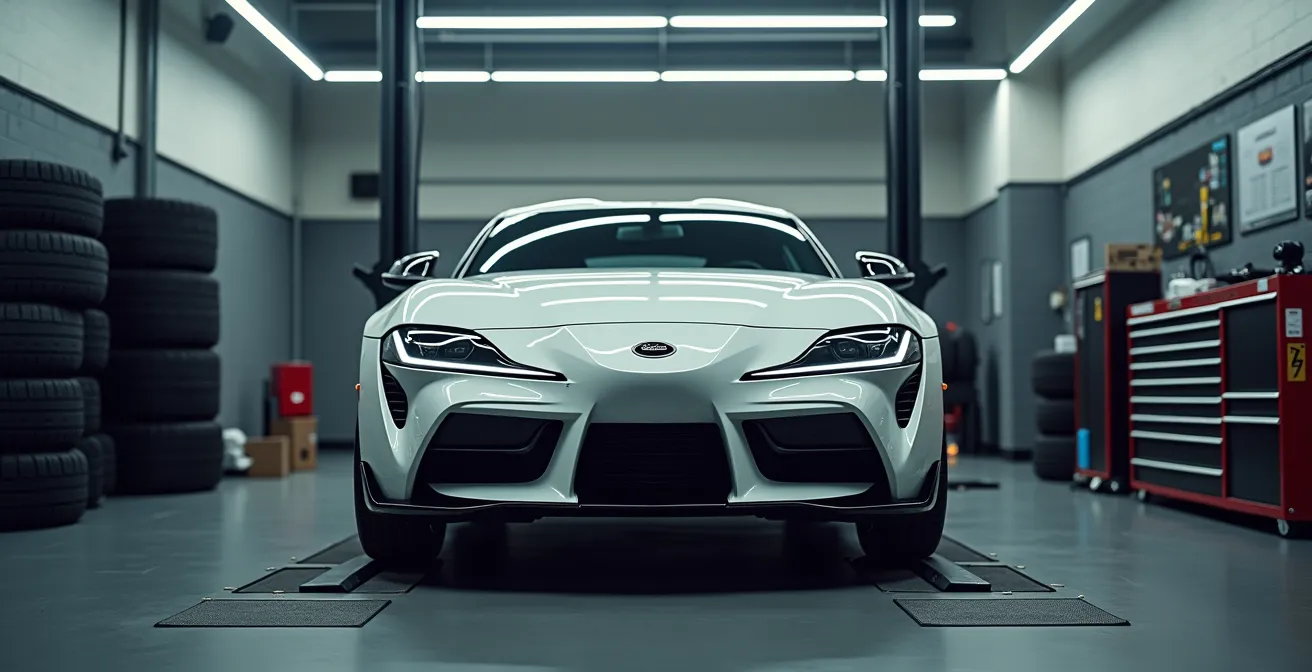
Contrary to the belief that you can afford a sport coupé if you can handle the monthly payment, the true cost is a punishing “subscription” you pay per mile, not per month.
- Performance “consumables” like tires and brakes wear out up to three times faster, costing thousands annually.
- Insurance for a young driver can easily add another $300-$400 per month, and depreciation erases 20% of the car’s value in the first year alone.
Recommendation: Before you sign any papers, calculate your estimated cost-per-mile including tires, brakes, fluids, insurance, and depreciation. The number will shock you, but it’s the only figure that matters.
That sport coupé in the showroom looks like a dream. You can picture yourself in it, the engine roaring, the sleek lines turning heads. You’ve run the numbers on the monthly payment, and it seems… manageable. This is the first and most dangerous mistake. As a mechanic who sees these cars in the bay every day, I’m telling you to forget the monthly payment. The sticker price is just the entry fee to a very expensive club.
The real cost of owning a performance car as a daily driver isn’t a fixed monthly bill; it’s a variable, punishing tax you pay for every single mile you drive. We’re not talking about just gas. We’re talking about a complete ecosystem of hidden expenses—what I call the consumables tax—that drains your bank account in ways a normal car never would. These are the costs the salesperson conveniently forgets to mention while you’re blinded by polished paint and horsepower figures.
But if the dream is too strong to ignore, you need to go in with your eyes wide open, armed with a mechanic’s brutal honesty. This isn’t about crushing your dream; it’s about protecting you from a financial nightmare. The key is to shift your mindset from “Can I afford the car?” to “Can I afford the cost-per-mile?” Understanding this difference is the only thing that will save you from owning a beautiful driveway ornament that you’re too broke to drive.
In this guide, we will break down the real-world expenses that come with daily-driving a performance machine. We’ll move past the fantasy and get into the gritty financial reality, giving you the tools to make a smart decision instead of an emotional one.
Summary: The Real Financial Picture of Daily-Driving a Sport Coupé
- Why You Will Spend $1,200 on Tires Every 15,000 Miles?
- How to Prepare a Rear-Wheel Drive Coupé for Snow and Ice?
- Sport Coupé vs. Hot Hatch: Which Is Cheaper to Insure for Drivers Under 30?
- The “New Model” Drop: Why Your Coupé Loses 20% Value When the Facelift Launches?
- Problem & Solution: Preventative Maintenance That Saves $5,000 in Engine Repairs
- Why Your Stopping Distance Quadruples When Speed Doubles?
- How to Document Maintenance to Prove Your Car Is Worth Premium Price?
- How to Safely Handle a High-Performance Car on Public Roads?
Why You Will Spend $1,200 on Tires Every 15,000 Miles?
Let’s get one thing straight: the tires on a sport coupé are not just rubber. They are high-tech, soft-compound performance components designed for maximum grip, and they have the lifespan of a mayfly. While the tires on a Honda Civic might last 50,000 miles, you’ll be lucky to get 15,000 to 20,000 miles out of a set of performance tires. They are the single biggest and most frequent “consumables tax” you will pay.
The cost is staggering. A single performance tire can range from $160 to over $1,209, meaning a full set will easily set you back $1,200 to $2,500 or more. This isn’t a one-time pain. If you drive 15,000 miles a year, this becomes an annual expense. The soft rubber that gives you incredible cornering grip wears away at an alarming rate, a process accelerated by the aggressive wheel alignment settings required for performance handling. This is a non-negotiable cost of admission.
But the spending doesn’t stop with the tires themselves. The ecosystem around them is a financial drain:
- Winter Tire Set: If you live anywhere with snow, your summer performance tires are useless and dangerous. You’ll need a completely separate set of winter tires ($600-$1,000) and ideally, separate wheels ($400-$600) to avoid damaging your expensive alloys during seasonal changes.
- TPMS Sensors: Your second set of wheels will need its own Tire Pressure Monitoring System sensors, adding another $200-$400 to the bill.
- Storage and Swapping: Unless you have a large garage, you’ll pay a shop $100-$200 per season to store your off-season set.
- Alignment: To protect your investment, a four-wheel alignment ($100-$150) is critical after every tire change to prevent premature wear.
When you add it all up, tires are not an occasional maintenance item; they are a significant, recurring subscription fee for keeping your car on the road.
How to Prepare a Rear-Wheel Drive Coupé for Snow and Ice?
In dry, warm weather, a rear-wheel-drive (RWD) coupé is a joy. In snow and ice, it can quickly become a 1.5-ton paperweight, or worse, a liability on wheels. The combination of high power, low weight over the drive wheels, and wide summer tires creates a recipe for disaster. Preparing it for winter isn’t a suggestion; it’s a mandatory investment in safety and usability.
The absolute first step is getting rid of your performance summer tires. Their hard rubber compound becomes as stiff as a hockey puck below 45°F (7°C), offering virtually no grip. You must invest in a set of high-quality winter tires. These have a softer compound that stays flexible in the cold and feature deep treads with thousands of tiny slits (sipes) that bite into snow and ice. This is the single most important factor for winter traction.
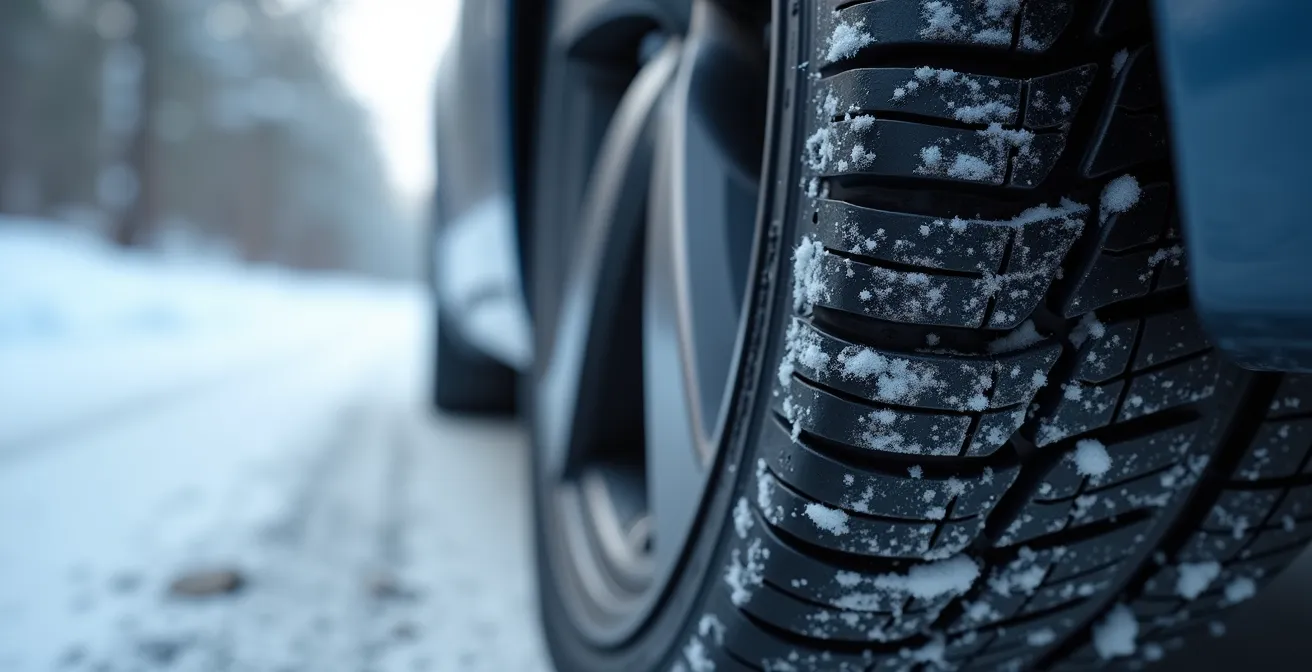
As the image above illustrates, proper winter tires have a visibly different, more aggressive tread pattern designed for treacherous conditions. Beyond tires, consider adding weight to the trunk. Placing two or three 50-pound sandbags directly over the rear axle can significantly improve traction by pressing the drive wheels onto the ground. It’s an old-school trick that still works wonders. Finally, adjust your driving style: every input—steering, throttle, and brakes—must be gentle and deliberate to avoid breaking traction.
Sport Coupé vs. Hot Hatch: Which Is Cheaper to Insure for Drivers Under 30?
The image you’re buying with a sport coupé comes with a hefty, recurring insurance bill, especially if you’re under 30. Insurance companies see a young driver in a powerful, two-door car and their risk calculators go into overdrive. They don’t just see the car; they see a statistical probability of expensive claims based on a history of similar drivers.
Data consistently shows that sport coupés are significantly more expensive to insure than even their high-performance hatchback counterparts. For example, data shows the 2025 Ford Mustang EcoBoost Fastback averaging $353 per month for younger drivers. That’s over $4,200 a year, just for insurance. A hot hatch, while still not cheap, often benefits from its four-door, more “practical” image, even if it has similar performance. They are perceived as less of a pure “risk-taking” vehicle.
To put this in perspective, here’s how the costs break down. This table clearly shows that even an “entry-level” sport coupé carries a premium over a comparable hot hatch, and the costs escalate quickly.
| Vehicle Type | Example Model | Monthly Insurance (Under 30) | Annual Cost | Key Factor |
|---|---|---|---|---|
| Entry Sport Coupe | Toyota GR86 | $257-$300 | $3,084-$3,600 | Lower theft risk profile |
| Premium Sport Coupe | BMW Z4 | $380-$400 | $4,560-$4,800 | Higher repair costs |
| Hot Hatch | VW Golf R | $320-$350 | $3,840-$4,200 | High claim frequency |
| Entry Hot Hatch | Hyundai Veloster N | $275-$310 | $3,300-$3,720 | Lower performance rating |
The reasons are simple: coupés often have higher repair costs due to more expensive parts and bodywork, they are stolen more frequently, and they are statistically involved in more single-vehicle, at-fault accidents. Before you fall in love with a coupé, get multiple insurance quotes. That monthly figure is a major part of your total cost of ownership and is completely non-negotiable.
The “New Model” Drop: Why Your Coupé Loses 20% Value When the Facelift Launches?
Of all the hidden costs, depreciation is the most brutal and the most invisible. It’s the money you lose without writing a single check. While all cars lose value, performance cars live on a financial cliff edge. As soon as you drive your new car off the dealership lot, it begins to lose value, and it’s common for it to lose 20% of its value in the first year alone. On a $50,000 car, that’s $10,000 vanished into thin air.
But the depreciation of a sport coupé is tied to something more specific than just age and mileage: the model cycle. Automakers typically release a “facelift” (a mid-cycle refresh with new headlights, bumpers, and tech) or an all-new generation every 3-4 years. The moment the new, shinier version is announced, the value of your “old” model doesn’t just drop, it plummets. Your car instantly becomes less desirable, and its resale value takes a massive hit, often another 10-15% overnight. This is the depreciation cliff.
Daily driving accelerates this process. Every mile, every rock chip, and every door ding reduces its appeal to the collectors and enthusiasts who might otherwise pay a premium. There are, however, rare exceptions to this rule.
Case Study: The Lexus LC 500’s End-of-Production Anomaly
The 2026 Lexus LC 500 marks the final model year for this acclaimed V8-powered sports car. This announcement creates a unique market dynamic. For buyers, it sparks urgency to acquire the last and most refined version. For existing owners, it provides a potential buffer against depreciation. Because it is the “last of its kind,” it has a higher chance of becoming a future collectible, which could help it retain value far better than a mass-market coupé that will be replaced by a new generation.
Betting on your car becoming a collectible is a gamble, not a financial strategy. For 99% of sport coupés, especially those used as daily drivers, depreciation will be your single largest expense.
Why Your Stopping Distance Quadruples When Speed Doubles?
One of the biggest thrills of a performance car is its acceleration. But the physics of speed have a dark side: kinetic energy. The energy an object has in motion is proportional to the square of its speed. This means if you double your speed from 30 mph to 60 mph, your car doesn’t have twice the energy; it has four times the kinetic energy. Your brakes are the only thing responsible for dissipating all that energy to bring you to a stop.
This is why performance cars have massive, expensive brake systems. The big rotors and multi-piston calipers aren’t for show; they are a physical necessity to handle the immense heat and forces involved in stopping a fast-moving car. As a daily driver, this has serious financial consequences. You will wear through brake pads and rotors much faster than on a normal car, especially with the stop-and-go nature of daily traffic.
This is another major part of the “consumables tax.” A full brake job on a performance car is not a few hundred dollars. High-performance brake components are costly, with a set of pads and rotors easily exceeding $1,000 or more for parts alone. And just like with tires, your choices have a direct impact on safety.
Tire Choice and Its Impact on Braking
Your brakes can only be as good as your tires’ grip on the road. A recent analysis highlighted that performance all-season tires like the BFGoodrich G-force Comp-2 A/S Plus offer demonstrably better handling and braking performance than standard touring tires. Choosing cheaper, lower-quality tires to save money is a dangerous mistake, as it directly compromises your car’s ability to stop, negating the advantage of your expensive brake system.
Skimping on brakes or tires to save money is a fool’s errand. The ability to stop is far more important than the ability to go, and on a performance car, that ability comes at a steep, recurring price.
Problem & Solution: Preventative Maintenance That Saves $5,000 in Engine Repairs
On a standard car, maintenance is about keeping it running. On a high-performance car, it’s about preventing catastrophic financial failure. The engines, transmissions, and differentials in these vehicles operate under extreme stress and tighter tolerances. Forgetting to change a specific fluid won’t just cause poor performance; it can lead to a five-figure repair bill. This is why I call preventative maintenance your financial firewall.
The cost of maintenance is best measured per mile. While typical vehicles might run $0.09 to $0.11 per mile for upkeep, you should expect to be at the high end of that range, or well beyond it. A simple oil change can cost twice as much due to the need for expensive synthetic oils and larger capacities. However, these frequent, smaller costs are your insurance policy against the big ones.
Ignoring the manufacturer’s *severe duty* maintenance schedule (which is what daily driving is) is financial suicide. A dual-clutch transmission (like VW’s DSG or Porsche’s PDK) that requires an $800 fluid service every 30,000 miles can easily turn into a $15,000 replacement if neglected. Your best tool is a proactive plan.
Your Preventative Maintenance Action Plan: The Financial Firewall
- Change engine oil every 5,000 miles for turbocharged engines, not the 10,000-mile interval advertised for “normal” driving.
- Flush brake fluid every 2 years, regardless of mileage, to remove moisture and prevent boiling under hard use.
- Service your DCT/PDK transmission fluid every 30,000 miles. This is the most critical and cost-effective preventative measure you can take.
- Replace differential fluid every 30,000 miles, especially if you have a limited-slip differential (LSD).
- Monitor coolant condition annually. Performance engines run hotter, degrading coolant faster and risking overheating.
Think of this checklist not as a series of expenses, but as a list of investments. Each one reinforces your financial firewall, protecting the expensive, high-strung heart of your vehicle.
How to Document Maintenance to Prove Your Car Is Worth Premium Price?
Since depreciation is your biggest enemy, your best weapon is meticulous documentation. When it comes time to sell, you aren’t just selling a used car; you’re selling a well-cared-for enthusiast machine. A thick binder full of receipts and a detailed digital log is the only proof you have that your car is worth more than the average, neglected example.
A complete service history can be the difference between getting top dollar and being forced to accept a lowball trade-in offer. It proves to the next buyer that you weren’t a cheapskate. It shows that you performed the expensive preventative maintenance (like that $800 transmission service) on time. This builds trust and justifies a premium price, effectively allowing you to recoup some of your maintenance spending.
To do this right, you need a bulletproof documentation strategy from day one:
- Go Dual-Format: Keep a physical binder with every single receipt, but also maintain a digital spreadsheet tracking mileage, dates, costs, and part numbers.
- Photograph Everything: Take a picture of every receipt and upload it to a cloud service (like Google Drive or Dropbox) as a backup. Paper fades, digital is forever.
- Document the “Why”: For each service, write a small note explaining the decision. For example, “Chose OEM brake pads over aftermarket for guaranteed fit and performance.”
- Track Fluids: Don’t just write “oil change.” Record the specific brand and grade of oil, transmission fluid, and coolant used. Enthusiast buyers care about this.
- Record Events: Note any track days or performance driving schools attended. This shows the car was used as intended but also cared for by an expert.
- Photograph Major Services: Take before-and-after photos of big jobs like new tires or a brake replacement. It’s compelling visual proof of the work done.
This level of detail transforms your car from a simple commodity into a curated vehicle with a verifiable history, giving you the leverage to command a much higher resale price.
Key Takeaways
- The true cost of a sport coupé is not the monthly payment but the “cost-per-mile,” which includes rapid-wear items like tires and brakes.
- Preventative maintenance is not an expense but a “financial firewall” against catastrophic, five-figure repair bills on complex components.
- Meticulous documentation is the only effective weapon against steep depreciation, proving your car’s value and justifying a premium resale price.
How to Safely Handle a High-Performance Car on Public Roads?
We’ve talked a lot about the financial costs, but there’s one more hidden expense: the mental cost. Daily-driving a high-performance car in a world of potholes, distracted drivers, and tight parking garages is not relaxing. It requires a level of constant attention and vigilance that is genuinely draining.
The stiff suspension that feels amazing on a smooth track will punish you over every bump and expansion joint. The poor visibility and long doors that look so sleek make navigating parking lots a nightmare. And the instant power that is so thrilling on an open road can be a liability on a wet, crowded street. This is what’s known as the “mental load” of performance car ownership.
The ‘Mental Load’ Tax of Daily Driving: the constant hyper-vigilance required to manage a powerful car with poor visibility and a stiff ride in dense traffic is mentally draining in a way that a normal car is not.
– A Girl’s Guide to Cars Editorial Team, 8 Sexy Sports Cars for Daily Driving
Safely handling the car means recognizing that its limits are far beyond your own and beyond what is safe or legal on public roads. The only way to truly and safely understand what your car is capable of is to invest in yourself. A high-performance driving school is not a frivolous expense; it’s a critical piece of safety equipment. It will teach you car control, emergency braking, and skid correction in a safe, controlled environment. This training is an investment that protects both you and your expensive machine.
Ultimately, driving a sport coupé daily is a trade-off. You’re trading comfort, practicality, and financial peace of mind for moments of driving pleasure. You just have to be brutally honest with yourself about whether the bill—both financial and mental—is one you’re truly willing and able to pay every single day.
Before you get swept away by the dream, do the real, hard math. Create a detailed budget based on the cost-per-mile principles we’ve discussed. Get real insurance quotes. Price out a set of tires and a brake job. If you can look at that total number and still smile, then you’re ready. If not, you may have just saved yourself from a very expensive mistake.