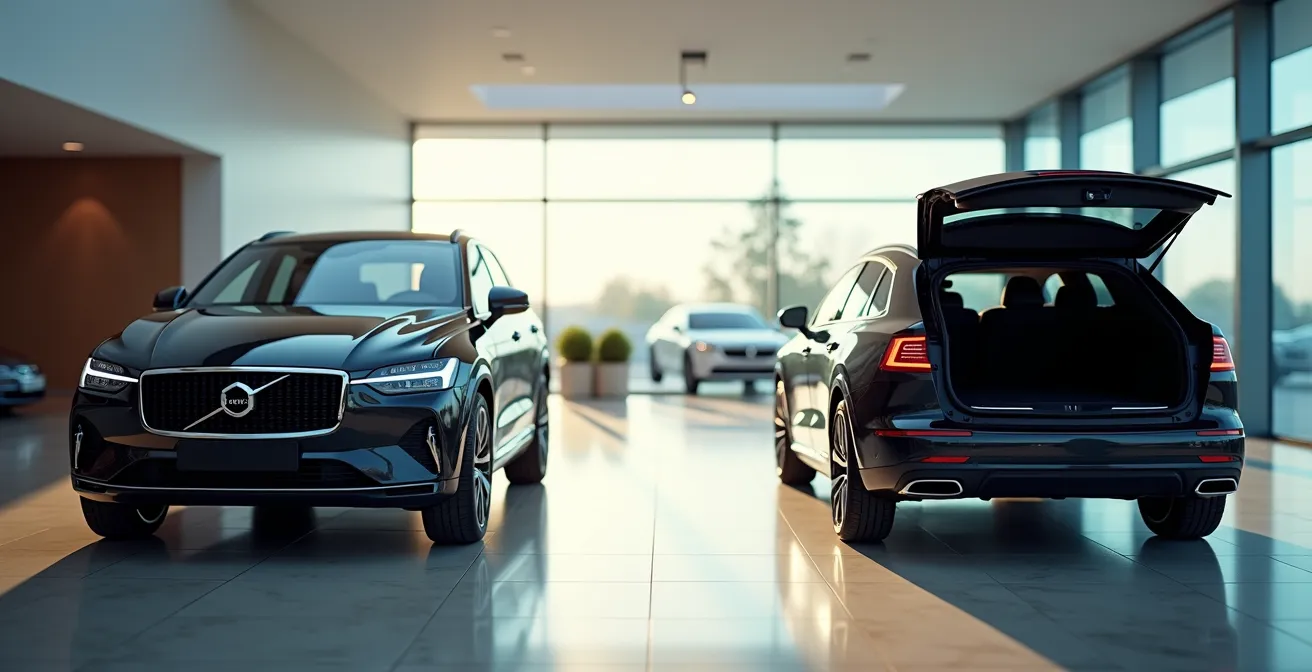
The single most impactful factor in your car’s resale value isn’t its brand, but the strategic combination of features, color, and body style you choose at purchase.
- Practical features like 4WD and advanced safety systems consistently offer a higher Return on Investment (ROI) than purely cosmetic upgrades.
- Market trends, such as the dominance of crossovers and seasonal demand for specialty vehicles, can be timed to add up to 20% to your final sale price.
Recommendation: Treat your car purchase like a financial asset by forecasting future demand and meticulously documenting its provenance to command a premium.
The moment you drive a new car off the lot, it begins its life as a depreciating asset. For a buyer who views their vehicle as a temporary holding, the primary financial goal is to minimize that depreciation. Common wisdom offers a familiar chorus of advice: keep it clean, follow the maintenance schedule, and stick to a reliable brand. While not incorrect, this advice is fundamentally incomplete. It treats value retention as a passive activity of preservation rather than an active strategy of financial forecasting.
This passivity leaves significant money on the table. The market doesn’t just reward well-maintained cars; it pays a premium for vehicles that align with predictable future demand. This guide reframes the entire problem. We will not offer a simple checklist of platitudes. Instead, we provide an automotive market analyst’s framework for treating your vehicle purchase as a calculated investment. The key is to shift your mindset from merely owning a car to managing an asset, focusing on quantifiable feature ROI and strategic market arbitrage.
Through this lens, we will dissect the financial impact of every major choice you make. We will explore the surprising economics of car color, the market forces driving body style values, the ROI of specific optional features, and even the critical importance of timing your eventual sale. By understanding these dynamics, you can build a comprehensive strategy to protect your capital and maximize your return when it’s time to sell.
This article provides a structured analysis of the key levers you can pull to influence your vehicle’s future worth. The following sections break down each component, from broad market trends to specific feature choices, giving you a complete financial playbook.
Summary: A Financial Guide to Vehicle Depreciation
- Why Buying a Bright Green Car Could Cost You $2,000 at Resale?
- How to Document Maintenance to Prove Your Car Is Worth Premium Price?
- Sedan vs. Crossover: Which Body Type Holds Value Better in the Current Market?
- The Mistake of Buying a Car Brand That Is Leaving Your Country
- Sequencing Your Sale: When Is the Best Month to Sell a Used Convertible?
- Swimming Pool vs. Additional Bedroom: Which Adds More Value?
- When to Act on an Insight: The 24-Hour Rule for Avoiding Panic
- What Are the Hidden Costs of Owning a Sport Coupé as a Daily Driver?
Why Buying a Bright Green Car Could Cost You $2,000 at Resale?
The long-held belief is that neutral colors—white, black, gray, and silver—are the safest bets for resale value. While they offer the broadest appeal, they don’t necessarily command the highest prices. The financial reality is more nuanced and depends entirely on market segmentation. A vibrant color on a mundane commuter sedan can indeed be a costly mistake, but on the right vehicle, it’s an investment. The key is matching the color to the vehicle’s personality and target buyer.
For instance, data shows that some of the lowest-depreciating colors are the most vibrant. An analysis of over 1.2 million used car transactions revealed that yellow cars depreciate by only 24% over three years, a significantly slower rate than the industry average of 31%. This isn’t because everyone wants a yellow car; it’s because yellow is common on sports cars and other low-volume specialty vehicles that tend to hold their value well regardless. Buyers in this segment are actively seeking colors that stand out.
This principle applies across different segments. Orange has become a signature, high-demand color for performance pickup trucks like the Ford Raptor and Toyota TRD Pro, directly boosting their appeal among enthusiasts. Similarly, beige and tan are top-performing colors for standard pickup trucks because they align with a utilitarian, rugged aesthetic. The mistake isn’t choosing a bright color; it’s choosing a color that conflicts with the vehicle’s market identity. A bright green on a luxury sedan is a liability; on a Jeep Wrangler, it can be a significant asset.
How to Document Maintenance to Prove Your Car Is Worth Premium Price?
Every seller claims their car has been “well-maintained,” but in the eyes of a discerning buyer, this claim is worthless without proof. A meticulously organized service history is not just a record; it is a tangible asset that can add hundreds, if not thousands, of dollars to your car’s value. It transforms your vehicle from a used commodity into an asset with a verifiable provenance. This is especially true for enthusiast or luxury vehicles, where a complete stack of receipts for a Porsche 911 matters far more than for a Nissan Altima.
Building this asset requires discipline from day one. It goes beyond simply keeping a few oil change receipts. Your goal is to create a professional, comprehensive portfolio that tells the complete story of the car’s life under your care. This includes:
- All Service Invoices: Keep every single receipt from dealerships and independent shops, organized chronologically.
- Parts Receipts: If you perform your own work, keep receipts for all parts and fluids (e.g., specific oil brands, OEM filters, high-performance brake pads).
- Tire Records: Document when tires were purchased and rotated.
- A Detailed Log: Maintain a simple spreadsheet or notebook recording the date, mileage, service performed, and cost for every single event.
The presentation of this documentation is as important as its content. A professional, leather-bound binder with organized tabs for different service categories makes an immediate and powerful impression on a potential buyer. It signals a level of care and fastidiousness that extends to the mechanical condition of the car itself, justifying a premium price before the buyer even starts the engine.

This physical portfolio serves as undeniable proof that your vehicle has received superior care. When a buyer is comparing two identical cars, the one with the “book” will almost always command a higher price and sell faster. You are not just selling a car; you are selling peace of mind, and that has significant financial value.
Sedan vs. Crossover: Which Body Type Holds Value Better in the Current Market?
For the last decade, the automotive market has been defined by one overarching trend: the unstoppable rise of the crossover and SUV. This profound shift in consumer preference is the single most important factor when forecasting the long-term value of a vehicle’s body style. From a purely financial perspective, betting against this trend by purchasing a sedan is a riskier proposition. The data is unequivocal: crossovers and SUVs hold their value better because that is where market demand is concentrated.
Today, crossovers and SUVs represent 52% of the used car market, a figure that continues to grow. This overwhelming demand creates a higher price floor for used models compared to their sedan counterparts. A direct comparison of depreciation rates illustrates this market reality clearly.
As a data-driven analysis of 5-year depreciation shows, the gap between body styles is significant. Pickup trucks consistently perform best due to their dual utility for both personal and commercial use, while sedans suffer from waning consumer interest.
| Body Style | Average 5-Year Depreciation | Best Performing Models | Key Value Factors |
|---|---|---|---|
| Crossover/SUV | 40-45% | Toyota 4Runner (25%), Jeep Wrangler (35%) | All-wheel drive, versatility, high demand |
| Sedan | 50-60% | Toyota Camry (40%), Honda Accord (37%) | Fuel efficiency, reliability, lower demand |
| Pickup Truck | 35-40% | Toyota Tacoma (28%), Ford F-150 (38%) | Utility, towing capacity, commercial use |
However, this doesn’t mean all sedans are poor investments. As the table highlights, best-in-class models from brands with a strong reputation for reliability, like the Honda Accord and Toyota Camry, can outperform lower-tier crossovers. The strategic choice is to either align with the dominant crossover trend or, if choosing a sedan, to select a top-performing model that has historically defied the segment’s overall decline.
The Mistake of Buying a Car Brand That Is Leaving Your Country
The conventional financial advice is clear and stark: never buy a car from a brand that has ceased operations in your country. These “orphan brands” are perceived as a major liability due to fears about parts availability, specialized service, and plummeting resale values. For the vast majority of vehicles, this holds true. A discontinued mass-market sedan from a defunct brand like Suzuki or Daewoo is a guaranteed path to severe depreciation.
However, a more sophisticated analysis reveals the Orphan Brand Paradox. In specific cases, a vehicle from a defunct brand can become a cult classic, holding its value remarkably well or even appreciating. This typically occurs when the vehicle possesses a unique combination of qualities: a high-performance variant, a distinct design, and a passionate enthusiast community. The Pontiac G8 GXP, a V8-powered sports sedan sold just before the brand’s demise, is a prime example. It became a collector’s item precisely because of its rarity and performance, defying the fate of its more mundane stablemates.
Investing in an orphan brand is an expert-level strategy that carries significant risk. It requires deep market knowledge and a thorough assessment of the specific model’s long-term viability. Before considering such a purchase, a rigorous due diligence process is essential.
Action Plan: Assessing an Orphan Brand’s Viability
- Parts Commitment: Verify if the parent company has legally committed to providing parts for a set period (often 10 years) after the brand’s departure.
- Community Activity: Research the health of online owner forums and local clubs. An active community ensures a shared knowledge base for repairs and parts sourcing.
- Specialist Network: Confirm the availability of independent mechanics in your area who specialize in the brand. Relying solely on a disappearing dealer network is a losing proposition.
- Cult Appeal: Objectively assess if the car has unique performance or design attributes that could foster a “cult” following. Is it a generic sedan or a limited-edition performance model?
- Historical Precedent: Compare the value trends of your target vehicle to similar orphan models from the past, such as those from Saab or Saturn, to understand potential depreciation curves.
Ultimately, buying an orphan brand is a high-risk, high-reward bet. For most buyers focused on minimizing depreciation, the rule remains: steer clear. For the savvy analyst, however, a carefully chosen orphan can be a contrarian and profitable investment.
Sequencing Your Sale: When Is the Best Month to Sell a Used Convertible?
A car’s value is not a static number; it fluctuates based on market demand, and no factor influences demand more predictably than the seasons. Treating your car sale like a financial trade, where timing is paramount, is a powerful form of market arbitrage that can unlock significant value. Selling a vehicle in its peak demand season can easily add thousands to its sale price. The most dramatic example of this principle is the convertible.
Selling a convertible in the bleak, cold days of December is a financial blunder. Buyers are not fantasizing about top-down driving; they are worried about snow tires and heated seats. As spring approaches, however, demand surges. A study of seasonal pricing patterns confirms this, showing that convertibles can command 15-20% higher prices in April and May compared to the winter months. For a $20,000 car, that’s a $3,000-$4,000 difference achieved simply by waiting a few months to list it for sale.

This concept of seasonal sequencing extends to all vehicle types. The market for 4x4s and all-wheel-drive SUVs peaks in the autumn and early winter, as consumers anticipate inclement weather. Family-oriented minivans and large SUVs see a bump in demand leading into the summer travel season. Even the market for fuel-efficient compact cars can see increased interest during periods of high gas prices.
The strategic takeaway is to plan your exit. If you own a specialty vehicle, identify its peak season and align your selling timeline accordingly. Don’t wait until you need to sell; anticipate the market’s rhythm and use it to your financial advantage. This patient, calculated approach is one of the easiest ways to maximize your return without spending a single dollar on the car itself.
Swimming Pool vs. Additional Bedroom: Which Adds More Value?
While you can’t add a swimming pool to a car, this classic real estate question poses a perfect analogy for car buyers: what adds more resale value—practical, utility-focused features (the ‘additional bedroom’) or luxury, lifestyle options (the ‘swimming pool’)? The answer, from a financial analyst’s perspective, is almost always the former. The used car market consistently pays a higher premium for features that enhance a vehicle’s core function and safety over those that are purely aesthetic or for comfort.
This principle of practicality over panache is most evident in the truck market. A detailed analysis from Jalopnik highlights this perfectly, noting that for a workhorse like the Ford F-150, functional upgrades have a direct and significant impact on resale value. As their analysis states:
On the Ford F-150, opting for four-wheel drive added a cool $1,800, the tow package tacked on another $1,000, and an upgraded engine brought in an extra $2,200. Nobody seems to care about fancy wheels on a workhorse.
– Jalopnik Analysis, What Features Increase A Car’s Resale Value Most?
This logic holds true across almost all vehicle segments. Features like advanced safety packages (blind-spot monitoring, automatic emergency braking), all-wheel drive, and even durable leather seats offer a strong Return on Investment (ROI). In contrast, features like a panoramic sunroof or premium paint jobs have a much lower ROI, returning only a fraction of their initial cost at resale.
The data on feature ROI provides a clear roadmap for optioning a new car. Choosing a feature should be a calculated decision, weighing its initial cost against its likely contribution to the final sale price.
| Feature Type | Initial Cost | Resale Value Add | ROI % |
|---|---|---|---|
| Advanced Safety Package | $1,500 | $1,000 | 67% |
| Panoramic Sunroof | $2,000 | $500-$1,000 | 25-50% |
| Leather Seats | $2,500 | $2,000 | 80% |
| Premium Paint | $595 | $90 | 15% |
| 4WD/AWD | $3,000 | $1,800 | 60% |
As the data from this ROI analysis suggests, when in doubt, invest in function. The “additional bedroom” will almost always add more value than the “swimming pool.”
When to Act on an Insight: The 24-Hour Rule for Avoiding Panic
In the fast-paced, high-pressure environment of the car market, a “limited-time offer” or a “one-of-a-kind deal” can trigger emotional, impulsive decisions. Whether buying or selling, acting on panic is a direct path to financial loss. The analyst’s antidote to this pressure is the 24-Hour Rule: a mandatory cooling-off period designed to replace emotion and urgency with data and verification. No matter how compelling an offer seems, you commit to taking no action for 24 hours.
This period is not for passive waiting; it is for active, focused research. The goal is to validate the “insight” or offer against the reality of the market. This framework prevents you from being swayed by a salesperson’s urgency or your own fear of missing out. The process involves a clear, five-step validation:
- Document the Offer: Write down the exact terms of the deal—price, features, trade-in value, etc. This externalizes the offer and makes it an object of analysis.
- Research Comparables: Use the next 24 hours to find at least three other comparable vehicles for sale and check recent sales data to establish a true market price.
- Calculate Total Cost: Factor in the vehicle’s likely 5-year depreciation to understand the total cost of ownership, not just the purchase price.
- Source Competing Offers: If you are selling, get firm offers from at least two other sources (e.g., another dealer, an online car buyer) to create a real-world value range.
- Make a Data-Driven Decision: After 24 hours, make your decision based on the collected data, not the initial emotional pressure.
This disciplined approach ensures you are operating from a position of knowledge. As experts from Consumer Reports emphasize, a single offer is not a market; it’s just an opinion. True value can only be determined by collecting multiple data points.
The exact appraisal amount will change based on local market conditions, the dealer’s inventory, and their ability to resell the car. To understand the value of your car, take it to multiple used car lots to see what they will give you for it. This will help you understand the high- and low-end values for your car.
– Consumer Reports & Black Book, Car Value Estimator Guide
The 24-Hour Rule is a simple but powerful financial discipline. It forces a pause, removes emotion, and replaces a single, biased data point with a robust, evidence-based view of the market.
Key Takeaways
- Quantify Feature ROI: Prioritize practical upgrades (AWD, safety tech) over cosmetic ones, as they deliver a demonstrably higher return on investment at resale.
- Exploit Market Timing: Treat the sale of your vehicle like trading an asset; selling convertibles in spring or 4x4s in fall can capture a seasonal premium of 15-20%.
- Build Verifiable Provenance: A meticulously organized service history is not just a record; it’s a tangible asset that justifies a premium price and proves superior care.
What Are the Hidden Costs of Owning a Sport Coupé as a Daily Driver?
For the enthusiast, the allure of driving a sport coupé every day is powerful. However, from a purely financial standpoint, this decision comes with a significant and often overlooked hidden cost: dramatically accelerated depreciation. While all cars depreciate with use, high-performance and specialty vehicles are uniquely sensitive to mileage. The market for these cars is heavily skewed towards low-mileage, “weekend-only” examples, and using one as a daily commuter pushes it into a different, much lower-value category.
The depreciation penalty for high-mileage use on a sports car is not linear; it is exponential. Data starkly illustrates that sports coupes driven daily (15,000+ miles/year) can depreciate up to 45% faster than examples driven sparingly on weekends. This is because the primary buyer pool for used sports cars consists of collectors and enthusiasts who place an enormous premium on originality and low mileage. A 5-year-old sports car with 75,000 miles is competing against sedans, not other sports cars.
Of course, there are exceptions that prove the rule. Certain “halo” cars with timeless designs and legendary performance, like the Porsche 911, can defy this trend. A Porsche 911 loses only around 19.5% of its value over 5 years, an astonishing figure for a high-performance vehicle. This resilience is due to its iconic status and a collector market so strong that it absorbs even higher-mileage examples. However, for every Porsche 911, there are dozens of other sports coupes from less-storied brands that will suffer immense depreciation if used as a daily driver. Beyond depreciation, other hidden costs include higher insurance premiums, more expensive tires, and more frequent, costly maintenance.
To apply these principles effectively, your next step is to analyze the specific models you are considering through the lens of 5-year depreciation and feature ROI. Approaching your purchase with this analytical rigor is the surest way to protect your investment.