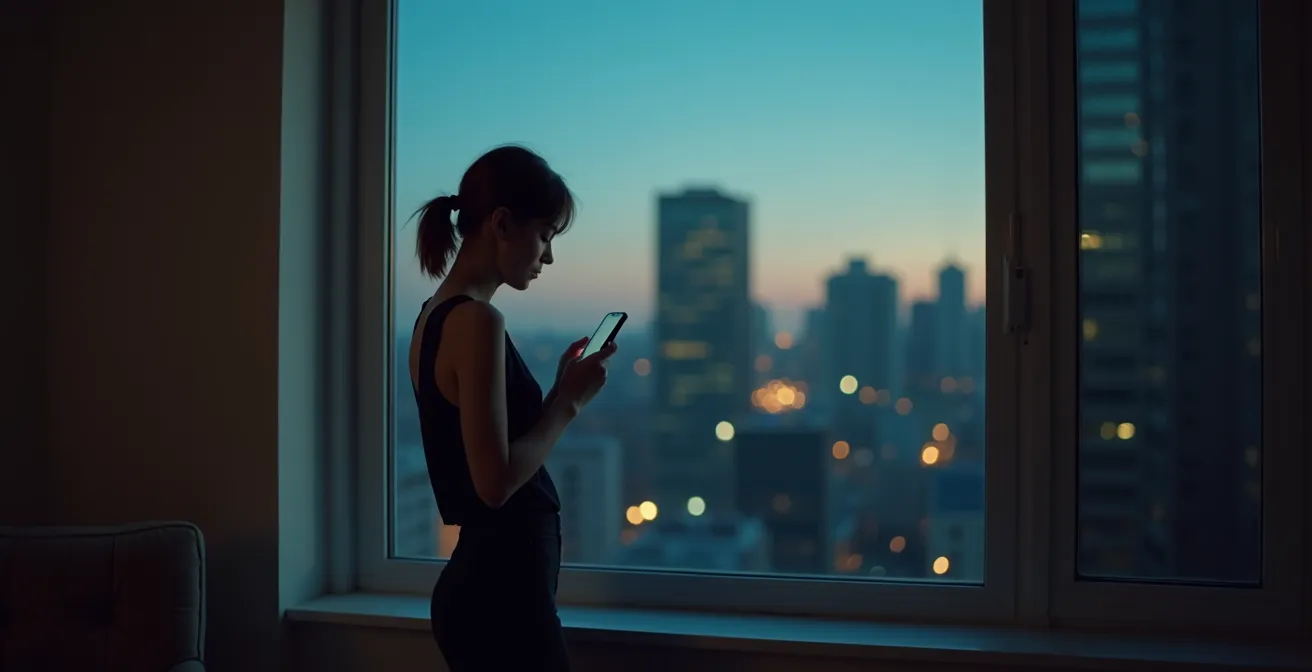
True work-life balance isn’t a matter of willpower; it’s a matter of strategic environmental design.
- Your brain responds to subtle physical and digital cues that constantly blur the line between your professional and personal life, sabotaging rest.
- Developing a system of “conscious usage” with your technology is far more sustainable and effective than a temporary, all-or-nothing digital detox.
Recommendation: Start tonight by creating one “sacred zone” in your home—like the dining table or bedroom—where work devices are physically forbidden.
It’s that familiar dread. It’s 8 PM, you’ve just settled down, and your phone buzzes with the unmistakable tone of a work email. Instantly, your mind is pulled from your family, your book, or your moment of peace and thrown back into spreadsheets and deadlines. For remote workers and freelancers, this scenario isn’t an exception; it’s the norm. The very technology that grants us freedom has become a digital leash, tethering us to our work 24/7. Your office is no longer a place you go to; it’s a device in your pocket.
The common advice feels hollow because it misses the point. You’re told to “set boundaries” or “turn off notifications,” as if it were a simple switch. But this advice ignores the deep-seated psychological pull of being always-on and the environments we’ve inadvertently created that sabotage our best intentions. It treats the symptom—checking your phone—without addressing the root cause.
But what if the key to work-life balance isn’t about mustering more willpower? What if it’s not a battle you have to fight every single evening? The real, sustainable solution lies in strategic design. By consciously shaping your physical, digital, and even urban environments, you can create a system where disconnection becomes the default, not a daily struggle. This is not about time management; it’s about mind management through environmental architecture.
This guide will walk you through the practical science of creating these boundaries. We’ll explore how to re-engineer your surroundings to build a psychological fortress between your work and your life, giving you the power to truly log off and reclaim your mental space.
Summary: Reclaiming Your Life When Your Office Is in Your Pocket
- Why Checking Emails at Night Ruins Your Deep Sleep Cycles?
- How to Design a Home Office That Physically Separates Work From Rest?
- Digital Detox vs. Conscious Usage: Which Strategy Lasts Longer?
- The Communication Mistake That Teaches Clients to Disturb You on Weekends
- Sequencing Your Week: When to Schedule “Deep Work” Without Notifications
- Why Living Near a Highway Increases Cortisol Levels by 20%?
- The “Cyberchondria” Loop: When Health Trackers Increase Your Anxiety
- How Does Urban Design Directly Influence the Mental Health of Residents?
Why Checking Emails at Night Ruins Your Deep Sleep Cycles?
That “quick check” of your inbox before bed does more damage than just eating into your downtime. It’s a direct assault on the architecture of your sleep. The primary culprit is the blue light emitted from your screen, which actively suppresses the production of melatonin, the hormone that signals to your body it’s time to rest. Without this crucial signal, falling asleep becomes more difficult, but the damage runs deeper.
Even if you doze off, your brain remains in a state of hyper-vigilance. Engaging with work-related problems puts your prefrontal cortex into high gear, making it nearly impossible to transition into the restorative phases of sleep. Your brain needs to cycle through deep sleep (for physical repair and memory consolidation) and REM sleep (for emotional regulation and creative problem-solving). Checking emails effectively tells your brain, “Stay alert; a problem might need solving at any moment.”
This state of low-grade cognitive arousal fragments your sleep architecture. You experience fewer and shorter deep sleep cycles, waking up feeling groggy and emotionally frayed, regardless of how many hours you were in bed. True rest requires psychological separation from work, and checking emails is the most effective way to demolish that separation right when you need it most.
How to Design a Home Office That Physically Separates Work From Rest?
When your living room doubles as your conference room, your brain loses its ability to associate spaces with specific functions. A laptop on the dining table is an environmental trigger—a constant, silent invitation to work. To achieve true disconnection, you must create clear physical boundaries that send an unambiguous signal to your brain: “work is over.”
This doesn’t mean you need a separate room with a door (though it helps). The goal is to create a ritual and a physical barrier. It could be a specific corner of a room that is exclusively for work. When you’re done for the day, you don’t just close your laptop; you physically put it away in a drawer, a cabinet, or a designated “work box.” This act of putting work out of sight is a powerful form of intentional friction, making it harder to casually slip back into work mode.
The image below illustrates this concept of “sacred zones”—creating distinct areas for work and life, even within a single space, to foster psychological separation.
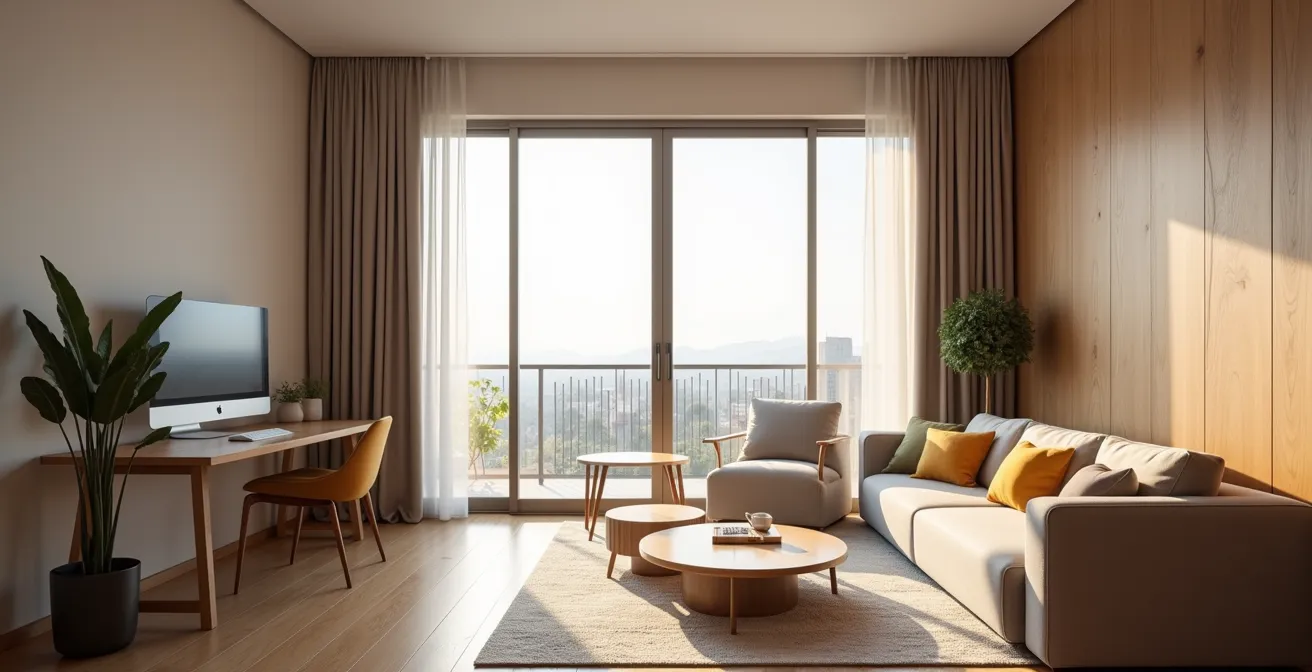
As you can see, the visual distinction is key. You can enhance this with sensory cues—a practice known as cognitive anchoring. Use a bright, cool-toned light for your workspace during the day and switch to warm, soft lighting in the evening. A specific scent, like citrus, can be used only during work hours, while a calming scent like lavender signals relaxation. These multi-sensory cues train your brain to transition more effectively from a work mindset to a rest mindset.
Your Action Plan: Creating Boundaries Through Workspace Design
- Designate specific ‘sacred zones’ in your home that are completely work-free (e.g., the bedroom, the dining table). This is non-negotiable.
- Create a physical ‘work box’ or drawer where all work devices—laptops, work phones, notebooks—are placed and sealed at the end of the day.
- Use distinct lighting setups. Invest in a smart bulb to switch from cool white light for work hours to warm amber light for personal time.
- Implement sensory anchoring. Use a diffuser with a specific essential oil for work (like peppermint or citrus) and a different one for rest (like lavender or chamomile).
- Establish a “shutdown ritual.” This could be a 10-minute walk around the block to simulate a commute, signaling a definitive end to the workday.
Digital Detox vs. Conscious Usage: Which Strategy Lasts Longer?
When feeling overwhelmed by digital noise, the idea of a “digital detox”—a complete break from all devices for a weekend or a week—can seem like the ultimate solution. And for a short period, it can be effective at resetting your dopamine baseline and reminding you what life is like without constant pings. However, for most remote professionals, it’s an unsustainable, all-or-nothing approach. The moment you return, the same overwhelming habits and expectations rush back in.
A more resilient and practical strategy is conscious usage. This isn’t about abstinence; it’s about thoughtful engagement. It involves using tools and building systems that manage your digital world for you. This might mean using apps that block distracting websites during certain hours, setting up different user profiles on your computer for “work” and “personal,” or leveraging features like Android’s Work Profile. In fact, research from Google’s Android Enterprise shows that 81% of work profile users are satisfied with managing their work-life balance on one device, compared to just 71% of those who don’t use such tools. This highlights the power of built-in, systemic boundaries over sheer willpower.
The following table, based on a Qualtrics analysis on phone usage, breaks down the core differences between these two philosophies, making it clear why conscious usage often leads to better long-term results.
| Aspect | Digital Detox | Conscious Usage |
|---|---|---|
| Duration | Temporary (days/weeks) | Ongoing lifestyle |
| Primary Purpose | Reset dopamine baseline | Sustainable boundaries |
| Success Rate | High short-term impact | Better long-term adherence |
| Implementation | Complete disconnection | Selective engagement |
| Best For | Breaking addiction patterns | Maintaining healthy balance |
Ultimately, a detox can be a good circuit-breaker, but conscious usage is the long-term skill that allows you to coexist with technology on your own terms. It’s about being the master of your tools, not the other way around.
The Communication Mistake That Teaches Clients to Disturb You on Weekends
As a digital wellness coach, I see one mistake more than any other: freelancers and remote workers inadvertently train their clients to disrespect their time. Every time you reply to an email at 10 PM on a Tuesday or answer a “quick question” on a Saturday morning, you are sending a clear message: “I am available, and my personal time is interruptible.” You are setting a precedent.
This is a difficult truth to accept because your responsiveness often comes from a place of diligence and a desire to provide excellent service. However, this reactive behavior is the root cause of boundary erosion. As business strategist Laura Garnett noted in a Forbes interview on work-life balance, the expectation of 24/7 availability is a direct consequence of addictive technology. But you have the power to retrain those expectations.
Technology is expanding the workday. We’re expected to be on call 24/7. Technology is so addictive — it’s easy to let that take away your balance.
– Laura Garnett, Forbes
The solution is to shift from a reactive to a proactive communication strategy. This means setting expectations from the very beginning of a project. Your email signature should clearly state your working hours and expected response time (e.g., “Available Mon-Fri, 9 AM-5 PM. I will respond to your message within 24 business hours.”). For emails that arrive over the weekend, draft your reply immediately if you wish, but use the “Schedule Send” feature to have it arrive at 9:01 AM on Monday morning. This allows you to clear your head while still reinforcing your professional boundaries. It’s a small change that sends a powerful, consistent message about the value you place on your own time.
Sequencing Your Week: When to Schedule “Deep Work” Without Notifications
In our hyper-connected world, the most valuable professional skill is the ability to do “deep work”—cognitively demanding tasks performed in a state of distraction-free concentration. Yet, this is precisely what the modern remote workday seems designed to prevent. The constant stream of emails, chat messages, and notifications creates a state of perpetual “shallow work,” where we’re busy but not necessarily productive. Research confirms this struggle; in fact, a Qualtrics study indicates that 36% of knowledge workers find it difficult to resist checking work-related messages outside of their official hours.
The key to reclaiming your focus is not to work longer, but to work smarter by strategically sequencing your week. This involves identifying the tasks that require your full, uninterrupted attention and scheduling them as non-negotiable appointments in your calendar. These are your deep work blocks. For most people, the first 2-3 hours of the workday, before decision fatigue sets in, are the most effective time for this. During these blocks, you must be ruthless: turn off your phone, close your email client, and disable all desktop notifications.
Visualizing your week with these protected blocks, as shown in the abstract representation below, transforms time from an open field into a structured series of focused sprints.

Treat these blocks with the same seriousness as a client meeting. Inform your team about your deep work schedule so they know when you are unavailable for quick questions. Batch all your shallow work—like answering emails and returning calls—into separate, designated blocks in the afternoon. This method of time blocking ensures that your most important work gets your best energy, while preventing the endless reactivity that drains your focus and extends your workday.
Why Living Near a Highway Increases Cortisol Levels by 20%?
While we often focus on digital stressors, our physical environment plays an equally critical role in our ability to disconnect and recover. Chronic exposure to low-level environmental stressors, such as the constant noise from a busy highway, has a measurable physiological impact. This isn’t just an annoyance; it’s a biological drain. The persistent sound keeps your nervous system in a subtle state of alert, leading to elevated levels of cortisol, the body’s primary stress hormone. Over time, this chronic stress depletes your mental and physical reserves, making it even harder to cope with the demands of work.
The problem of a poor work-life balance is not isolated to our screens. Indeed, stress management research shows that less than half of workers claim to have a ‘healthy’ work-life balance when they are constantly connected. This problem is compounded when your home environment fails to be a place of genuine sanctuary. Your home should be the place where your restorative capacity is replenished, but if it’s filled with environmental stressors like traffic noise, that capacity is continuously drained, leaving you more vulnerable to burnout from digital pressures.
Case Study: The Compounding Effect of Environmental and Digital Stress
A study published in the National Center for Biotechnology Information examined the factors of work-life conflict and found that environmental stressors at home significantly worsen the effects of digital stress. Workers who were exposed to both a stressful home environment and constant smartphone connectivity showed much higher rates of work-home interference. The pressures from both domains became mutually reinforcing, creating a vicious cycle that dramatically reduced the individual’s overall ability to rest and recover.
This demonstrates that creating a healthy work-life balance is an ecological challenge. You must consider not only your digital habits but also the physical environment in which you are trying to rest. Mitigating environmental stressors—by using noise-canceling headphones, adding sound-dampening curtains, or simply spending time in a quiet park—is a crucial, and often overlooked, component of digital wellness.
The “Cyberchondria” Loop: When Health Trackers Increase Your Anxiety
In the quest for well-being, many of us turn to technology for answers. We use wearables to track our sleep, apps to monitor our heart rate, and devices to count our steps. While these tools can provide valuable insights, they can also backfire, trapping us in a cycle of anxiety known as “cyberchondria”—the obsessive and often unfounded worry over health fueled by digital information. Instead of promoting rest, these trackers can turn it into another performance metric to be optimized.
Suddenly, a night of “poor” sleep according to your app isn’t just a sign you’re tired; it’s a data point indicating failure. A slightly elevated heart rate isn’t a normal fluctuation; it’s a cause for concern. This pressure to perform perfectly even in our rest creates a “second shift” of self-optimization work, eliminating any chance for true, unmeasured downtime. As one remote worker expressed, this feeling is pervasive:
Remote workers report feeling guilty about taking breaks and often feel pressure to be constantly available. The addition of health tracking creates a ‘second shift’ of self-optimization work, where even rest becomes a performance metric that needs to be optimized and monitored, eliminating true downtime from their daily routine.
– Employee Perspective, People Managing People
Breaking this loop requires shifting your focus from external data to internal awareness, also known as somatic awareness. Instead of asking “What does my app say?”, ask “How does my body actually feel?”. The goal is to use these tools as a guide, not a judge. If a tracker is causing you more stress than relief, it has defeated its purpose. True well-being comes from listening to your body’s innate signals, not from achieving a perfect score on a digital dashboard.
Key Takeaways
- True work-life balance is achieved by strategically designing your environment to support disconnection, not by relying on willpower alone.
- Creating physical separation between your work and living areas (through dedicated workspaces and ‘sacred zones’) is essential for building psychological separation.
- Chronic environmental stressors, from digital notifications to neighborhood noise, continuously deplete your mental and physical capacity to rest and recover.
How Does Urban Design Directly Influence the Mental Health of Residents?
The conversation about work-life balance must extend beyond the walls of our homes and the glow of our screens. As the workforce becomes increasingly mobile, the design of our cities and neighborhoods has a direct and profound impact on our mental health and ability to disconnect. Projections from IDC indicate this is a massive trend, predicting that mobile workers will account for over 60% of the total U.S. workforce by 2024. For this growing population, the city itself becomes an extension of the office.
Urban design that prioritizes green spaces, walkable neighborhoods, and accessible “third places”—like cafes, libraries, and parks—provides crucial opportunities for transition and restoration. These are neutral spaces that are neither work nor home, allowing for a mental reset. A walk through a park on the way home from a co-working space can act as a psychological buffer, helping to shed the stress of the day before re-engaging with personal life. Conversely, a city dominated by traffic and concrete, with few places for quiet contemplation, can amplify stress and erase any chance of recovery.
Case Study: The Role of “Third Places” in Work-Life Boundaries
A 2024 quasi-experimental study published by Emerald found that workers who had easy access to flexible third spaces reported significantly better work-life boundaries. When their companies adopted more flexible policies regarding personal smartphone use during the day, these employees were better able to manage the integration of their work and personal domains. The study concluded that accessible and welcoming urban environments provide essential transition spaces that empower workers to create healthier boundaries in a digitally-connected world.
This shows that our individual well-being is intrinsically linked to our collective environment. While you can optimize your home office, your ability to truly thrive also depends on having access to restorative public spaces. Advocating for and utilizing these spaces is not just a civic activity; it’s a vital part of a holistic work-life balance strategy.
Your well-being is non-negotiable. The digital world will always ask for more, but you have the power to decide what you are willing to give. Start today by choosing one physical or digital boundary to design and implement. This is not a one-time fix, but the beginning of a conscious practice. Your future self will thank you.
Frequently Asked Questions About Digital Well-Being
How can I break free from obsessive health tracking?
Start by designating specific times for checking health data rather than constant monitoring. Limit checks to once daily at a set time, such as in the morning, to prevent it from becoming a day-long obsession.
What’s the alternative to digital health monitoring?
Practice somatic awareness through daily body scans. Spend 5 minutes sitting quietly and assessing how you feel physically, emotionally, and mentally, without the need for external validation from a device. This builds internal listening skills.
Should I completely abandon health tracking apps?
Not necessarily. Consider a gradual reduction rather than complete elimination. Use the apps for specific, time-bound goals (e.g., training for a 5k) instead of continuous, open-ended monitoring of all metrics. Use the tool; don’t let the tool use you.