
Navigating zoning regulations for a home extension often feels like an adversarial process. However, the key to success is not to fight the system, but to understand its internal logic. Municipal codes are primarily designed to ensure public safety, maintain community character, and protect property values. By learning to frame your project in a language that addresses these core administrative concerns, you transform a potential conflict into a structured negotiation, significantly increasing your chances of approval.
The dream of adding a new room, an in-law suite, or a second story to your home often begins with excitement and architectural sketches. Yet, this vision quickly collides with the formidable reality of municipal bureaucracy: zoning ordinances, building codes, and planning committees. Many homeowners, confused by the dense legal language, either abandon their projects or make costly mistakes. The common advice—”check with your local planning department”—is a starting point, but it’s not a strategy. It’s crucial to understand the fundamental difference between two separate processes: zoning approval, which governs what you can build and where (use, height, location), and a building permit, which dictates how you must build it (structural safety, materials, electrical codes).
This guide is designed to demystify the zoning process from the perspective of an urban planning consultant. The goal is to move beyond a simple checklist of rules. Instead, we will delve into the administrative rationale behind them. Understanding why a setback exists or what a planning committee is mandated to protect is the most powerful tool a homeowner can possess. This approach allows you to anticipate objections, prepare a robust application, and present your case not as a request for a favor, but as a compliant and well-reasoned proposal that aligns with the municipality’s own objectives.
By grasping this internal logic, you can navigate the path to approval with confidence. This article will break down the most common hurdles, from property line setbacks to non-conforming structures, providing a clear roadmap for your home extension project. The following sections will provide a systematic examination of each critical component of the zoning landscape.
Summary: A Homeowner’s Guide to Navigating Zoning Regulations
- Why You Can’t Build Within 10 Feet of Your Property Line?
- How to Present a Case to the Planning Committee for an Exception?
- Residential Only vs. Mixed-Use Zoning: Which Offers Better Property Value?
- The Consequence of Building an In-Law Suite Without a Permit
- Problem & Solution: Renovating Non-Conforming Structures Legally
- How to Navigate Zoning Laws That Require Grid Connection?
- Urban Infill vs. Rural Greenfield: Which Is Cheaper to Develop?
- Which Energy Efficiency Upgrades Pay for Themselves in Under 10 Years?
Why You Can’t Build Within 10 Feet of Your Property Line?
The invisible boundaries dictating how close to your property line you can build are known as setback requirements. These are not arbitrary rules; they are a cornerstone of municipal planning, rooted in the core tenets of public health, safety, and general welfare. Setbacks ensure adequate light and air between properties, provide privacy for residents, allow access for emergency vehicles and utility maintenance, and manage stormwater runoff. They are a fundamental tool for preventing overcrowding and preserving the established character of a neighborhood. While a 10-foot rule is a common example, the exact dimensions vary significantly.
In practice, these regulations create a “building envelope” on your lot—the specific area where construction is permitted. According to an analysis of property line regulations, it’s common to see requirements for 20 to 35 feet for front setbacks and 5 to 15 feet for side setbacks. An extension that encroaches into this restricted space is considered non-compliant and will almost certainly be denied a building permit at the outset. Understanding your specific local setbacks, which can be found in your municipality’s zoning ordinance or on its official map, is the non-negotiable first step in planning any extension.
Ignoring these constraints is a critical error. The internal logic of the planning department views setbacks as a foundational element of orderly development. Any proposal to build within these areas is immediately flagged as a deviation from the master plan. Therefore, your project’s initial design must respect this building envelope. If site constraints make this physically impossible, your path forward is not to ignore the rule, but to prepare for a formal variance request, which is a plea for an official exception based on demonstrable hardship.
How to Present a Case to the Planning Committee for an Exception?
When your project cannot meet standard zoning requirements, such as setbacks, your recourse is to request a variance from the Zoning Board of Appeals or Planning Committee. This is a formal hearing where you must present a compelling case for an exception. Success hinges on your ability to speak the committee’s language, which is based on legal precedent and specific criteria, not on your personal desires. The two most critical pillars of a successful variance case are proving “unnecessary hardship” and demonstrating that the variance will not harm the public interest or the character of the neighborhood.
“Unnecessary hardship” does not mean financial inconvenience. It means that unique characteristics of your property (e.g., an unusual shape, steep topography, or environmental features) prevent you from making reasonable use of it under the strict letter of the law. You must build an administrative record with evidence: site surveys, topographical maps, and architectural drawings that clearly show why a standard-compliant design is not feasible. Furthermore, you must demonstrate that your request is the minimum variance necessary to alleviate this hardship. It’s also wise to anticipate questions about cost, as a variance typically involves application fees, public notice fees, and potentially hiring legal or planning consultants, which can run into several thousand dollars.
The committee must also weigh your request against the community’s welfare. Gaining the support of your neighbors is therefore a powerful strategic move. Notify them of your plans early, listen to their concerns, and gather letters of support if possible. A project that faces organized neighborhood opposition is significantly less likely to be approved. Presenting a professional, well-documented case that highlights neighborhood support and mitigates any potential negative impacts is key.
This process is about demonstrating that your unique situation warrants a minor deviation from the rules, without setting a negative precedent or compromising the principles of the zoning ordinance.

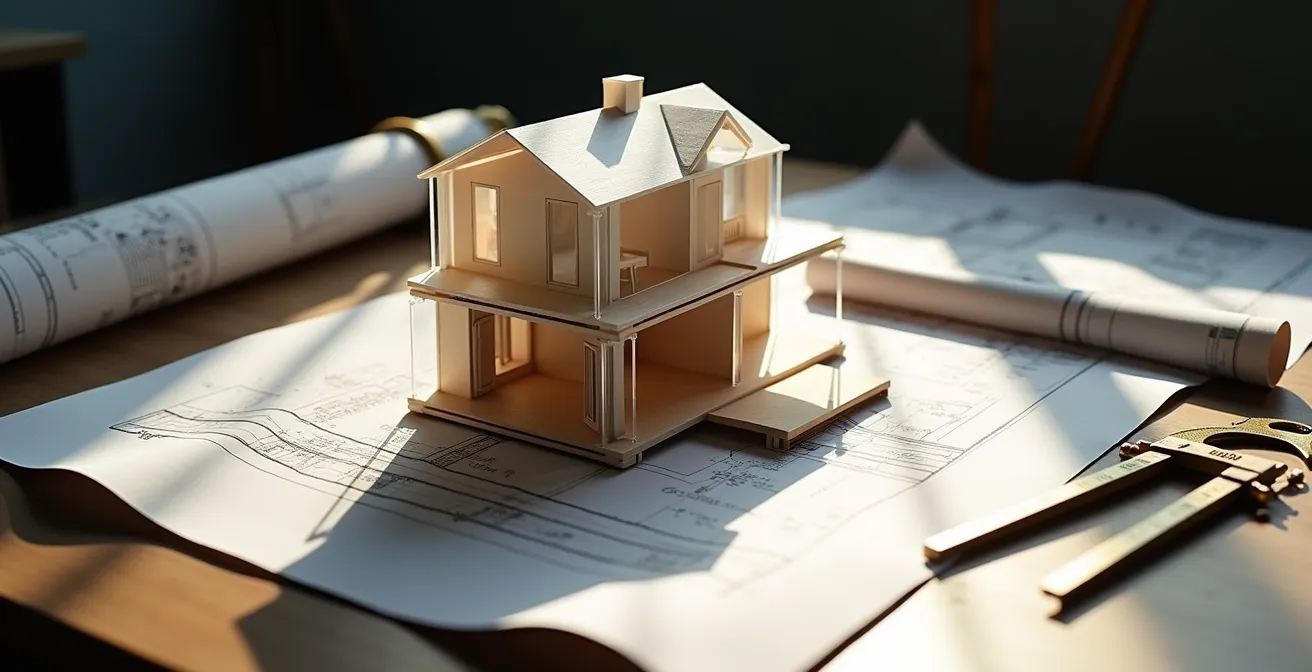
As the visual demonstrates, a professional presentation involves more than just words. Detailed models, site plans, and shadow studies can effectively communicate the limited impact of your proposed extension on adjacent properties. A successful case in Phoenix provides a tangible example.
Case Study: Phoenix Setback Variance Approvals
In 2025, zoning adjustments in Phoenix, Arizona, highlighted several successful variance requests for Accessory Dwelling Units (ADUs) and extensions. Applicants were able to reduce front yard setbacks from 30 feet to as little as 0-10 feet. The key to their success was a two-pronged approach: first, they clearly demonstrated unique property characteristics that made standard setbacks prohibitive. Second, they engaged in proactive neighborhood consultation *before* the hearings, securing support that was presented to the committee. The Arcadia Camelback Mountain Neighborhood Association, which tracked these cases, noted that applications with detailed site plans and evidence of neighbor support had a significantly higher rate of approval.
Residential Only vs. Mixed-Use Zoning: Which Offers Better Property Value?
The zoning designation of your property is a primary driver of its long-term value and utility. The two most common categories for homeowners are Residential-Only (R-1) and Mixed-Use. R-1 zoning is what most people picture for a suburban neighborhood: single-family homes, quiet streets, and a clear separation from commercial activity. Its primary value proposition is stability, predictability, and the preservation of a tranquil residential character. This appeals strongly to families and those seeking a peaceful environment.
Mixed-Use zoning, by contrast, integrates residential, commercial, and sometimes light industrial uses within the same district or even the same building. This creates vibrant, walkable communities where residents can live, work, and shop without relying on a car. While once seen as less desirable, mixed-use areas are now increasingly sought after by young professionals and investors. The development flexibility allows for multiple revenue streams (e.g., an apartment above a retail shop) and caters to a modern lifestyle. This demand translates directly into financial returns; the latest research reveals a 12% property value increase in mixed-use developments between 2023 and 2025, outpacing single-use zones.
Choosing between them is a matter of strategic goals. If you are planning a simple home extension for personal use in an established neighborhood, the protections of R-1 zoning are beneficial. However, if your extension is an investment—like an ADU for rental income—the property’s potential value could be significantly higher in a mixed-use zone, though it may come with more complex regulations regarding parking, noise, and business operations. Understanding your current zoning is not just a regulatory hurdle; it’s a critical piece of financial intelligence for your property.
The following table, based on a recent comparative analysis, breaks down the key differences that impact property valuation.
| Factor | Residential-Only Zoning | Mixed-Use Zoning |
|---|---|---|
| Property Value Growth | Stable, predictable appreciation | 12% higher appreciation (2023-2025) |
| Development Flexibility | Limited to residential uses | Multiple revenue streams possible |
| Buyer Demographics | Families seeking quiet neighborhoods | Investors and young professionals |
| Neighborhood Character | Preserved single-use tranquility | Vibrant, walkable communities |
| Future Rezoning Risk | May face pressure for densification | Already accommodates growth |
The Consequence of Building an In-Law Suite Without a Permit
The temptation to bypass the bureaucratic process and build an extension or in-law suite without a permit is a high-risk gamble with severe financial and legal consequences. From an administrative standpoint, unpermitted construction is a direct challenge to municipal authority and a potential threat to public safety. When discovered—often through a neighbor’s complaint, during a subsequent unrelated permit process, or at the time of sale—the enforcement actions are swift and costly. You will almost certainly receive a “stop work” order and a notice of violation.
The financial penalties are just the beginning. The municipality will require you to either tear down the structure or attempt to legalize it through a retroactive permit process. This is exponentially more difficult and expensive than obtaining a permit correctly from the start. You will likely have to hire an architect or engineer to create “as-built” drawings of the existing structure. Inspectors will then require you to expose framing, wiring, and plumbing to verify they meet *current* building codes, which may be stricter than when the work was done. This can mean tearing out perfectly good drywall and finishes, leading to thousands of dollars in remedial work. As Angi Home Services states in their guide on the topic:
Building without permission from your municipality could land you with violations and expensive fines, and you may even be forced to knock down the addition and return your property to its original condition
– Angi Home Services, What Permits Are Needed to Build an Addition
Furthermore, fines for unpermitted work are often double or triple the standard permit fees. The structure will also be uninsurable and can create significant title issues, making it impossible to sell the property until the violation is resolved. In short, the perceived savings of skipping the permit are an illusion that often leads to a financial and logistical nightmare.
Action Plan: Your 5-Step Audit for Retroactive Permitting
- Immediate Cessation & Assessment: Stop all work immediately and hire a licensed professional to create an as-built report and a detailed code compliance gap analysis.
- Voluntary Disclosure & Documentation: Contact the municipal building department to voluntarily report the unpermitted structure and formally begin the legalization process with all your collected documents.
- Formal Application Submission: Prepare and submit the complete retroactive permit application, including professional as-built drawings and any required engineering reports.
- Scheduled Inspections & Corrections: Coordinate with inspectors, expose all necessary systems (framing, electrical, plumbing) for review, and execute all mandated corrections to meet current building codes.
- Finalization and Occupancy: Pay all associated fines and penalties, successfully pass the final inspection, and obtain the official Certificate of Occupancy to formally legalize the structure.
Problem & Solution: Renovating Non-Conforming Structures Legally
Many homeowners discover that their property is already a “legal non-conforming use” or contains a non-conforming structure. This means the property was legally built at the time, but the zoning laws have since changed, making it non-compliant today. A common example is a house built 5 feet from the property line when the rule was 5 feet, but the setback has since been increased to 10 feet. The house is now “non-conforming.” You are not required to tear it down; its status is protected by a “grandfather clause.”
However, this protection has limits, especially when you plan to renovate or expand. Municipal ordinances often state that you cannot expand or intensify the non-conformity. For example, you typically cannot build a second-story addition on top of a structure that already encroaches on a setback, as this would make the non-conformity larger. In some jurisdictions, if a non-conforming structure is destroyed by more than 50% of its value (e.g., by fire), you may be required to rebuild in full compliance with current codes, losing your grandfathered status.
The solution is to work within the constraints of your grandfathered rights. This often involves creative architectural solutions, such as expanding vertically or to the rear of the property in a way that does not increase the existing non-conforming footprint. The key is to consult with the planning department *before* designing your extension. You need a formal determination of your property’s legal non-conforming status and a clear understanding of what renovation or expansion activities are permitted under the local ordinance. This proactive clarification prevents you from investing in plans that are destined for denial.
As this visualization shows, a smart design can add significant living space by building upward, respecting the original footprint and thereby navigating the limitations placed on a non-conforming structure.
Case Study: Navigating Grandfathered Use in a Commercial Zone
A single-family home located in an area that was later rezoned for commercial use provides a clear example of a grandfathered property. The owner wished to understand their rights for future renovation or sale. A consultation with the city confirmed the property’s “grandfathered” residential status would be protected. Crucially, the city also confirmed that this status would persist even if the home were completely destroyed, provided rebuilding began within a specified timeframe. This official confirmation of protected use significantly stabilized the property’s value and clarified the legal pathways for future development and financing, demonstrating the power of formal administrative consultation.
How to Navigate Zoning Laws That Require Grid Connection?
A less-discussed but critical zoning requirement in many areas is the mandate for utility and grid connection. While the idea of a fully off-grid home extension powered by solar and running on its own well and septic system appeals to many, municipalities often prohibit it. The administrative logic behind this is rooted in public health and safety. Mandating connection to the public sewer and water supply ensures proper waste disposal and access to safe drinking water, preventing public health hazards. Connection to the electrical grid ensures reliable power for safety systems and provides a basis for property valuation and tax assessment.
Why do these laws exist? Primarily for public health and safety. Zoning laws mandate connections to ensure access to reliable services like water and sewer, which are monitored for safety standards. They also ensure emergency services can locate and service a property effectively. For a homeowner, this means that even if you plan to install a large solar array and battery system, you will likely still be required to maintain a physical connection to the electrical grid. Proposing a completely off-grid addition in a serviced urban or suburban area will almost certainly be rejected during the zoning review process.
The modern solution is not to fight the connection requirement but to embrace grid-interactive systems. These systems remain connected to the utility grid but are designed for near-zero consumption. Using technologies like solar panels and battery storage (e.g., a Tesla Powerwall), a home can generate its own power, store it for later use, and even feed excess energy back to the grid, potentially for credit. This approach satisfies the municipal requirement for connection while achieving the homeowner’s goal of energy independence and sustainability. Exceptions to mandatory grid connection are extremely rare and typically only considered in remote, unserviced rural areas where applicants can provide extensive, state-approved engineering plans for complete self-sufficiency.
Urban Infill vs. Rural Greenfield: Which Is Cheaper to Develop?
When planning a new structure, the location—be it an urban infill lot or a rural greenfield site—dramatically alters the cost profile, largely due to zoning and site conditions. At first glance, a spacious rural plot seems cheaper to develop than a cramped city lot. However, the total project cost often tells a different story. Rural “greenfield” development involves building on previously undeveloped land, which presents significant infrastructure costs that are often absent in the city.
Developing on a greenfield site requires expensive new connections to utilities. You may need to run electrical and water lines over long distances, and you will almost certainly have to pay for the installation of a new septic system and well, which can cost tens of thousands of dollars. While land acquisition might be cheaper, municipalities often levy high impact fees on new rural developments to cover the costs of new roads, schools, and parks required to service the growing area. The permitting process, however, is often simpler and faster than in a dense urban environment.
Conversely, urban infill development—building on a vacant or underused lot within an existing neighborhood—presents its own challenges. Site access is difficult, foundation work can be complex due to adjacent structures, and the zoning and design review processes are notoriously long and complex. A 2024 report indicates that 45% of developers cite zoning as a top barrier in urban areas, causing delays and inflating soft costs (design, legal fees). However, all major utilities are typically already at the curb, eliminating the high cost of trenching and new system installations. Impact fees may also be lower or waived to encourage densification.
Ultimately, there is no universally “cheaper” option. The choice depends on which costs you are better equipped to handle: the high hard costs of new infrastructure in rural areas or the high soft costs and complexities of navigating bureaucracy in the city.
This comparative table, based on data from an analysis of development cost factors, clarifies the trade-offs.
| Cost Factor | Urban Infill/Intensification | Rural/Suburban Expansion |
|---|---|---|
| Foundation Complexity | High – shoring for neighbors, complex excavation | Low – standard foundations on virgin land |
| Site Access | Difficult – tight spaces, traffic management | Easy – open access, staging areas available |
| Utility Connections | Existing – minimal trenching needed | Expensive – long trenches, septic/well systems |
| Impact Fees | Often lower or waived for infill | High – thousands for schools, roads, parks |
| Soft Costs (Design/Legal) | Very high – complex zoning, design reviews | Lower – simpler, more permissive zoning |
| Overall Timeline | Longer – multiple approvals needed | Shorter – streamlined rural processes |
Key Takeaways
- Setbacks are not arbitrary; they are essential tools for ensuring public safety, privacy, and emergency access, forming the basis of neighborhood character.
- Securing a zoning variance requires proving “unnecessary hardship” due to unique property features, not just personal or financial preference.
- Building without a permit is a costly mistake; the process of retroactive legalization and penalties far exceeds the cost of initial compliance.
Which Energy Efficiency Upgrades Pay for Themselves in Under 10 Years?
Once you have successfully navigated the zoning and permitting labyrinth for your home extension, the final strategic consideration is value optimization. Investing in energy efficiency upgrades is one of the most effective ways to add long-term value, reduce operating costs, and enhance comfort. The key question is which of these upgrades offer the best return on investment (ROI), specifically paying for themselves in under a decade. While exact payback periods depend heavily on local climate, utility rates, and available incentives, a clear hierarchy of high-impact upgrades has emerged.
The fastest payback typically comes from improvements to the building envelope. This includes:
- Attic Insulation: Adding or improving attic insulation is often the single most cost-effective upgrade. It dramatically reduces heat loss in the winter and heat gain in the summer, with payback periods often falling between 2 to 5 years.
- Air Sealing: Systematically sealing gaps and cracks around windows, doors, electrical outlets, and ductwork can cut heating and cooling costs by 10-20% alone. It is a low-cost, high-impact measure with a very rapid ROI.
The next tier of upgrades involves mechanical systems and windows. High-efficiency windows (e.g., double- or triple-pane with low-E coatings) can have a payback period of around 10-15 years, but when installed as part of a new extension, their marginal cost is lower, accelerating the ROI. Upgrading to a modern, high-efficiency HVAC system, particularly an electric heat pump, can also yield a sub-10-year payback, especially when replacing an old, inefficient oil or electric resistance system and when combined with federal or state tax credits.
Finally, while rooftop solar panels are a significant upfront investment, rapidly falling costs and generous tax incentives have brought their typical payback period into the 8 to 12-year range in many parts of the country. By prioritizing upgrades from the top of this list down—starting with the building envelope—you can strategically phase your investments to ensure that your new, legally compliant home extension is also an efficient and cost-effective one for years to come.
With your permits secured, the next logical step is to consult with an energy auditor or a certified contractor to model the specific payback periods for these upgrades based on your home’s design and local climate.
Frequently Asked Questions on Navigating Zoning Laws for Your Home Extension Project?
Can I get an exception to mandatory grid connection requirements?
Exceptions require proving complete self-sufficiency with engineered plans for state-approved septic systems, certified wells, and robust solar/battery systems with fossil-fuel backup generators.
What are grid-interactive systems for home extensions?
Grid-interactive homes remain connected to utilities while achieving near-zero consumption through solar panels, battery storage like Tesla Powerwall, and feeding excess energy back to the grid.
Why do zoning laws mandate grid connections?
Requirements stem from public health concerns (sewer/water access), safety standards (emergency service access, fire prevention), and property valuation for tax assessment purposes.