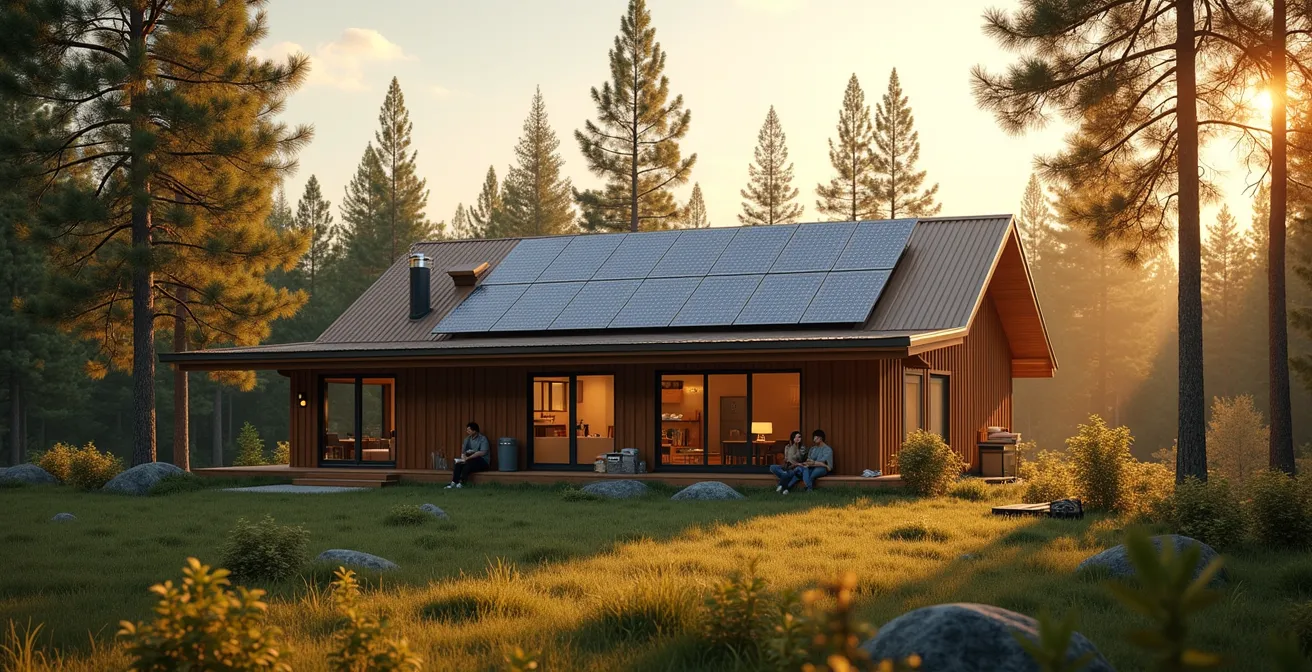
Contrary to the romantic ideal, taking a home off-grid isn’t about escaping rules—it’s about mastering a new set of unforgiving engineering, legal, and financial constraints. Success hinges not on the size of your solar array, but on a ruthless plan for winter energy deficits, legal compliance through technical workarounds, and designing for inevitable system failures.
The dream of cutting the cord with the utility company is a powerful one. It speaks of self-reliance, environmental stewardship, and freedom from monthly bills. Most guides on the topic will tell you to install solar panels, buy a battery, and enjoy your newfound autonomy. They paint a picture of quiet, clean, and uncomplicated energy independence. This picture is dangerously incomplete.
From an engineering perspective, achieving true off-grid status for a modern home is not a simple purchase; it’s a rigorous exercise in constraint management. The real challenges aren’t just technical, but also legal and financial. They lie in the details that are often glossed over: the physics of winter sun, the stubborn realities of local building codes, and the certainty that, without a robust design, every component in your system is a potential point of failure that can leave you in the dark.
But if the real challenge isn’t buying equipment, but designing a resilient system, what does that actually entail? This article moves beyond the marketing hype to give you the engineer’s reality check. We will dissect the non-negotiable calculations, the legal workarounds, and the critical failure points you must address. This is the blueprint for moving from a fragile, idealistic setup to a robust, truly independent home.
This guide breaks down the core engineering and logistical challenges you must solve to successfully transition a modern home to full off-grid autonomy. Explore the sections below to understand the critical requirements from a systems engineering perspective.
Summary: The Realities of Off-Grid Home Energy Autonomy
- Why Your Solar Array Needs to Be 3x Larger for December Usage?
- How to Navigate Zoning Laws That Require Grid Connection?
- Lithium-Ion vs. LiFePO4:Is It Smarter to Buy or Rent During a Volatile Housing Market?
- The Single Point of Failure That Can Leave You in the Dark for Weeks
- Problem & Solution: Running Heavy Power Tools on a Limited Solar Setup
- Problem & Solution: Reducing Heating Bills by 15% With Smart Thermostats
- How to Calculate the Battery Capacity Needed to Run Your Fridge During Blackouts?
- Which Renewable Energy System Offers the Best ROI for Suburban Homes?
Why Your Solar Array Needs to Be 3x Larger for December Usage?
The most common and costly mistake in off-grid planning is underestimating the “Winter Solstice Deficit.” It’s not enough to size your solar array based on your home’s average annual energy use. The system must be engineered for the single worst day of the year. Due to the low sun angle and shorter days in winter, a solar panel’s output plummets. In many northern latitudes, this means a 30-40% reduction in solar output during December-January compared to sunnier months. This isn’t a minor dip; it’s a catastrophic drop that standard calculations often ignore.
For example, a 2kWp solar array might produce an annual average of 5.4 kWh/day, which seems sufficient for a home consuming 5kWh/day. However, in winter, that same array’s production can fall below 2 kWh/day, creating a massive deficit that will drain your batteries in days. To survive the winter without a backup generator running constantly, you must size your array based on your December energy needs and the drastically reduced peak sun hours of that month. This often means installing an array two to three times larger than what a simple “annual average” calculator would suggest. This isn’t overbuilding; it’s designing for survival.
The financial implications are significant. You must weigh the high upfront cost of a winter-proof array against the long-term cost and inconvenience of relying on a generator for several months a year. This is a non-negotiable trade-off at the heart of off-grid design. Ignoring the winter deficit is not a shortcut; it’s a blueprint for failure.
How to Navigate Zoning Laws That Require Grid Connection?
A common romantic notion of off-grid living is a total separation from all infrastructure and regulation. The reality is that many jurisdictions have building codes or zoning laws that legally require a home to be connected to the utility grid, often for safety and public health reasons (e.g., ensuring power for well pumps and septic systems). This creates a direct legal barrier to your goal of “cutting the cord.” Simply ignoring these rules can result in fines, denied permits, or even an inability to get an occupancy certificate for your home.
The engineer’s solution is not to fight the law, but to comply with it technically while achieving functional autonomy. This is accomplished with a “grid-tied, zero-export” system. You install a system that is physically connected to the grid, satisfying the legal requirement. However, the inverter is programmed to never pull power from the grid and, critically, to never send excess power back to it. Your home runs 99.9% off your own solar and battery system, but the physical connection keeps you compliant.
This technical setup, which is detailed in many guides on off-grid construction, is the key to navigating this legal constraint. It demonstrates how “off-grid” is often a legal and financial state as much as a physical one.
As the diagram suggests, the complexity lies in the control system. You must ensure your battery systems meet modern safety standards, like UL 9540, to be approved for connection by local authorities. This approach requires meticulous research into local codes before you even purchase a property, turning a legal roadblock into a solvable engineering problem.
Lithium-Ion vs. LiFePO4:Is It Smarter to Buy or Rent During a Volatile Housing Market?
Your battery bank is the heart of your off-grid system, and the choice of chemistry is one of the most critical long-term decisions you’ll make. It’s not just a technical choice; it’s a major financial one, with current market pricing showing batteries ranging from $5,000-$15,000. The two main contenders are standard Lithium-Ion (NMC) and Lithium Iron Phosphate (LiFePO4). While Lithium-Ion may have a lower upfront cost, a Total Cost of Ownership (TCO) analysis reveals a different story, especially when considering the battery as a long-term asset tied to your home’s value.
LiFePO4 batteries, despite being more expensive initially, offer a dramatically longer cycle life (3,000-5,000 cycles vs. 500-1,500 for Li-Ion) and are chemically far more stable, with a minimal risk of thermal runaway. This safety profile can lead to lower homeowner’s insurance premiums. In a volatile housing market, this becomes a crucial factor. A permanently installed, safe, and long-lasting LiFePO4 system adds tangible value to your property. A cheaper Lithium-Ion system, with its shorter lifespan and higher perceived risk, may be seen as a liability that needs replacement by a potential buyer.
The decision to “buy” into a superior, more expensive technology like LiFePO4 can be seen as an investment in the property itself. The alternative is effectively “renting” a cheaper technology that will need costly replacement, eroding your long-term return on investment, as this comparative analysis from off-grid system guides shows.
| Factor | LiFePO4 | Lithium-Ion |
|---|---|---|
| Upfront Cost | Higher (+20-30%) | Lower baseline |
| Cycle Life | 3,000-5,000 cycles | 500-1,500 cycles |
| Thermal Runaway Risk | Minimal (safer) | Higher risk |
| Insurance Impact | Lower premiums | Higher premiums |
| Home Resale Value | Adds permanent value | May complicate sale |
| 10-Year TCO | Lower overall | Higher (replacements needed) |
The Single Point of Failure That Can Leave You in the Dark for Weeks
In any engineered system, the most dangerous element is the Single Point of Failure (SPOF)—a component whose failure will take the entire system down. In many basic off-grid solar designs, this is the central inverter. This device does the heavy lifting of converting DC power from your batteries to AC power for your home. If it fails, your lights go out, your fridge stops, and your entire solar array and battery bank become useless bricks. Waiting for a replacement part or a specialized technician can take days or even weeks, a catastrophic scenario for a home that is truly off-grid.
A resilient system is designed with redundancy to eliminate SPOFs. As the community on the DIY Solar Forum wisely advises, true resilience comes from a decentralized architecture:
Instead of one massive central inverter, detail a more resilient setup using multiple smaller, stackable inverters or microinverters, allowing the system to operate at partial capacity if one unit fails
– DIY Solar Forum Community, Off-grid system redundancy design discussions
This approach means that if one inverter fails, you might lose power to a few circuits, but the rest of the house remains operational. Beyond design, resilience requires preparation. You must have the basic skills and tools to diagnose and bypass problems, and a kit of essential spare parts on hand. This is not about being a master electrician; it’s about having the ability to perform basic troubleshooting to keep your critical systems running while you await professional help.
Checklist: Auditing Your System’s Resilience
- Points of contact: Identify all critical failure points where the system can fail (inverter, charge controller, battery management system).
- Collecte: Inventory existing backup components and single-source dependencies (e.g., one central inverter, single string of panels).
- Cohérence: Compare your setup against a resilience blueprint (e.g., microinverters, redundant wiring, manual bypasses).
- Mémorabilité/émotion: Evaluate the real-world impact of a failure. What is your “dark for weeks” scenario? Is it acceptable?
- Plan d’intégration: Create a prioritized plan to add redundancy, starting with the most critical and likely failure point.
Problem & Solution: Running Heavy Power Tools on a Limited Solar Setup
One of the harshest realities of off-grid living is managing high-draw appliances. Devices with large motors, like well pumps, air compressors, or saws, create a massive initial power demand known as inrush current. This surge can be 5-10 times the tool’s normal running wattage, and it can easily overwhelm your inverter, causing it to shut down to protect itself. This is why a 2,000-watt inverter might fail to start a 1,500-watt saw. It’s a common and frustrating problem that requires both technical solutions and behavioral changes.
Technically, soft starters or capacitors can be installed on large motors to dampen the inrush current, allowing the inverter to handle the startup load. However, the most effective strategy is behavioral: load scheduling or “task stacking.” This means consciously planning to run your heavy power tools only during peak solar production hours (typically 10 a.m. to 2 p.m.). This ensures you are running these demanding loads directly from the sun’s power, not draining your precious battery reserves. This also requires accounting for real-world inefficiencies.

As this visual representation implies, off-grid living requires you to think like a power manager. Furthermore, professional calculations always apply a “derating factor” to account for system losses. As detailed in comprehensive off-grid guides, you must assume a 1.4 derating factor to cover inverter inefficiency, panel soiling, and voltage drop. Ignoring this means your system will consistently underperform your expectations, especially when trying to run heavy equipment.
Problem & Solution: Reducing Heating Bills by 15% With Smart Thermostats
The single biggest energy consumer in most homes is heating and cooling. In an off-grid scenario, where every kilowatt-hour is self-generated and precious, heating with electricity is often prohibitively expensive. The hard truth is that off-grid homeowners typically pay between 50 cents to $1 per kWh, compared to 8-24 cents for grid power. At these prices, running electric resistance heat is financial suicide. This makes energy conservation not just a good idea, but the absolute cornerstone of a successful off-grid strategy. The cheapest and greenest watt is the one you never have to generate.
Smart thermostats, combined with a “zoned heating” strategy, are a powerful tool for radical energy reduction. Instead of heating the entire house to a single temperature, you create micro-climates. Program the system to keep bedrooms cool during the day and living areas warmer. Utilize passive solar by letting the sun heat thermal mass (like concrete floors) in the afternoon, then let the temperature drop significantly at night. A zoned system allows you to actively rotate heating from room to room based on occupancy, drastically cutting down on the use of your primary heating fuel, whether it’s propane, wood, or something else.
This isn’t about sacrificing comfort; it’s about being intelligent with your resources. Implementing a 5-10°F temperature setback during sleep hours alone can have a massive impact. By meticulously monitoring your fuel consumption weekly, you can fine-tune these settings and systematically drive down your largest energy expenditure. This aggressive focus on conservation is the difference between a system that thrives and one that is constantly struggling to keep up.
How to Calculate the Battery Capacity Needed to Run Your Fridge During Blackouts?
Moving from guesswork to precise engineering is critical when sizing your battery bank for essential loads. A common question is how to keep a refrigerator running, but a simple calculation based on the appliance’s wattage is dangerously misleading. You must account for several hidden variables that significantly increase the actual energy required from your batteries. A proper calculation is a multi-step process that accounts for real-world inefficiencies.
First, you determine the appliance’s daily usage, which is its wattage multiplied by its duty cycle (the percentage of time it’s actually running) over 24 hours. But that’s just the start. You must then add 10-15% to account for the energy lost during the DC-to-AC conversion in your inverter. Next, you must factor in the Peukert Effect, a phenomenon where a battery’s available capacity decreases as the rate of discharge increases, adding another 5-10% to your requirement. Finally, you decide on your desired “days of autonomy”—how many cloudy days you want to survive without sun—and add a final safety margin of at least 20%.
While many DIY systems can be built with relatively safe 12-volt configurations, the process requires significant patience and research. It’s often wise to have an electrician verify the final system for safety. The following table breaks down the variables for a precise calculation.
| Variable | Calculation Factor | Example (200W Fridge) |
|---|---|---|
| Appliance Daily Usage | Watts × Duty Cycle × 24hrs | 200W × 0.3 × 24 = 1,440Wh |
| Inverter Inefficiency | Add 10-15% | 1,440 × 1.1 = 1,584Wh |
| Battery Peukert Effect | Add 5-10% | 1,584 × 1.05 = 1,663Wh |
| Days of Autonomy | Multiply by days needed | 1,663 × 3 = 4,989Wh |
| Safety Margin | Add 20% | 4,989 × 1.2 = 5,987Wh |
As you can see, a simple 1,440Wh daily need quickly balloons to a required battery capacity of nearly 6,000Wh once real-world factors are included. This is the level of detail required for a reliable system.
Key takeaways
- Winter Deficit Sizing: Your solar array must be sized for the worst-case winter day, not the annual average, which often requires 2-3x the panel capacity.
- Legal and Technical Compliance: True off-grid often requires a “grid-tied, zero-export” system to satisfy local laws while maintaining functional autonomy.
- Design for Failure: A resilient system is not one that never fails, but one designed with redundancy (e.g., multiple inverters) to eliminate single points of failure.
Which Renewable Energy System Offers the Best ROI for Suburban Homes?
When evaluating the investment in an off-grid system, focusing solely on the financial Return on Investment (ROI) is a limited view. While it’s true that with federal tax credits, solar systems typically achieve payback within 8-12 years, this calculation misses the primary driver for many of the approximately 180,000 American families currently living off-grid: resilience. The true ROI of an off-grid system must be measured in a more holistic way, blending financial returns with the immense value of energy independence.
A “Resilience ROI” metric offers a more complete picture. It quantifies the value of being immune to power outages. You can calculate this by multiplying the number of days of blackout protection your system offers by the historical frequency of outages in your area. What is the financial and emotional cost of losing power for three days? For a week? For those who work from home or have critical medical equipment, this value can be immense. This is added to the lifestyle benefits, such as reduced environmental anxiety and the satisfaction of self-sufficiency.
Of course, a realistic calculation must also include long-term maintenance costs. An inverter may need replacement in 10-15 years, and even the best LiFePO4 batteries have a finite lifespan. Solar panels themselves degrade at a rate of about 0.5% annually. A proper 25-year TCO analysis includes these future costs to provide a sober, long-term financial picture. By combining financial, resilience, and lifestyle metrics, you can create a holistic scorecard to determine the true, multifaceted return on your off-grid investment.
Ultimately, achieving off-grid autonomy is an engineering discipline. By approaching it with a focus on worst-case scenarios, legal diligence, and system resilience, you can transform the romantic dream into a functional and reliable reality. To begin this journey, the next logical step is to conduct a detailed audit of your own home’s energy consumption and property-specific constraints.